


On Sunday in Taipei, the sun rose.
The city’s parks and morning markets filled with people enjoying the unseasonable warmth, and the smell of the city’s inexplicably expensive coffees drifted through the laneways as scooters buzzed through the crowds of pedestrians and bicycles.
Twelve hours earlier an election watched by the world, framed as a choice between “war and peace” or “democracy and authoritarianism” with existential implications for the global order, came to an end. A winner was declared, a loser conceded, voters were either overjoyed or disappointed. China — the aggressor party in this situation — was predictably cranky. But that was it.
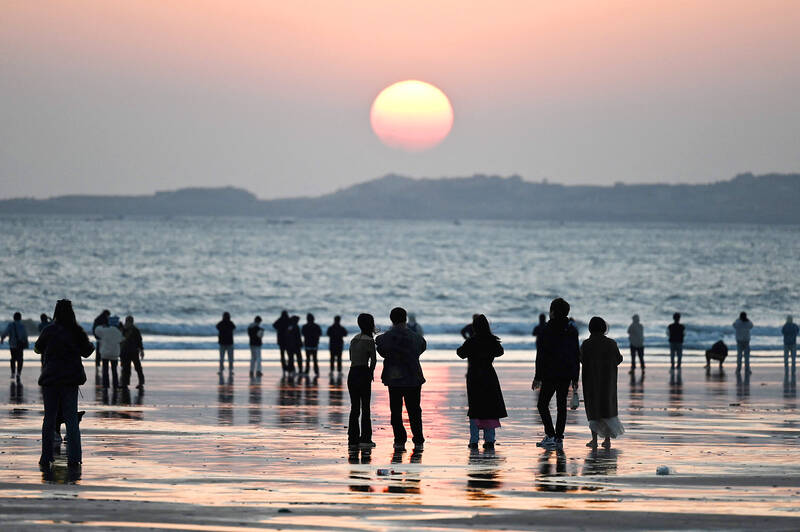
Photo: AFP
For some of the many Americans here, watching this presidential vote, 10 months ahead of their own, was inspiring but also a little painful. The global superpower which for so long has heralded itself as the leader of the democratic world is no longer the best example of it. For Taiwan’s 23.5 million people at the weekend, they proudly held that title.
The campaign was a boisterous, hyperpartisan, chaotic affair that inspired almost 72 percent of eligible voters to show up at the polls. Many of them also returned at the end of the day to watch the count, an extraordinarily transparent and analogue process involving volunteers holding each paper ballot up and shouting the voter’s choice to another worker who marked it down — in pencil — on an A3 sheet stuck to the wall with sticky tape. Thousands of others gathered outside party headquarters to hear the seats called in real time.
In Taipei it was hard to push through the heaving Democratic Progress party (DPP) crowd. Confetti rained down as it was announced that William Lai (賴清德) and his running mate Hsiao Bi-khim (蕭美琴) had won.

Photo: Bloomberg
The opposition Chinese Nationalist Party (KMT) event in New Taipei city was sad from the start. Rows and rows of empty red stools, a small national flag hopefully placed on each one, sat empty. Journalists paced the ground, outnumbering the interviewees they were searching for.
Voters returned the ruling Democratic Progressive Party (DPP) to presidential power but took away their majority in the legislature.
A new third party, the Taiwan People’s party (TPP), split the opposition vote but also inspired a surge of idealistic youth to join its ranks.

Photo: Bloomberg
PRIDE
For many voters, regardless of stripe, the biggest takeaway from the election is pride in the system itself. The small democracy won plaudits internationally for its robust and transparent vote, despite efforts from China to influence the outcome and in marked contrast to Taiwan’s recent history of authoritarian rule.
Saturday’s vote was only the eighth time that Taiwanese citizens have chosen their own president in free elections. The KMT’s candidate, Hou You-yi (侯友宜), was praised for his swift concession on election night. He told a small crowd of disappointed supporters that he was “deeply sorry” for failing to win.
“I respect the final choice of the voters. This is a democratic election, which means that the voters decide the election’s outcome. We need to face the voters and listen to them,” Hou said.
Some had backed him primarily because they thought it important that Taiwan’s government undergo a change in leadership.
“It should be considered natural; every four years we should switch to a better government,” says Jerry Peng, who voted for Hou. But “I still want to congratulate the DPP, because they won some of the hearts in Taiwan. I hope that they can continue to do the right thing.”
Such a sentiment would have been impossible in his father’s generation.
Across the political rallies, attendees shared their strong political opinions, but also encouraged the Guardian to speak to as many people as we could to get all perspectives.
“It has not been easy for us to get to where we are now,” 83-year-old Mr Song says at a pre-election rally, detailing the brutal history of Taiwan’s authoritarian era.
“We people work hard together. We have deep freedom. It is a holy land for freedom, Taiwan is very free.”
GOVERNMENT OF MANY COLORS
Now the dust has settled, the hangovers have faded and the confetti has been cleared, political observers are mulling the implications.
In his acceptance speech Lai said the DPP had “not worked hard enough” to get a majority, and that Taiwan’s people “expect an effective government as well as strong checks and balances.”
He declared he would study the policies and positions of his opponents and that they would be incorporated “as long as they bring benefit to the people.” He said he would appoint cross-party members to official roles.
There are concerns the new DPP administration is going to struggle to push its policy agenda through the legislature. It had campaigned on a platform largely centered on defending Taiwan from China’s annexation threats, but domestically, the third-placed TPP “hold the pivotal place in the parliament,” says Nathan Batto, associate research fellow at Academia Sinica and author of the Frozen Garlic Taiwan political blog.
“They will have power. They’re more likely to side with the KMT because their whole discourse is being an opposition party.”
Trouble in east Asia’s oldest party?
For the KMT, having failed to secure more than 40 percent of the vote in three successive elections, some are wondering if east Asia’s oldest party could be in terminal decline.
However, Batto says deep introspection in the party is unlikely.
“The KMT internal politics is dominated by the hardcore Chinese nationalist wing of the party. The party members who vote in party elections and make the party decisions are heavily skewed towards the old military families with strong Chinese nationalist tendencies. That makes it very hard to reform or move away from old positions within the party.”
Part of Lai’s victory can be attributed to the lack of a credible opposition. The KMT won seats in the legislature, but the fact that the DPP, which is defined by its pro-sovereignty stance, has won an unprecedented three terms in office suggests that the KMT’s position on Taiwan’s cultural and economic links with China is out of kilter with public opinion.
Alexander Huang (黃介正), the director of international relations for the KMT, disagrees.
“I really don’t believe that we [the KMT] have a Taiwan identity problem right now. I really don’t think so. Because everyone is Taiwanese. I was born and raised here.”
The problem, says Huang, is that the KMT failed to explain clearly to Taiwanese voters the nuances of their position, something that is “very hard to translate into campaign slogans.”

Last week, Viola Zhou published a marvelous deep dive into the culture clash between Taiwanese boss mentality and American labor practices at the Taiwan Semiconductor (TSMC) plant in Arizona in Rest of World. “The American engineers complained of rigid, counterproductive hierarchies at the company,” while the Taiwanese said American workers aren’t dedicated. The article is a delight, but what it is depicting is the clash between a work culture that offers employee autonomy and at least nods at work-life balance, and one that runs on hierarchical discipline enforced by chickenshit. And it runs on chickenshit because chickenshit is a cultural
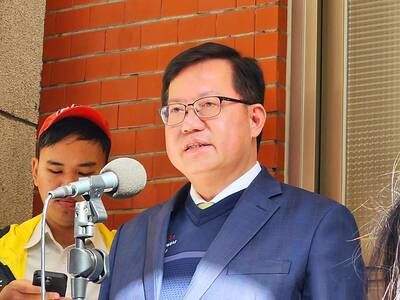
By far the most jarring of the new appointments for the incoming administration is that of Tseng Wen-tsan (鄭文燦) to head the Straits Exchange Foundation (SEF). That is a huge demotion for one of the most powerful figures in the Democratic Progressive Party (DPP). Tseng has one of the most impressive resumes in the party. He was very active during the Wild Lily Movement and his generation is now the one taking power. He has served in many of the requisite government, party and elected positions to build out a solid political profile. Elected as mayor of Taoyuan as part of the
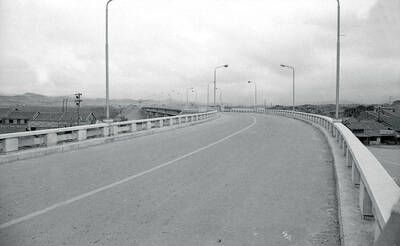
April 29 to May 5 One month before the Taipei-Keelung New Road (北基新路) was set to open, the news that US general Douglas MacArthur had died, reached Taiwan. The military leader saw Taiwan as an “unsinkable aircraft carrier” that was of huge strategic value to the US. He’d been a proponent of keeping it out of Chinese Communist Party (CCP) hands. Coupled with the fact that the US had funded more than 50 percent of the road’s construction costs, the authorities at the last minute renamed it the MacArthur Thruway (麥帥公路) for his “great contributions to the free world and deep
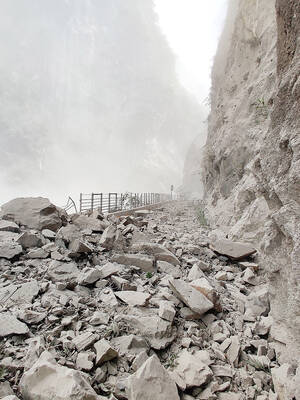
Moritz Mieg, 22, lay face down in the rubble, the ground shaking violently beneath him. Boulders crashed down around him, some stones hitting his back. “I just hoped that it would be one big hit and over, because I did not want to be hit nearly to death and then have to slowly die,” the student from Germany tells Taipei Times. MORNING WALK Early on April 3, Mieg set out on a scenic hike through Taroko Gorge in Hualien County (花蓮). It was a fine day for it. Little did he know that the complex intersection of tectonic plates Taiwan sits


 RSS
RSS