


Leading British universities have been influenced by Chinese agents, with diplomatic and unofficial pressure resulting in censorship on campus, according to a Channel 4 documentary.
The Dispatches documentary, Secrets and Power: China in the UK, alleges that the University of Nottingham closed its School of Contemporary Chinese Studies in 2016 in response to pressure from Beijing.
The former head of the institute, Steve Tsang, has openly criticized the Chinese Communist party (CCP) on several occasions, but said that university management asked him not to speak to the media during Xi Jinping’s (習近平) visit to the UK in 2015.
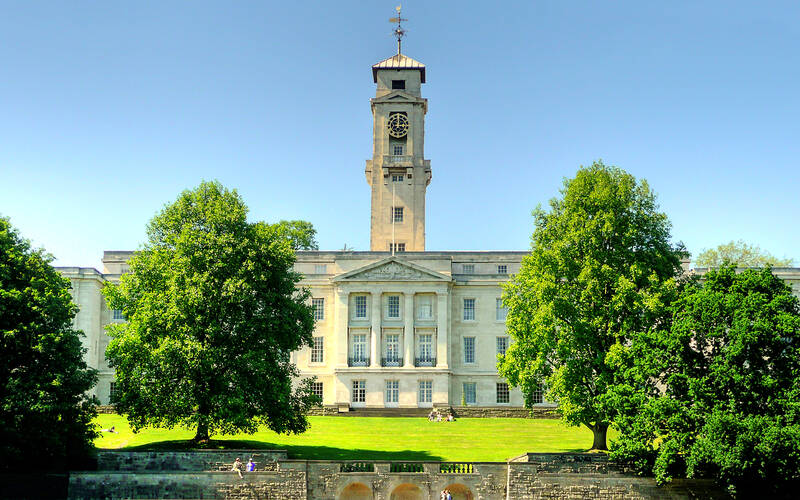
Photo courtesy of Wikimedia Commons
The saga at the University of Nottingham, which denies that the School of Contemporary Chinese Studies was closed for political reasons, is one of many examples of alleged Chinese influence in the UK made in the new episode of Dispatches.
The programme also looks at Imperial College London, where it claims a leading computer science professor collaborated with researchers at a Chinese university to publish papers on the use of artificial intelligence weaponry that could be used to benefit the Chinese military.
It reports that Guo Yike, the founder of Imperial College’s Data Science Institute, has written eight papers with collaborators from Shanghai University on developing ways to use AI to control fleets of drone ships.
In 2019, Guo signed a research deal with JARI, a Chinese research institute with links to the Chinese military. The research deal was terminated in 2021 and Imperial College said that it returned the funding associated with the partnership.
Guo said his papers were “basic” and “written to help expand our existing base of scientific or technological knowledge rather than immediately solve specific real-world problems.” He added: “The papers include viewpoints that can benefit societies worldwide.”
The documentary also claimed to have uncovered a suspected Chinese spying attempt targeted at Hong Kong activists in the UK.
Finn Lau, a UK-based activist from Hong Kong who is subject to a HK$1m bounty from the Hong Kong police, says he was approached by a man by the name of Richard Vong, who claimed to be a journalist for the Toronto Guardian. On a video call, a clip of which was exclusively shared with the Guardian, Vong questioned Lau about his work with a campaign group, Global Detwin with China, which encourages UK cities to sever “twin cities” arrangements with Chinese cities because of human rights concerns.
The editor of the Toronto Guardian told Dispatches that nobody recalled Richard Vong had ever worked there. On the call with Lau, “Vong” declined to say how he spelled his surname, describing it as a “very personal” matter.
The Dispatches team used facial recognition software to track down the supposed journalist, and assert he is actually an American man who had worked as an English teacher in Shanghai.
The Chinese embassy in London said claims about suspected spying were “sheer disinformation.” It also denied that it had ever attempted to interfere with British universities.
Martijn Rasser, a former senior intelligence officer at the CIA interviewed by Dispatches, said: “Beijing is acting with impunity in the United Kingdom and is rubbing the UK’s face into it.”

As mega K-pop group BTS returns to the stage after a hiatus of more than three years, one major market is conspicuously missing from its 12-month world tour: China. The omission of one of the group’s biggest fan bases comes as no surprise. In fact, just the opposite would have been huge news. China has blocked most South Korean entertainment since 2016 under an unofficial ban that also restricts movies and the country’s popular TV dramas. For some Chinese, that means flying to Seoul to see their favorite groups perform — as many were expected to do for three shows opening
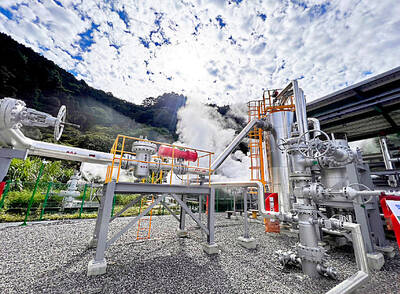
Taiwan’s semiconductor industry consumes electricity at rates that would strain most national grids. Taiwan Semiconductor Manufacturing Co (TSMC) alone accounted for more than 9 percent, or 2,590 megawatts (MW), of the nation’s power demand last year. The factories that produce chips for the world’s phones and servers run around the clock. They cannot tolerate blackouts. Yet Taiwan imports 97 percent of its energy, with liquefied natural gas reserves measured in days. Underground, Taiwan has options. Studies from National Taiwan University estimate recoverable geothermal resources at more than 33,000 MW. Current installed capacity stands below 10 MW. OBSTACLES Despite Taiwan’s significant geothermal potential, the
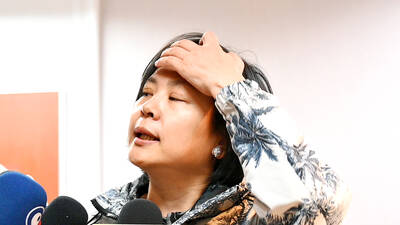
The entire Li Zhenxiu (李貞秀) saga has been an ugly, complicated mess. Born in China’s Hunan Province, she moved to work in Shenzhen, where she met her future Taiwanese husband. Most accounts have her arriving in Taiwan and marrying somewhere between 1993 and 1999. She built a successful career in Taiwan in the tech industry before founding her own company. She also served in high-ranking positions on various environmentally-focused tech associations. She says she was inspired by the founding of the Taiwan People’s Party (TPP) in 2019 by Ko Wen-je (柯文哲), and began volunteering for the party soon after. Ko

Chinese Nationalist Party (KMT) Chair Cheng Li-wun (鄭麗文) returned from her trip to meet People’s Republic of China (PRC) dictator Xi Jinping (習近平) bearing “a gift” for the people of Taiwan: 10 measures the PRC proposed to “facilitate the peaceful development of cross-strait relations.” “China on Sunday unveiled 10 new incentive measures for Taiwan,” wrote Reuters, wrongly. The PRC’s longstanding habit with Taiwan relations is to repackage already extant or once-existing policies and declare that they are “new.” The list forwarded by Cheng reflects that practice. NEW MEASURES? Note the first item: establishing regular communication mechanisms between the Chinese Communist Party


 RSS
RSS