


Donald Trump’s hush money payment to the adult film star Stormy Daniels is a “zombie case” that keeps coming back from the dead, a former New York prosecutor writes in a new book published as his former office once again considers filing criminal charges against the former president over the matter.
People vs Donald Trump: An Inside Account, will be published in the US on Tuesday. It has been extensively reported.
Mark Pomerantz’s book has proved controversial, not least because it arrives as the Manhattan district attorney, Alvin Bragg, continues to investigate Trump, empaneling a grand jury hearing evidence about the Daniels payment. Bragg and Pomerantz, who fell out over the investigation of Trump, have exchanged broadsides in the media.
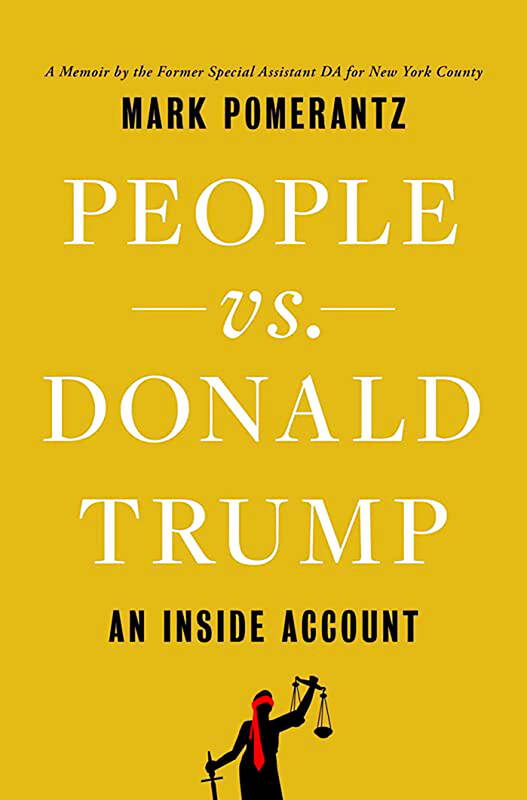
On the page, Pomerantz lists numerous matters on which he says New York prosecutors considered charging Trump, including his tax affairs, his relationships with financial institutions including Deutsche Bank and Ladder Capital, property deals in Washington and Chicago and leases at Trump Tower in Manhattan.
But he says the Daniels payment came to seem a viable way to take Trump on.
Daniels, whose real name is Stephanie Clifford, claims to have had an affair with Trump in 2006. He denies it, but in 2016, as he ran for president, his then lawyer and fixer, Michael Cohen, paid Daniels US$130,000 to stay quiet.
News of the payment broke in early 2018, when Trump was president. Trump was revealed to have reimbursed Cohen for the payment but only Cohen paid a legal price, his breach of election finance law contributing to a three-year prison sentence. Trump has never been charged.
MONEY LAUNDERING?
In his book, Pomerantz writes that he came to view the payment as a potential money-laundering offense.
“If Clifford had gotten money by threatening to tell the world that she had slept with Donald Trump,” he writes, “that sounded like extortion to me. And if it was extortion, then maybe the hush money she received could be regarded as criminal proceeds, so action taken to conceal Trump’s identity as the source of the money was chargeable as money laundering.”
This, Pomerantz writes, was “a new idea, and I got enthusiastic about it.”
He shared his ideas with other investigators, he says, and “the return to life of the hush money facts as a potential basis for prosecution sparked a nickname for this part of the investigation … the ‘zombie’ case, because it was alive, and then it was dead, and now it had sprung back to life.”
Pomerantz writes that he thought the “zombie case” was “very strong,” as the basic facts were “readily provable.” He describes Cohen’s willing cooperation and evidence that Trump directed Cohen to lie about the payment in the Oval Office itself.
In late February 2021, Pomerantz says, he sent a memo to the New York district attorney, then Cy Vance Jr, outlining the “zombie case” and its vital contention that the US$130,000 Cohen paid Daniels was “‘dirty money,’ or the proceeds of a crime.”
He admits he was presenting “a somewhat awkward construct,” in part as he would have to prove Trump was a victim of blackmail.
Cohen’s description of Trump’s reaction to Daniels’s claims helped. Pomerantz writes: “I asked what words did they use, and his answer was that Trump referred to it as ‘fucking blackmail.’ That was more than sufficient for my purposes.”
But Pomerantz says his “creative theorizing smacked into [the New York district attorney’s] cautious and conservative culture.”
Other investigators “balked” at his extortion theory, he writes, partially because it would be hard to prove Daniels had physically threatened Trump, as necessary under New York law.
Pomerantz then focused on Daniels’s lawyer and extracting information from federal prosecutors in New York. But he said he came upon “a new legal problem” which returned the “zombie case” to its grave.
‘CRIMINAL PROCEEDS’
Under New York law, he writes, the money Daniels received “had to qualify as ‘criminal proceeds’ when Cohen sent it; otherwise sending was not money laundering. If the money became criminal proceeds only when received, the crime of money laundering had not taken place.”
And so the “zombie case” was dead again.
Pomerantz describes a brief flutter back to life, when he and colleagues were “contemplating an indictment that featured false business records … which would bring the ‘zombie’ theory back from the dead once again.”
But Bragg, who succeeded Vance as Manhattan district attorney, became a lightning rod for liberals when he was reported to have backed away from indicting Trump on any charge. Pomerantz resigned in February last year, accusing Bragg of acting “contrary to the public interest.”
On Sunday, discussing Trump’s tax affairs, Pomerantz told CBS: “If you take the exact same conduct, and make it not about Donald Trump and not about a former president of the United States, would the case have been indicted? It would have been indicted in a flat second.”
Pomerantz also called Bragg’s decision not to indict Trump a “grave failure of justice.”
Bragg told the New York Times Pomerantz “decided to quit a year ago and sign a book deal.”
“I haven’t read the book and won’t comment on any ongoing investigation because of the harm it could cause to the case,” Bragg said.
Bragg did secure a conviction against the chief financial officer of the Trump Organization, Allen Weisselberg, on tax charges. Not long after that, the investigation of the Daniels payment was reported to be ongoing.
Trump complained about “a continuation of the Greatest Witch Hunt of all time.”
But Pomerantz’s “zombie” case has bounced back from the grave once again.
In his book, Pomerantz says that if the hush money case is the only one the New York DA pursues against Trump, it will be “a very peculiar and unsatisfying end to this whole saga,” given that “persistent fraud … permeated [Trump’s] financial statements.”
“That case involves serious criminal misconduct, [but] it pales in comparison to the financial statement fraud.”
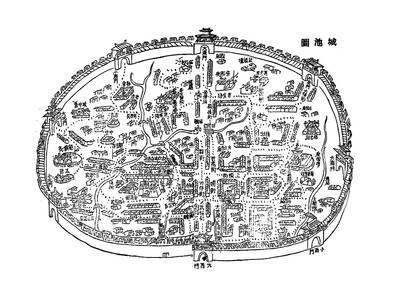
May 26 to June 1 When the Qing Dynasty first took control over many parts of Taiwan in 1684, it roughly continued the Kingdom of Tungning’s administrative borders (see below), setting up one prefecture and three counties. The actual area of control covered today’s Chiayi, Tainan and Kaohsiung. The administrative center was in Taiwan Prefecture, in today’s Tainan. But as Han settlement expanded and due to rebellions and other international incidents, the administrative units became more complex. By the time Taiwan became a province of the Qing in 1887, there were three prefectures, eleven counties, three subprefectures and one directly-administered prefecture, with

It’s an enormous dome of colorful glass, something between the Sistine Chapel and a Marc Chagall fresco. And yet, it’s just a subway station. Formosa Boulevard is the heart of Kaohsiung’s mass transit system. In metro terms, it’s modest: the only transfer station in a network with just two lines. But it’s a landmark nonetheless: a civic space that serves as much more than a point of transit. On a hot Sunday, the corridors and vast halls are filled with a market selling everything from second-hand clothes to toys and house decorations. It’s just one of the many events the station hosts,

Among Thailand’s Chinese Nationalist Party (KMT) villages, a certain rivalry exists between Arunothai, the largest of these villages, and Mae Salong, which is currently the most prosperous. Historically, the rivalry stems from a split in KMT military factions in the early 1960s, which divided command and opium territories after Chiang Kai-shek (蔣介石) cut off open support in 1961 due to international pressure (see part two, “The KMT opium lords of the Golden Triangle,” on May 20). But today this rivalry manifests as a different kind of split, with Arunothai leading a pro-China faction and Mae Salong staunchly aligned to Taiwan.

Two moves show Taichung Mayor Lu Shiow-yen (盧秀燕) is gunning for Chinese Nationalist Party (KMT) party chair and the 2028 presidential election. Technically, these are not yet “officially” official, but by the rules of Taiwan politics, she is now on the dance floor. Earlier this month Lu confirmed in an interview in Japan’s Nikkei that she was considering running for KMT chair. This is not new news, but according to reports from her camp she previously was still considering the case for and against running. By choosing a respected, international news outlet, she declared it to the world. While the outside world


 RSS
RSS