


Chuang Ming-tseng (莊明增) recalls carrying oil bamboo torches up Siuluan Mountain (秀巒山) and forming “fire dragons” with his classmates as a child. But the chief of Hsinchu County’s Beipu Township (北埔) only learned the true significance of this unique Lantern Festival ritual a few years ago.
“We just thought it was fun,” he tells the Taipei Times. “Locals just knew to go up there during this time … Over time, many forgot why this custom existed.”
With the event gaining popularity in recent years — last month’s event attracted more than 3,000 participants, forming one continuous fire dragon — the township office needed to provide a coherent narrative to the spectacle. Elders can still remember that it was originally to repair Beipu’s severed “dragon vein” (龍脈), referring to mountain ridges that carry auspicious energy from a “dragon lair” (龍穴, or meridian spot) to the town.
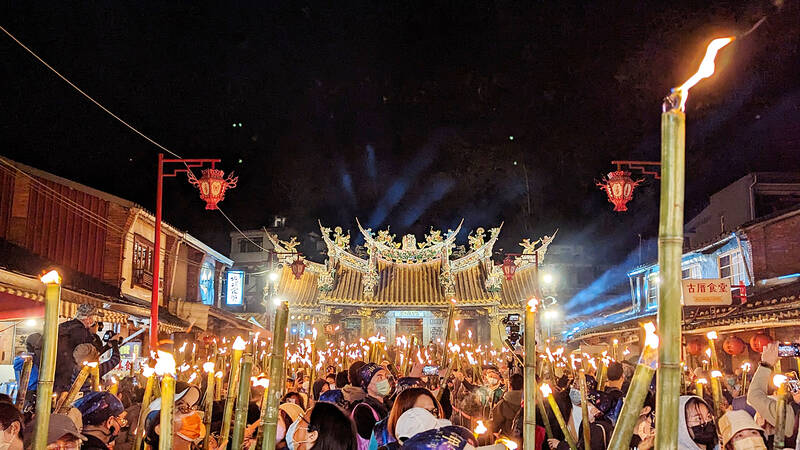
Photo: Han Cheung, Taipei Times
“Prosperity can come through a dragon vein in many forms, including wealth, a flourishing population or a successful career in politics,” Citien Temple (慈天宮) director Chiang Jui-chin (姜瑞金) says.
Chiang adds that the original temple was built on the vein in the 1830s, and the current settlement formed around it.
Through field research, organizers concluded that Japanese colonizers had cut the vein by building a straight road between the temple and the mountain to suppress the fortunes of the influential Chiang (姜) family. Chiang Jui-chin says this act led to the decline of Beipu — and many sons in the Chiang clan to die young. After the Japanese defeat in 1945, a geomancer instructed the townspeople to walk up the mountain in a queue holding torches on the 15th day of the Lunar New Year to rejuvenate the town, and the practice has continued ever since.
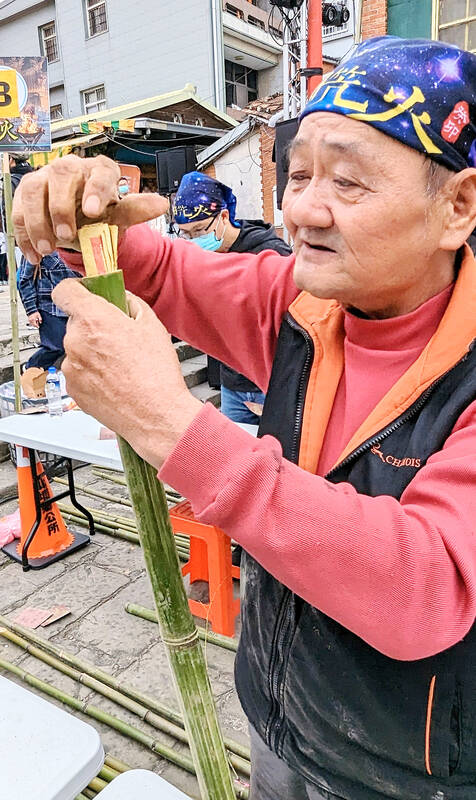
Photo: Han Cheung, Taipei Times
“Fire is considered prosperous, so it’s able to reconnect the vein,” Chiang says. “But back then, 50 or 60 years ago, we weren’t trying to form dragons, we were just having fun running all over the hills with our torches. Since there were no tall buildings then, you could see from afar little fire dragons zipping all over the mountain.”
SLEEPING TIGER
There were just a few fireworks set off on Saturday before the crowd traveled up the hill, but no firecrackers could be heard. That’s because this particular dragon lair is shaped like a sleeping tiger and must not be disturbed, Chiang says.
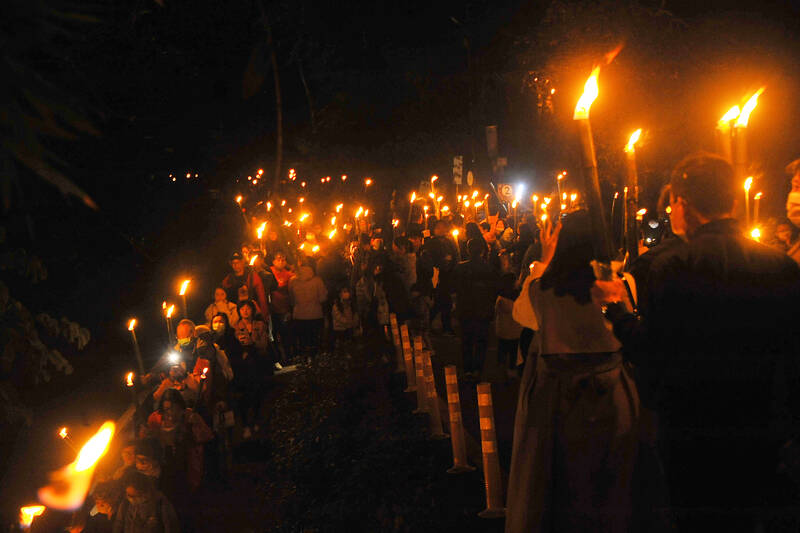
Photo: Han Cheung, Taipei Times
Chiang says that during the Lunar New Year in 1907, the Chiang family broke the taboo by holding a raucous celebration in front of the temple. That November, the Beipu Uprising against the Japanese broke out, and eventually the rebels fled into the surrounding mountains. The Japanese troops threatened to slaughter the entire town’s inhabitants if they couldn’t catch the insurgents, and it cost the Chiangs and other local elites a lot of money and pleading to prevent a massacre.
“That’s why the stage is always down the road when we hold major religious events,” Chiang says. “That way, the gods can see it, but the tiger can’t hear it.”
When asked if the thousands of people walking up the mountain would disturb the tiger, Chiang replies: “[They] aren’t loud enough.”
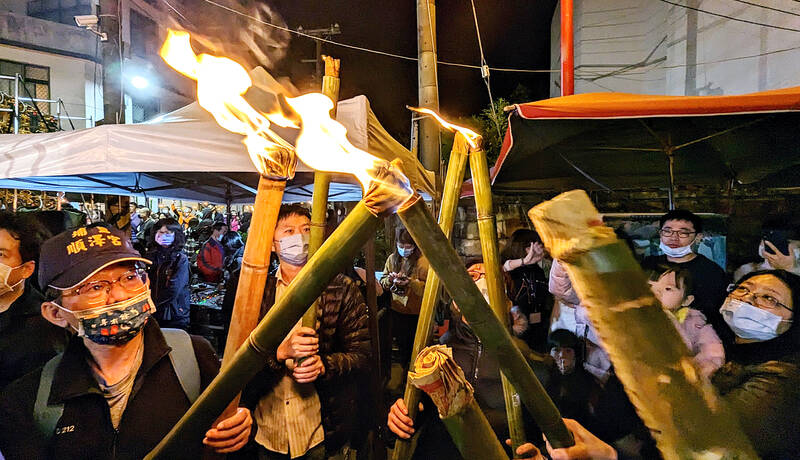
Photo: Han Cheung, Taipei Times
The bamboo torch festival has become increasingly well-organized and attended since the Beipu Township Office took over in 2019. Tourists now sign up weeks in advance, and volunteers on site help enthusiastic visitors construct the torch, which is made by pouring oil into the bamboo’s center and stuffing the top with a roll of spirit paper.
Television host Hsu Tzu-yen (徐子雁), a mainstay at festivals in this area, is animatedly providing over-the-top commentary and directing the crowd, while modern fire dancers strut their stuff on stage.
The whole temple plaza is lit up, and a temple official carries the “mother flame” to the main stage where local leaders — including Chuang — ignite their torches. The fire is then passed through the crowd, torch-to-torch, until a mosaic of orange dots cover the entire area. Then they march, along with participants from nine surrounding villages, up a concrete footpath into the hills.
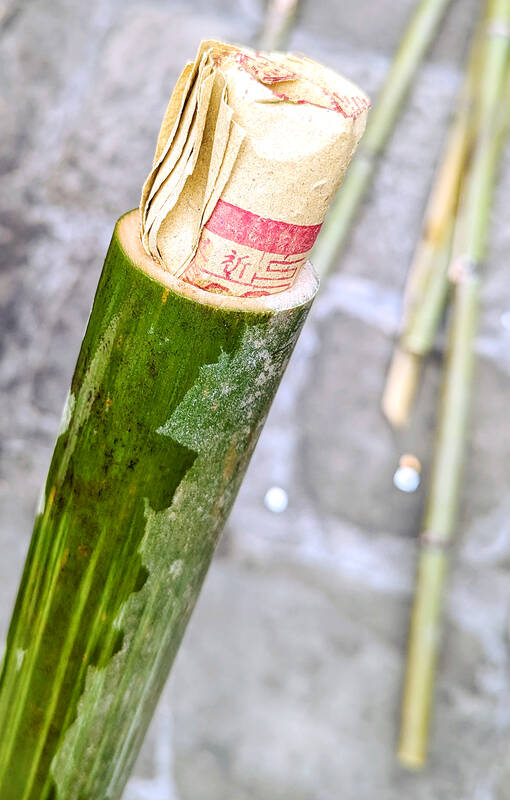
Photo: Han Cheung, Taipei Times
CHANGING TIMES
This spectacle didn’t exist when Chuang and Chiang were growing up, as organizations and families would head up on their own. Most families owned bamboo torches anyway, Chiang says, and it was mostly the boys who would carry them while the girls brought lanterns. At one point, adults placed treasures in the mountains for the children to hunt.
“What’s curious is that even though the town used to consist of mostly wooden buildings, there’s never been a fire due to this ritual as far as I can remember,” Chiang says.
Since the turn of the century, various groups in town, including the business association, have tried their hand at turning the practice into a local attraction. Chiang says they enjoyed considerable success in the early 2000s, but later stopped due to funding issues. Efforts restarted in the mid-2010s, and according to the Liberty Times (Taipei Times’ sister paper), the 2018 event attracted about 400 participants.
The “mother flame” part was devised in 2019 by the township office to create more of a sense of ceremony, Chuang says. Having the village leaders receive the flame on stage symbolizes the unity across the township, while passing it to tourists from the center to the periphery represents continuing the spirit of prosperity and the strength to protect one’s home and country, he says.
It’s not completely invented, Chuang says, as there used to be a continuously burning flame in the temple, but it was extinguished due to its designation as a historic building.
Chuang also provides evidence for the Japanese cutting the dragon vein: in addition to elders mentioning “repairing the vein,” he says the straight road behind the temple unnaturally cuts off a crucial part of its “dragon spirit.” There are many instances of people destroying dragon lairs or veins throughout history, and the Japanese had good reason to fear the Chiang family, especially since one member, Chiang Shao-tzu (姜紹祖), led a fierce resistance against their occupation in 1895.
“These stories were only passed down orally and there isn’t a complete record of it, but after organizing all the information we found, it makes a lot of sense,” Chuang says.
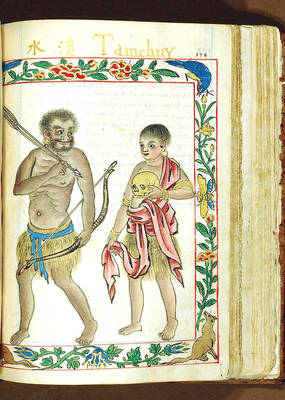
The Portuguese never established a presence on Taiwan, but they must have traded with the indigenous people because later traders reported that the locals referred to parts of deer using Portuguese words. What goods might the Portuguese have offered their indigenous trade partners? Among them must have been slaves, for the Portuguese dealt slaves across Asia. Though we often speak of “Portuguese” ships, imagining them as picturesque vessels manned by pointy-bearded Iberians, in Asia Portuguese shipping between local destinations was crewed by Asian seamen, with a handful of white or Eurasian officers. “Even the great carracks of 1,000-2,000 tons which plied

It’s only half the size of its more famous counterpart in Taipei, but the Botanical Garden of the National Museum of Nature Science (NMNS, 國立自然科學博物館植物園) is surely one of urban Taiwan’s most inviting green spaces. Covering 4.5 hectares immediately northeast of the government-run museum in Taichung’s North District (北區), the garden features more than 700 plant species, many of which are labeled in Chinese but not in English. Since its establishment in 1999, the site’s managers have done their best to replicate a number of native ecosystems, dividing the site into eight areas. The name of the Coral Atoll Zone might
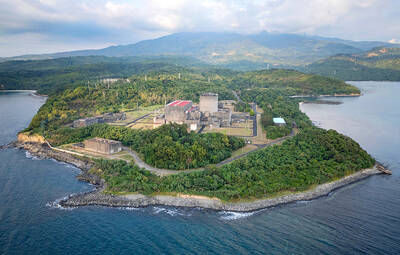
Nuclear power is getting a second look in Southeast Asia as countries prepare to meet surging energy demand as they vie for artificial intelligence-focused data centers. Several Southeast Asian nations are reviving mothballed nuclear plans and setting ambitious targets and nearly half of the region could, if they pursue those goals, have nuclear energy in the 2030s. Even countries without current plans have signaled their interest. Southeast Asia has never produced a single watt of nuclear energy, despite long-held atomic ambitions. But that may soon change as pressure mounts to reduce emissions that contribute to climate change, while meeting growing power needs. The

On Monday morning, in quick succession, the Chinese Communist Party (CCP) and the Chinese Nationalist Party (KMT) released statements announcing “that the Central Committee of the Communist Party of China and General Secretary Xi Jinping (習近平) have invited KMT Chairwoman Cheng Li-wun (鄭麗文) to lead a delegation on a visit to the mainland” as the KMT’s press release worded it. The KMT’s press release added “Chairwoman Cheng expressed her gratitude for the invitation and has gladly accepted it.” Beijing’s official Xinhua news release described Song Tao (宋濤), head of the Taiwan Work Office of the CCP Central Committee, as


 RSS
RSS