


For Jason Hunter, the math is simple.
If Carol, his 79-year-old mother, is to stay with her only son in Taiwan, but isn’t able to gain residency status here, she’ll have to leave the country at least twice a year.
Each time, she’ll need to apply for a new visa, or on return seek visa-free entry (which is good for no more than 90 days). Of course, there’s no guarantee that she’ll be granted a fresh visa, let alone one that can be extended.
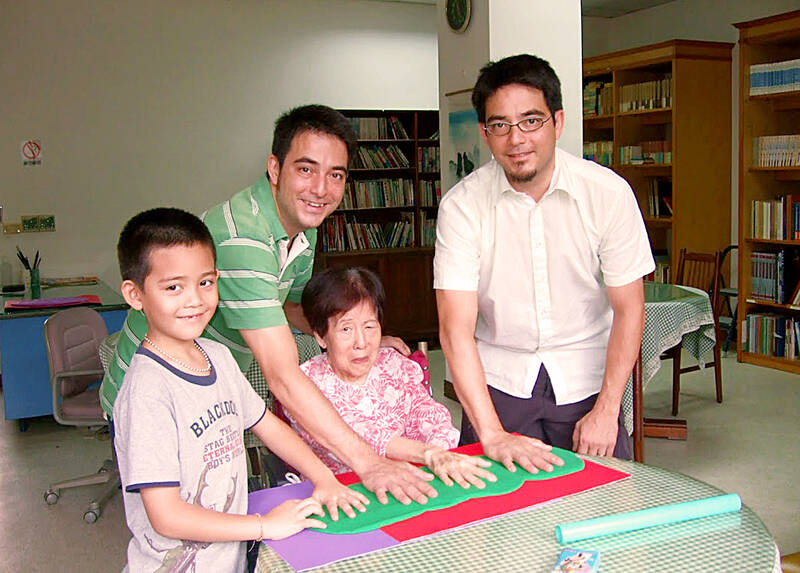
Photo courtesy of Robert Dawson
“What’s more, there’s no way my mom could do a visa run by herself,” says Jason, an American who lives and works in Tainan. He or his wife, Wan-chun, would have to take time off work to accompany Carol, or pay someone to go with her.
Obviously, as she gets older, flying abroad will become more and more difficult for Carol. The authorities occasionally allow foreign-passport holders unable to extend their visas to stay in Taiwan a little longer, if they’re suffering from “severe acute illness,” the Ministry of Foreign Affairs’ Bureau of Consular Affairs (BOCA) confirmed in an Oct. 31 e-mail. However, Jason says he isn’t sure he’d be able to rely on this if his mother’s health took a turn for the worse.
When Robert Dawson and his mother faced circumstances similar to those now confronting Jason and Carol, they had somewhat better luck.
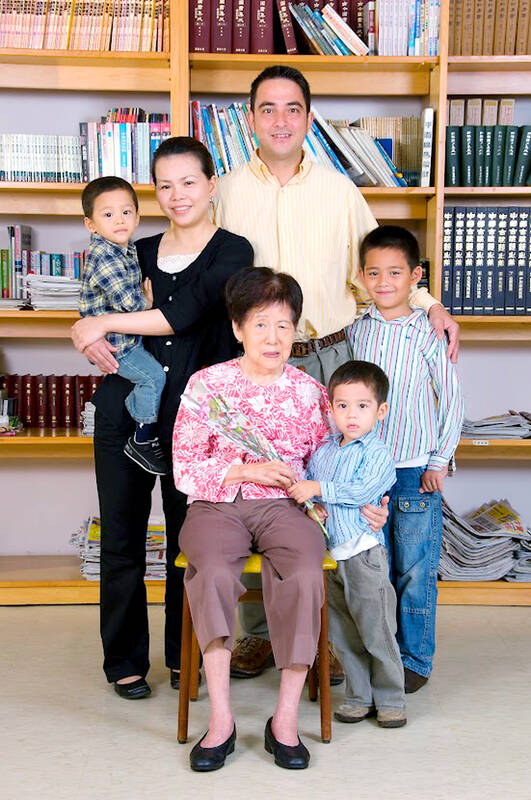
Photo courtesy of Robert Dawson
BEGGING FOR A VISA
Robert’s mother, Eleanor, moved from the US to Taiwan in 2007, after suffering a debilitating stroke. She arrived on a five-year multiple entry visitor visa that allowed her to stay for up to six months at a time. Every half year or so, therefore, she and Robert flew to Hong Kong or Macau for a few hours, so her visa would “reset.”
After the initial five years was up, Taiwan’s visa office in Hong Kong granted her a new five-year multiple-entry visa, but only after Robert “begged and begged” them to reverse their initial refusal. That second visa kept her on the right side of the law until she passed away in 2017.
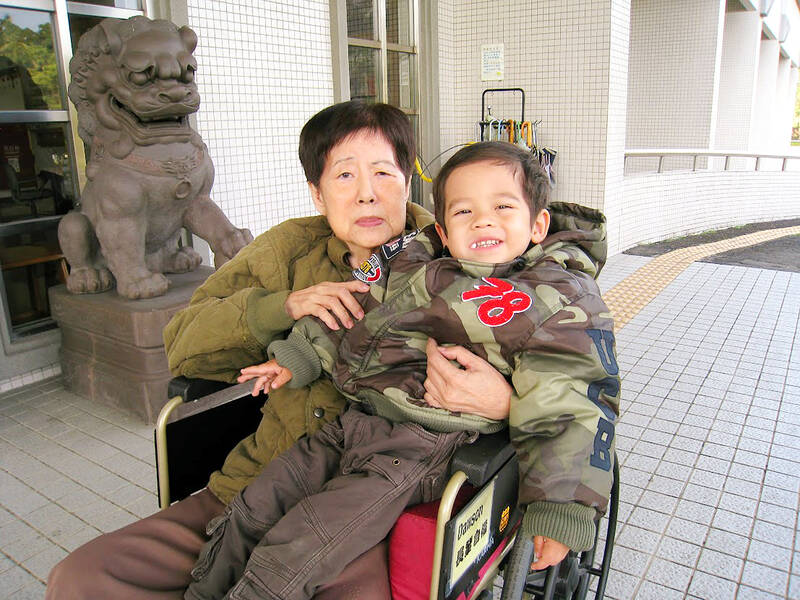
Photo courtesy of Robert Dawson
Such visas, which were only ever available to US citizens, are not issued these days.
Robert found a nursing home for her on the outskirts of Tainan, the city in which he’s lived since 1994.
“I’m so glad I brought her here. She wasn’t glad about leaving her home, but I think she was well cared for, and we got to see her often. She made the most of it. One advantage she had was that she already spoke Mandarin. And she picked up more Taiwanese in one decade than I’ve managed in three,” he recalls.
While Eleanor’s nursing home was more expensive than many local elder-care centers, it cost a fraction of what she’d been paying in the US. She adored the place, staying there until she passed away.
After his attempts to regularize his mother’s status in Taiwan were rebuffed by the National Immigration Agency and the BOCA, Robert — a permanent resident married to a Taiwanese citizen, with whom he has three sons — approached William Lai (賴清德), then Tainan’s mayor, now Taiwan’s vice president, for assistance.
Lai later told him that he’d pleaded Eleanor’s case with the relevant agencies, but they wouldn’t budge.
“Nonetheless, I’m grateful that he tried to help,” Robert says.
Robert is certain that his mother’s presence in Taiwan contributed positively to the local economy.
Because she never qualified for the National Health Insurance (NHI) system or any other welfare schemes, neither her care-center fees nor her medical treatment were subsidized.
On top of what Eleanor spent, Robert’s brother, David, made annual trips to Taiwan from the US to see their mother. In some years, David was joined by his wife and children.
“I know first-hand what a welcoming country Taiwan is, and how it’d be a welcoming destination for retirees,” says Robert, going on to praise the country’s “well-trained and hardworking caregivers, and relatively low prices for senior care.”
“Foreign residents who want to provide for their aging parents, and the parents themselves, would benefit from a more open Taiwan, and Taiwan would also benefit, at the very least from their economic contributions,” he says.
OBSTACLES
Asked if he can reconcile the rules he came up against with the government’s oft-stated intention to attract foreign talent, he adds: “If they have serious plans to recruit overseas professionals, I think the current situation is a major obstacle.”
Jason agrees that, if the government allowed elderly parents to accompany foreign adults working here, it wouldn’t be a price that has to be paid to attract overseas talent to Taiwan, but instead a net benefit.
“My mom may be elderly and not working, but she’ll be contributing to the economy,” says Jason. “In addition to retirement home fees, she pays for the seniors’ activity center to send someone over twice a day, five days a week, to do rehabilitation and activities with her. Her food, medical and other expenses are all met with money she brought into Taiwan,” he says.
Finding a retirement home willing to take Carol has been another challenge for Jason. Some of the establishments he contacted turned them away as soon as they learned that Carol speaks neither Mandarin nor Taiwanese, saying the language barrier would make it impossible for their staff to provide satisfactory care.
He has looked into his mother renting an apartment, and hiring a foreign caregiver to live with and assist her. However, there seems to be no way this could be done without breaking the law.
Jason has also wondered if Carol might be able to stay long-term by qualifying for an investor or entrepreneur visa.
If worse comes to worst, he doesn’t rule out seeking a Taiwanese man who could marry his long-divorced mother. He admits it may well be impossible to find someone both willing and suitable, but if a match could be made, Carol could apply for residency as the spouse of a citizen. She’d then qualify for NHI, but not welfare programs that the government has decided should be available only to Taiwanese citizens.
EXCLUDING TAX-PAYING FOREIGNERS
This exclusion exasperates not only foreigners who’ve made Taiwan their home, and whose taxes support such programs, but also their local spouses and children.
“Social welfare provides support such as house-visits by trained nurses and therapists, financial help for purchasing assistive devices, and, most importantly, the handicapped passport which entitles holders to a long list of services, including the ‘blue badge’ sticker for your vehicle and wheelchair taxi services,” says Katy, a Taiwanese citizen who prefers not to give her Chinese name.
Katy’s British husband has lived in Taipei since 1989.
“He ran a business and paid taxes in Taiwan for many years, [but he’s] denied all of these benefits because he’s not a citizen,” she says.
At least one Taiwanese commentator on labor and immigration issues cautiously supports opening the door to non-citizen retirees.
David Chang (張代偉), secretary-general of Crossroads — an NGO that describes itself as working to facilitate exchanges of talent between “local Taiwanese and international communities for the promotion of cultural, academic and industry diversification” — says he’s aware that some long-term foreign residents hope they can bring their aging parents to Taiwan, but that the issue hasn’t received much attention compared to other issues, such as banking or housing.
Chang says that allowing the parents of some expatriates to stay in Taiwan might not only help attract and retain foreign professionals, “but would also bring in the accumulated resources of those older folks. With its excellent healthcare system, overall safety and convenience and culture of respect for elders, Taiwan certainly has the foundations to become a ‘retirement island.’ Through careful design of new participation structures and regulatory reform, an influx of retirees may even help to fill gaps in the healthcare and long-term care systems, and spur healthy development of the local retirement industry.”
To protect the interests of local taxpayers, any scheme that allows retirees to settle in Taiwan would have to contemplate scenarios including the retiree becoming indigent, elder abandonment and the sponsoring child in Taiwan predeceasing the parent.
Chang cautions that any major change in policy would have to be weighed against the direction of national development envisioned by Taiwan’s leaders, and whether the country would openly welcome additions to an already aging population, while enacting corresponding measures to address labor shortages, culture shock and language accessibility.
“Many of the challenges that foreign professionals currently face in their daily lives in Taiwan would also apply to these retirees,” he says.

In late October of 1873 the government of Japan decided against sending a military expedition to Korea to force that nation to open trade relations. Across the government supporters of the expedition resigned immediately. The spectacle of revolt by disaffected samurai began to loom over Japanese politics. In January of 1874 disaffected samurai attacked a senior minister in Tokyo. A month later, a group of pro-Korea expedition and anti-foreign elements from Saga prefecture in Kyushu revolted, driven in part by high food prices stemming from poor harvests. Their leader, according to Edward Drea’s classic Japan’s Imperial Army, was a samurai

The following three paragraphs are just some of what the local Chinese-language press is reporting on breathlessly and following every twist and turn with the eagerness of a soap opera fan. For many English-language readers, it probably comes across as incomprehensibly opaque, so bear with me briefly dear reader: To the surprise of many, former pop singer and Democratic Progressive Party (DPP) ex-lawmaker Yu Tien (余天) of the Taiwan Normal Country Promotion Association (TNCPA) at the last minute dropped out of the running for committee chair of the DPP’s New Taipei City chapter, paving the way for DPP legislator Su

It’s hard to know where to begin with Mark Tovell’s Taiwan: Roads Above the Clouds. Having published a travelogue myself, as well as having contributed to several guidebooks, at first glance Tovell’s book appears to inhabit a middle ground — the kind of hard-to-sell nowheresville publishers detest. Leaf through the pages and you’ll find them suffuse with the purple prose best associated with travel literature: “When the sun is low on a warm, clear morning, and with the heat already rising, we stand at the riverside bike path leading south from Sanxia’s old cobble streets.” Hardly the stuff of your

April 22 to April 28 The true identity of the mastermind behind the Demon Gang (魔鬼黨) was undoubtedly on the minds of countless schoolchildren in late 1958. In the days leading up to the big reveal, more than 10,000 guesses were sent to Ta Hwa Publishing Co (大華文化社) for a chance to win prizes. The smash success of the comic series Great Battle Against the Demon Gang (大戰魔鬼黨) came as a surprise to author Yeh Hung-chia (葉宏甲), who had long given up on his dream after being jailed for 10 months in 1947 over political cartoons. Protagonist


 RSS
RSS