


In Taiwan, the rain often falls neither when nor where it’s most needed.
Almost every year, downpours trigger floods and landslides. Yet, because the country has a long dry season and its topography makes retaining and transferring water difficult, there was a serious drought in 2015 and an even worse one last year.
Meeting the water needs of Taiwan’s households and its thirsty farming and industrial sectors is becoming more and more difficult. One element of the government’s response is a proposal to divert water from Nanshi Creek (南勢溪) in New Taipei City’s Wulai District (烏來) to the upper reaches of Shihmen Reservoir (石門水庫) in neighboring Taoyuan.
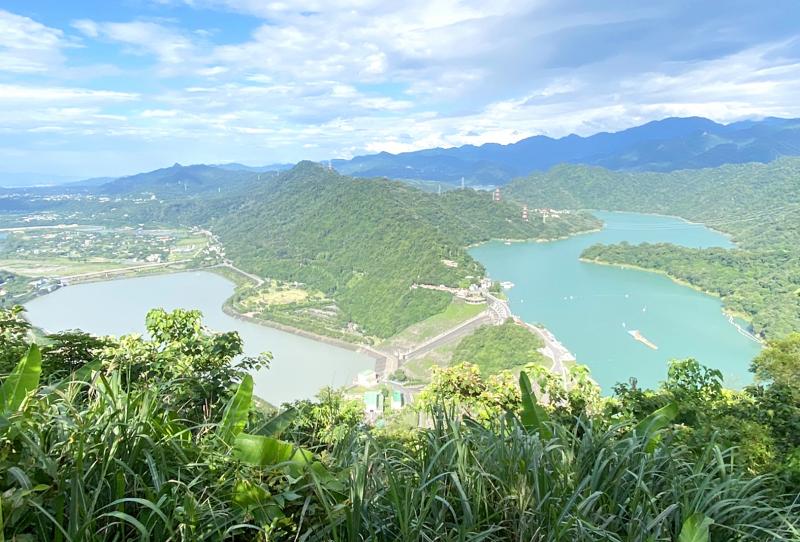
Photo: Lee Jung-ping, Taipei Times
The Ministry of Economic Affairs’ Water Resources Agency (WRA) is also planning to build a tunnel-pipeline to connect Shihmen Reservoir with the reservoirs that serve Hsinchu Science Park. But it’s what the WRA wants to do in Wulai that alarms activists like Huang Tai-hua (黃泰華), CEO of the Taiwan Ecological Engineering Development Foundation.
According to a draft plan published by the WRA on May 17 , a 17.2km-long, five-meter-diameter tunnel between Wulai and Zeren (澤仁) in Taoyuan’s Fusing District (復興) would add at least 107,000 tonnes of water per day to Shihmen Reservoir, without harming the interests of users downstream in Hsindian (新店) and Taipei.
Huang fears that construction of the diversion tunnel and ancillary facilities such as weirs will devastate Nanshi Creek’s near-pristine watershed, part of which belongs to the 7,759-hectare Chatianshan Nature Reserve (插天山自然保留區).

Photo courtesy of Chen Ming-de
Within Wulai there are several renowned birdwatching spots. Crab-eating mongooses and various amphibians dwell within the reserve. At high elevations, there have been sightings of Formosan black bears.
ECOLOGICAL CONSEQUENCES
Reducing the amount of water a mountain stream carries is bound to have ecological consequences.
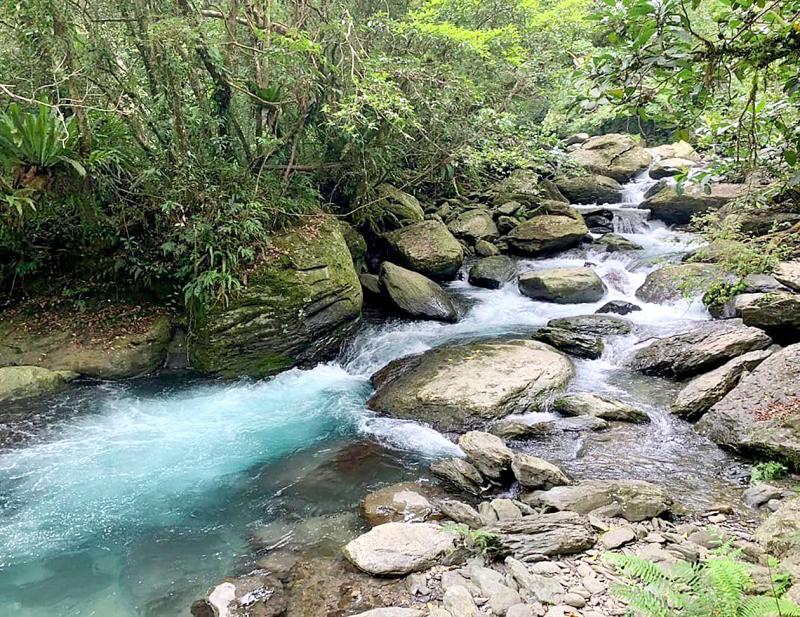
Photo courtesy of Huang Tai-hua
A 2014 paper by researchers in Colorado concluded that diversions “can reduce peak and base flow, thereby changing the abiotic factors to which stream and riparian ecosystems have adjusted. Many riparian plant species are adapted to the unique timing, magnitude and duration of the natural flow regime.”
According to a paper published this February by Spanish scientists, diverting water can cause changes in organic-matter decomposition that “may cause profound shifts in the trophic structure and energetic balance of the ecosystem,” as organic matter is central to food webs in forested rivers.
On top of its impact on the creatures that live in Wulai’s forests and creeks, the project may have a huge carbon footprint. Some 370,000m3 of concrete was used in the building of the 12.9km-long Hsuehshan Tunnel (雪山隧道). Producing 1m3 of concrete generates carbon emissions of around 2.2 tonnes. Cement trucks typically carry 6m3 of concrete at a time, so — even if half of the construction work is done from the Taoyuan side — tourists hoping to enjoy Wulai’s scenery will have to share the road with thousands of large diesel-burning vehicles.
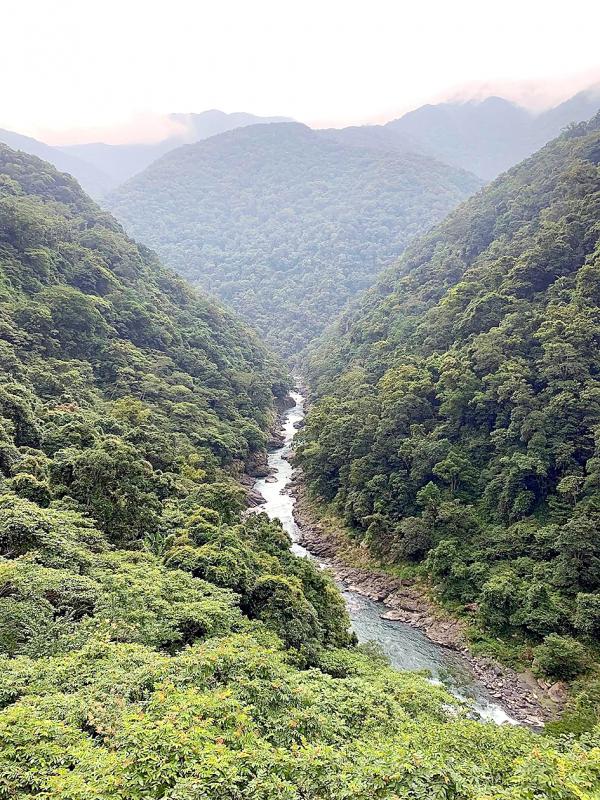
Photo courtesy of Huang Tai-hua
Huang also asks what will happen to the tens of thousands of soil and rock that will be excavated during the digging of the tunnel.
“We don’t have any data about the project’s carbon footprint. Most officials believe engineers can conquer nature and control everything. If we ask these questions, they’ll find a company to conduct an evaluation, and the environmental impact assessment (EIA) will conclude there won’t be any serious impact,” Huang says.
Huang has little confidence in Taiwan’s EIA process, which many critics decry as rubber-stamping. He hopes the diversion project can be turned into a major issue ahead of the local elections scheduled for Nov. 26, and that public pressure will force the government to withdraw the proposal.
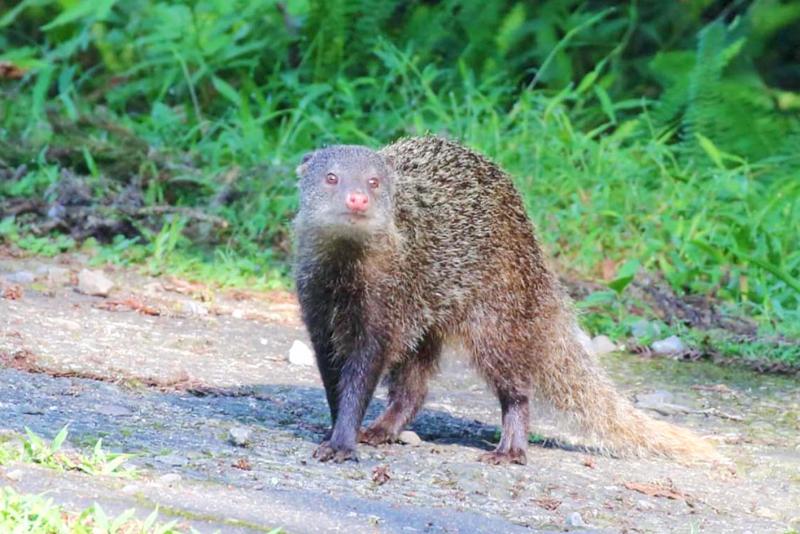
Photo courtesy of Chen Ming-de
The WRA’s blueprint places the water intake at an uninhabited spot called Tunlu (屯鹿), 280m above sea level and about 6km downstream of the indigenous Atayal community of Tranan (福山).
Huang rejects any notion that this location means the most ecologically valuable parts of the valley will escape the affects of construction and subsequent water diversion.
“Downstream of Tunlu, around Neidong National Forest Recreation Area (內洞國家森林遊樂區) and toward the village of Wulai, is also unspoiled and important. The forest beside the creek is mature and primitive. Many endangered species live there,” he says.
ALARMING PRECEDENT
In addition, Huang says, there’s a risk that building the diversion tunnel will destabilize the area’s geology.
Taiwan is criss-crossed by faults. On top of the possibility that tectonic activity might wreck the tunnel, there’s a fear that large-scale excavation could set the scene for a catastrophic collapse like the one which buried Siaolin (小林) in a mountainous part of Kaohsiung during 2009’s Typhoon Morakot.
Siaolin survivors are among those who suspect the disaster wouldn’t have happened were it not for work being done on a tunnel to transfer water from Cishan River (旗山溪) and Laonong River (荖濃溪) into Zengwen Reservoir (曾文水庫).
The WRA has never accepted any responsibility for the calamity, which killed close to 500 people. But despite occasional calls to complete the tunnel, work on southern Taiwan’s water diversion project has never resumed. Suspending this project after billions of New Taiwan Dollars were spent hasn’t, of course, undone the severe environmental damage done to those two waterways.
What’s more, Huang isn’t impressed by the WRA’s meteorological justification for the Nanshi Creek diversion tunnel. The agency says that different rainfall patterns mean the creek is likely to have water to spare when Shihmen Reservoir, which is fed by Dahan River (大漢溪), is running low.
The problem with Shihmen Reservoir is not so much a lack of rain at certain times, he says, but poor management of the watershed. Overdevelopment of the surrounding hillsides has resulted in the reservoir losing capacity due to sedimentation.
It’s been pointed out that Feicui Reservoir (翡翠水庫) in New Taipei City, which was planned and completed after Shihmen Reservoir, doesn’t suffer from serious silting. There, the authorities have been far stricter when it comes to preventing development within the watershed.
Some say that this isn’t simply because policymakers have learned from their mistakes. They note that Feicui Reservoir supplies the water that central government officials drink, hence the importance attached to keeping it unpolluted.
Protecting watersheds and diverting water aren’t the only tools in the government’s toolbox. For years, observers have been urging the authorities to replace existing pipelines so less water is lost, and to hike its price to encourage recycling. Reforming agriculture, so less land is used for growing rice, is one option. Desalination is another.
Huang and others are hoping that public criticism of the plan will lead to the government getting cold feet. But if the WRA is having second thoughts about the Nanshi Creek diversion tunnel, it’s not letting on.
WATER AGENCY RESPONDS
In an e-mailed response to questions sent by this reporter, the agency yesterday reiterated its justification for what it calls “cross-regional water resource dispatch,” saying the diversion plan will “improve the stability of regional water supply.”
As for the impact on local ecosystems, the WRA offered the vaguest of assurances: The project will “comprehensively consider avoiding nature reserves… and reducing environmental impact.”
The agency didn’t answer questions about the percentage of the creek’s total discharge that will be diverted, the risk of sedimentation within the tunnel, whether the tunnel might exacerbate Shihmen Reservoir’s silting problem, whether construction will require roads to be built or widened and how much concrete will be poured.
The WRA should already have answers to these questions, and their response — that some of this information will be published at some point in the future on the Web site of the Environmental Protection Administration — is highly disappointing.
The agency said it expects the project to proceed to the EIA stage in the second half of this year. It’s imperative, therefore, that anyone who adores the ecological diversity and natural beauty of Wulai makes their opinion known before then.
Steven Crook, the author or co-author of four books about Taiwan, has been following environmental issues since he arrived in the country in 1991. He drives a hybrid and carries his own chopsticks. The views expressed here are his own.

Taiwan’s English education system is being pulled apart by three opposing forces. Bilingual Nation 2030 pulls students toward English and global communication. Artificial Intelligence (AI) readiness pulls them toward digital judgment, verification and AI-mediated work. But Taiwan’s old exam culture pulls them back toward memorization, grammar drills, timed reading and correct answers. If the education system keeps using old exams to define success, it risks producing graduates who are neither genuinely bilingual nor genuinely AI-ready, but trained for tasks machines can already perform. The first force is Bilingual Nation 2030. Launched in 2018, the policy aimed to “help Taiwan’s workforce connect

It seems every few days one bumps into one of those “real man” comments in which Taiwan is urged to “face reality” or similar, and “make a deal,” with the speaker implying that soon it will be too late. “Deal” advocates always present themselves as having a superior grip on reality, and the manly ability to make the “hard choice.” Their testosterone-laden language often echoes that of Taiwan sellout advocates. Note that such commentary always specifies a process (“make a deal, work with, make progress”), never the end state of what occupation by a violent authoritarian colonialist state will entail. In
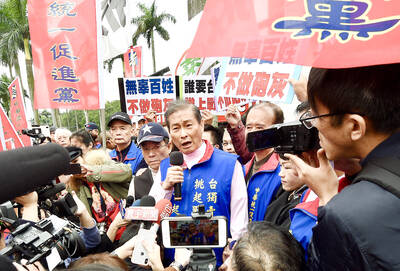
There are shadowy cabals plotting to sell out Taiwan to be annexed by China, by invasion if necessary. Fortunately, they are buffoons. In 2019, former Bamboo Union gangster and founder of the China Unification Promotion Party (CUPP), Chang An-le (張安樂, colorfully known as “White Wolf”), led a protest at the Legislative Yuan against comments made by then-premier Su Tseng-chang (蘇貞昌) that in the event of an attack by China, he would never surrender, but would protect the nation by fighting to the end, even if he only had a broom. Chang had party members bring a wooden casket that they
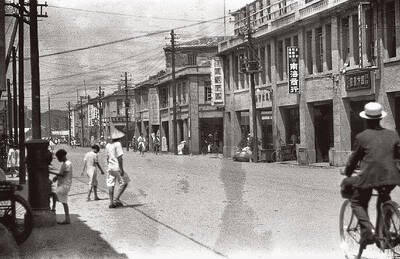
June 1 to June 7 "If all Taiwanese were as afraid of dying as you, then what would happen?” Physician Shih Chiang-nan (施江南) reportedly said this to his wife Chen Chiao-tung (陳焦桐) after she urged him to stop intervening on behalf of Taiwanese soldiers stranded overseas after serving in the Japanese Army during World War II. Shih had clashed with high-ranking officials over the issue, engaged in several heated arguments with Taiwan governor-general Chen Yi (陳儀) and allegedly shouted at general Ko Yuan-fen (柯遠芬), chief of staff of the Taiwan Garrison Command, over


 RSS
RSS