


One evening towards the end of 2003, Chloe Sells was entering the J-Bar in Aspen, Colorado, in search of a late night drink, when an older woman approached her. As Sells recalls in her new photobook, Hot Damn!: “She looked me up and down and said, ‘We’re looking for some help for Hunter. Are you a night owl? Would you be interested?’”
Hunter, as every local knew, was Hunter S Thompson, the celebrated creator of “gonzo” journalism, and the town’s most infamous resident. The woman was his wife, Anita. “It took me only a moment,” Sells says, “to answer ‘Yes’ to everything.”
Sells ended up working as Thompson’s personal assistant for just over a year, doing “anything and everything that needed doing.” Her typical working hours were 11pm until dawn, and her tasks included preparing his often elaborate dinners to order (microwave turkey dinner with soup, chutney, peanut butter and salsa), reading his prose back to him while he shouted instructions (“Louder, louder, slower, slower”) and dealing with his increasingly frequent bouts of explosive anger at his publishers, editors, acolytes and the world in general.
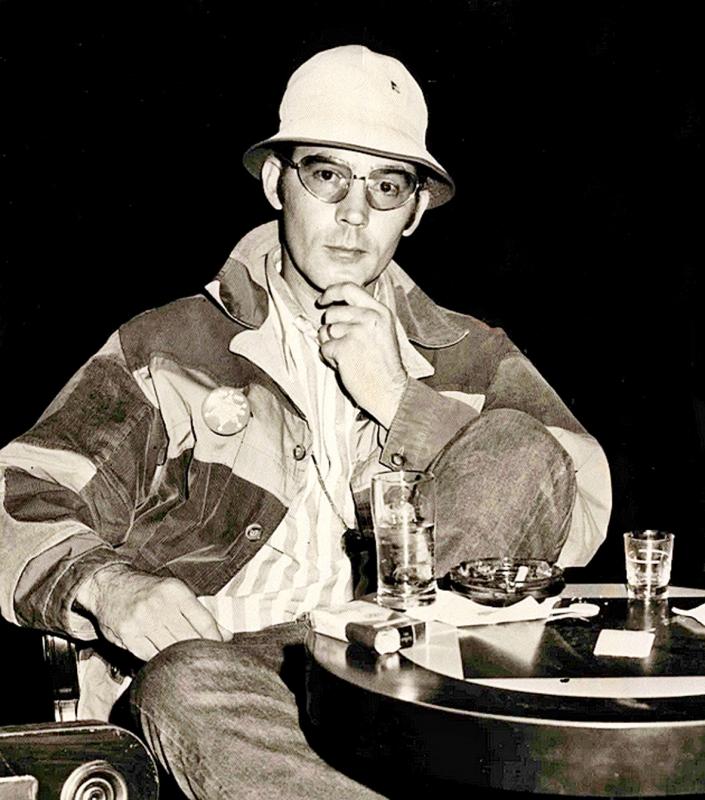
Photo: Wikimedia Commons
“I was in my late 20s in full rock ‘n’ roll mode, young and bulletproof,” she says. “I’d grown up in Aspen in a pretty wild, bohemian family and I knew nothing that Hunter did could bother me. In fact, the only thing that got to me was the cigarette smoke. There was so much of it.”
Sells’ father had been a hippy in his youth, opening one of Colorado’s earliest “head shops” in nearby Boulder, selling drug paraphernalia. Just like Thompson, he had relocated to the mountains in Aspen in the late 60s to escape the pressures of the straight life. In the decades that followed, though, the town became a hangout for the privileged and the famous, drawn by its breathtaking Rocky Mountains, winter sports, libertarian politics and abundant availability of cocaine.
“You could trek and ski by day and do shitloads of coke at night,” says Sells, laughing. “There were dealers and busts — and mountains’ worth of cocaine that was regularly flown in on Cessnas.”
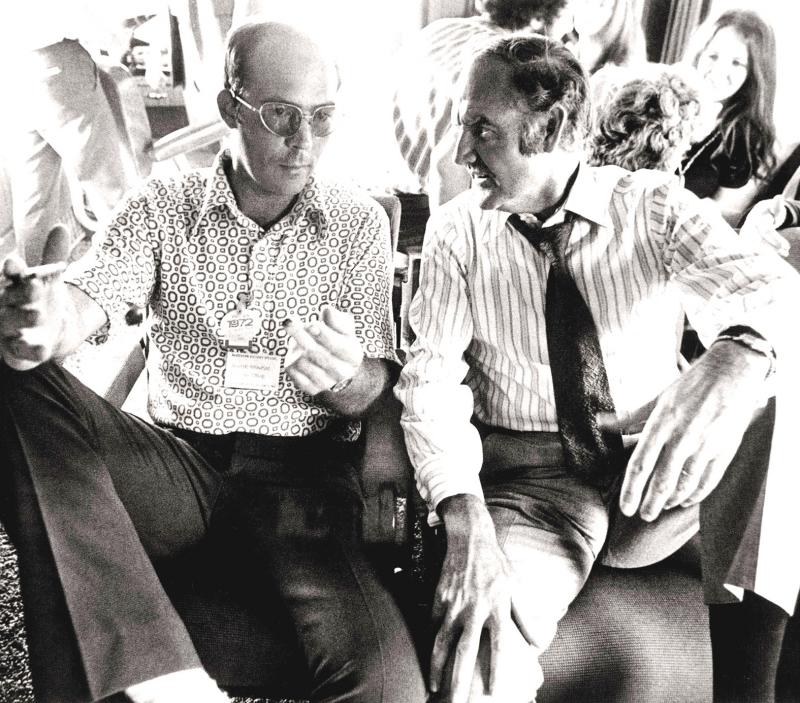
Photo: Wikimedia Commons
By the 1990s, Aspen had become a realtor’s dream, drawing A-list celebrities including Goldie Hawn and Sylvester Stallone, as well as younger acolytes of Thompson’s including Johnny Depp, who played his alter ego — Raoul Duke — in the film version of the writer’s most famous book, Fear and Loathing in Las Vegas.
“You’d suddenly see famous people everywhere,” says Sells, “but the prevailing attitude in Aspen is not to stare or make a big deal out of it.”
At Owl Farm, Thompson’s compound in Woody Creek, she realized early on that her irascible employer demanded not just her unyielding attention, but also constant intellectual stimulation into the early hours.
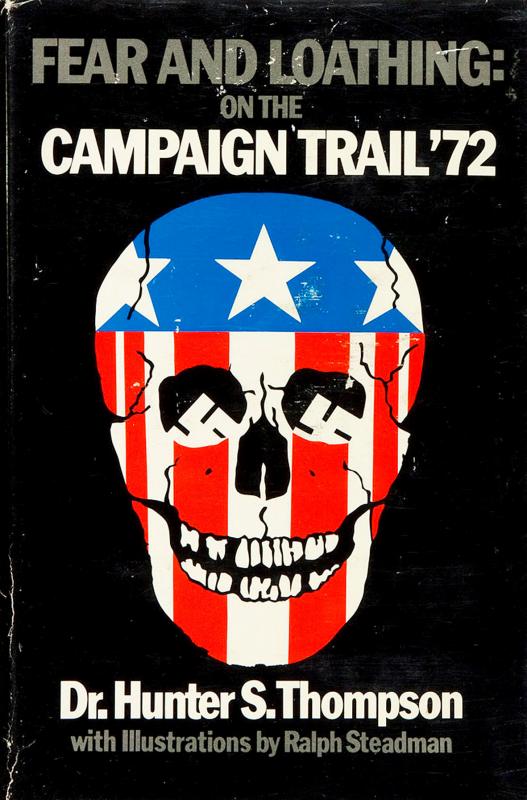
Photo: Wikimedia Commons
“I decided early on never to get wasted with him,” she says proudly. “I stayed straight throughout my time there. I’d seen the scorn he reserved for those who turned up to pay homage to him, got completely stoned and started acting stupid. They were never welcomed back.”
For all his volatile unpredictability, Sells describes Thompson as “essentially an old-fashioned southern gentleman,” whose fits of anger were often immediately followed by heartfelt contrition. Once, having taunted her with the news that Taschen was publishing a book of his photographs, he immediately felt guilty and granted her free rein to photograph the interiors and contents of Owl Farm, the one part of his life that had not been extensively documented. She immediately took him up on his offer.
The negatives from that time languished in storage for 10 years, while Sells’ work moved from straight documentary towards a vividly experimental approach close to pure abstraction — swirls and patterns of color deftly applied to her landscapes in the darkroom.
Something of a bohemian herself, Sells has lived for over 20 years between London and Botswana, where her late husband Peter Sandenbergh ran a safari camp business. Her previous book, Flamingo, was shot on the Makgadikgadi Salt Pans in the desolate heart of the Kalahari Desert. In 2016, Peter died of cancer and, soon after, she found out that she was pregnant from the IVF treatment they had undergone while he was ill.
“Suddenly, my partner was gone and I was pregnant and trying to figure out what to do and how to be an artist,” she says. “That’s when I thought, ‘Let’s just dust off those old negatives from Aspen.’”
Unsurprisingly, Hot Damn! — which took five years to complete to her satisfaction — is a more hybrid work than her previous series. Sells originally shot Thompson’s living quarters and possessions in a fly-on-the-wall documentary style that captures all the hovering chaos of a life lived on the edge: his cluttered writing desk, piles of unfinished manuscripts, various stuffed and mounted birds and animals, guns, ephemera from his writing career, his collections of hats and his electric typewriter, plus endless Post-it notes with often extravagant titles — Sodomized at the Airport, Olympic Disaster in Utah, The Wisdom of Nashville and the Violence of Jack Nicholson. Pure gonzo, in fact.
More intriguing are the dreamily psychedelic images that punctuate the book, creating a narrative that shifts constantly from the visceral to the woozily disorienting — not unlike, one imagines, day-to-day life in Woody Creek.
“I don’t make documentary work any more,” Sells says, “and to be honest, I looked at some of the pictures and thought they were a bit boring. I started using the Japanese and Italian marbling techniques I had studied to push the boundaries a bit. It took a few years before it really started to sing, but I think it offers this emotive quality that gets closer to what the ride was like — the speed, the intensity, the pressure of working with Hunter, but also the strange intimacy. It points to his legacy, but also to the spirit of my own creativity.”
Much to Thompson’s annoyance, Sells departed Woody Creek for the last time in January 2005, having decided to travel to Thailand to document the aftermath of the Indian Ocean tsunami. A few weeks later, on Feb. 20, her father called her to break the news that Thompson had died from a self-inflicted gunshot wound to the head.
“My legs buckled and I fell to my knees,” she says, lapsing into silence for a few moments. “It’s not that I didn’t see it coming, because he spoke about it a lot. His health was giving out and he was in constant chronic pain. His body was degenerating and his mind was not as sharp. Basically, he was not having fun. Plus, he had this Hemingway crush.” Hemingway had taken his life with a double-barreled shotgun in 1961.
Sells remembers one early-hours conversation, when Thompson told her mysteriously that he had his death taken care of.
“In my head, I was thinking, ‘How is that even possible?’ Then a few days later, I was like, ‘OK, that’s what was going to happen.’ But it never occurred to me it would happen on my watch. That I was so close to it is what was really shocking.”
How does Sells think back on her time at Woody Creek?
“With gratitude,” she says. “Hunter was a handful: he lived to break the rules. That was his thing. But he was also inspiring and invigorating to be around, because he was just so sharp and smart. He would have had serious fun taking down Trump, that’s for sure. But underneath it all, he was an old school gentleman. He couldn’t help it, even amid all the rants and the bad behavior. He was someone who would stand up when a lady entered the room.” She pauses for a second. “That’s if he was capable of standing up.”

Taiwan’s overtaking of South Korea in GDP per capita is not a temporary anomaly, but the result of deeper structural problems in the South Korean economy says Chang Young-chul, the former CEO of Korea Asset Management Corp. Chang says that while it reflects Taiwan’s own gains, it also highlights weakening growth momentum in South Korea. As design and foundry capabilities become more important in the AI era, Seoul risks losing competitiveness if it relies too heavily on memory chips. IMF forecasts showing Taiwan widening its lead over South Korea have fueled debate in Seoul over memory chip dependence, industrial policy and

“China wants to unify with Taiwan at the lowest possible cost, and it currently believes that unification will become easier and less costly as time passes,” wrote Amanda Hsiao (蕭嫣然) and Bonnie Glaser in Foreign Affairs (“Why China Waits”) this month, describing how the People’s Republic of China (PRC) is playing the long game in its quest to seize Taiwan. This has been a favorite claim of many writers over the years, easy to argue because it is so trite. Very obviously, if the PRC isn’t attacking Taiwan, it is waiting. But for what? Hsiao and Glaser’s main point is trivial,
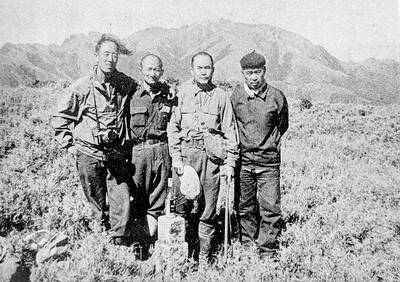
May 18 to May 24 Gathered on Yangtou Mountain (羊頭山) on Dec. 5, 1972, Taiwan’s hiking enthusiasts formally declared the formation of the “100 Peaks Club” (百岳俱樂部) and unveiled the final list of mountains. Famed mountaineer Lin Wen-an (林文安) led this effort for the Chinese Alpine Association (中華山岳協會). Working with other experienced climbers, he chose 100 peaks above 10,000 feet (3,048m) that featured triangulation points and varied in difficulty and character. The list sparked an alpine hiking craze, inspiring many to take up mountaineering and competing to “conquer” the summits. A common misconception is that the 100 Peaks represent Taiwan’s 100 tallest

In a sudden move last week, opposition lawmakers of the Chinese Nationalist Party (KMT) and Taiwan People’s Party (TPP) passed a NT$780 billion special defense budget as a preemptive measure to stop either Chinese leader Xi Jinping (習近平) or US President Donald Trump from blocking US arms sales to Taiwan at their summit in Beijing, said KMT heavyweight Jaw Shaw-kong (趙少康), speaking to the Taipei Foreign Correspondents Club on Wednesday night in Taipei. The 76-year-old Jaw, a political talk show host who ran as the KMT’s vice presidential candidate in 2024, says that he personally brokered the deal to resolve


 RSS
RSS