


In their terrific new book, the veteran reporters Mark Bowden and Matthew Teague argue that the mob that invaded the Capitol in Washington almost exactly a year ago “had no more chance of overthrowing the US government than hippies in 1967 had trying to levitate the Pentagon.”
The “real insurrection” was the one “led by Trump and his coterie of sycophants” in Georgia, Wisconsin, Nevada, Michigan, Pennsylvania and Arizona. It “was only slightly better organized than the mob but considerably more calculated and dangerous.”
That real insurrection is the subject of this timely and important volume. The authors have used a stethoscope to examine the minutia of the American election process. The result is a thrilling and suspenseful celebration of the survival of democracy.
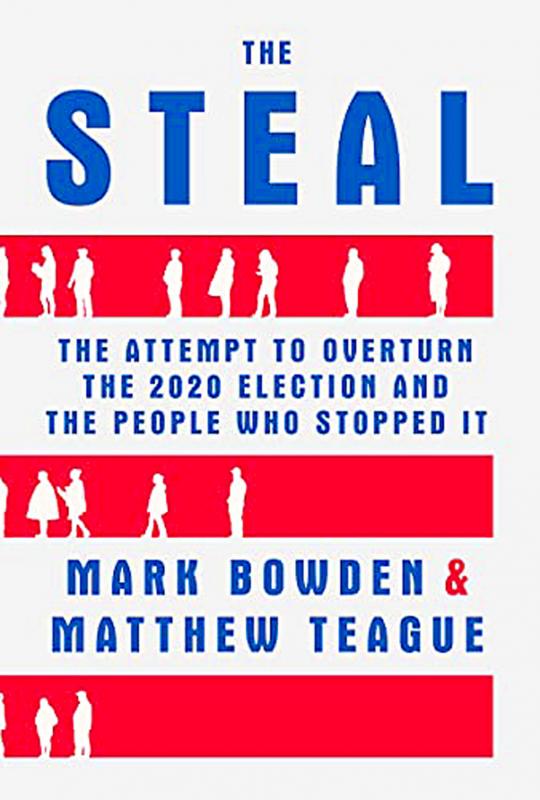
The attempted coup was led by Donald Trump. Its intended denouement, in which the vice-president, Mike Pence, would ignore the votes of the six states above plus Washington DC in order to swing the election to Trump, was outlined in an insane memo written by the lawyer John Eastman, described here as “surely the most seditious document to emerge from the White House in American history.”
That final act, of course, never happened. Not even Pence, the most sycophantic vice-president of modern times, could bring himself to violate the constitution so blatantly to keep his boss in the White House.
But the genuine heroes, brought to life here, were the “hundreds of obscure Americans from every walk of life, state and local officials, judges and election workers. Many of them were Republicans, some were Trump supporters. They refused to accept his slander of themselves, their communities and their workers, and they refused to betray their sworn duty to their office and their country. They were the real patriots.”
Bowden and Teague — the latter a Guardian contributor — take us through six battles that lasted from the night of the election, Nov. 3 2020, until Joe Biden’s election was finally certified by Congress early on Jan. 7 last year.
Their book performs a vital service, demonstrating just how well our tattered democracy managed to function despite vicious partisanship and all the new challenges created by the pandemic. For the first time, I understood how brilliantly new machines used to count the votes performed, the intricacies of opening outer and inner envelopes, capturing the images of both then preserving the vital paper ballots inside, making it possible to confirm electronic results with a hand count in case of any failure in technology.
In Arizona, the elections department conducted “the mandatory hand count of election day ballots from 2 percent of the vote centers and 1 percent of the early ballots as required by Arizona law and it yielded a 100 percent match to the results produced by the tabulation equipment.”
Scott Jarrett was co-director of elections in the populous Maricopa county, and he is one of the crucial bureaucrats celebrated here: “A pale slender young man … dressed in a plain gray suit, the very picture of an earnest functionary, a man happily engaged in the actual machinery of government and quietly proud of his own unheralded importance and competence.”
In a public hearing crowded with crazed conspiracy theorists, Jarrett carefully explained how only one of the two “encrypted memory cards (both with tamper-proof evidence seals)” was transported from various polling centers to the main counting location, “so that the results on one card could be double-checked against the other as well as the precinct ballot report they had generated. Backing up that memory were, of course, the actual ballots that had been run through the machines. The memory cards and the ballots were sealed and delivered by “two members of different parties,” escorted by county sheriffs.
Clint Hickman, chairman of the Maricopa county board of supervisors, noted that if the eyes of some in the audience were glazing over, he just wanted “people that are watching this” to understand “we don’t glaze over.”
The authors point out that Hickman was touching on a fundamental feature of The Steal, the factitious narrative concocted by Trump and his cronies: conspiracy theorists depend on ignorance.
“They begin with distrust: only a sucker believes the official story. They then replace the often tedious, mundane details of an intricate process … with a simpler narrative:” theft.
They invent colorful stories about a “deal struck with a late Venezuelan dictator to deliver tainted election machines, or a plot to preprint fake ballots in the dead of night.” This creates what cognitive scientists call “a community of knowledge.”
The big problem that didn’t exist even 30 years ago is the speed with which such idiotic stories are spread through the Internet and by the Twitter feed of a malevolent president like Trump, exploding the reach of such stories and their power to undermine democratic norms.
The book reminds us that democracy itself depends on a modicum of trust. That is why Trump’s ability to persuade so many Americans of the truth of so many lies has had such a disastrous effect on our body politic.
Bowden and Teague have performed a singular service by revealing the details that disprove Republicans’ unceasing inventions about voter fraud.
The problem is that so many Republicans will continue to ignore the lessons of this book. American democracy could still be destroyed by the torrent of voter suppression laws already passed by Republican-controlled state legislatures, spurred by lies invented by Trump and amplified by insidious “journalists” like Maria Bartiromo and Tucker Carlson, whose perfidy is brilliantly dissected in these pages.
If democracy does prevail, it will survive because of the ability of authors like Teague and Bowden to make the truth even more compelling than Fox News fictions.

It’s only half the size of its more famous counterpart in Taipei, but the Botanical Garden of the National Museum of Nature Science (NMNS, 國立自然科學博物館植物園) is surely one of urban Taiwan’s most inviting green spaces. Covering 4.5 hectares immediately northeast of the government-run museum in Taichung’s North District (北區), the garden features more than 700 plant species, many of which are labeled in Chinese but not in English. Since its establishment in 1999, the site’s managers have done their best to replicate a number of native ecosystems, dividing the site into eight areas. The name of the Coral Atoll Zone might

On Monday morning, in quick succession, the Chinese Communist Party (CCP) and the Chinese Nationalist Party (KMT) released statements announcing “that the Central Committee of the Communist Party of China and General Secretary Xi Jinping (習近平) have invited KMT Chairwoman Cheng Li-wun (鄭麗文) to lead a delegation on a visit to the mainland” as the KMT’s press release worded it. The KMT’s press release added “Chairwoman Cheng expressed her gratitude for the invitation and has gladly accepted it.” Beijing’s official Xinhua news release described Song Tao (宋濤), head of the Taiwan Work Office of the CCP Central Committee, as
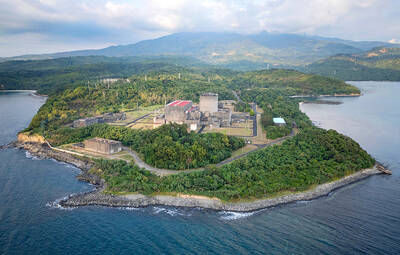
Nuclear power is getting a second look in Southeast Asia as countries prepare to meet surging energy demand as they vie for artificial intelligence-focused data centers. Several Southeast Asian nations are reviving mothballed nuclear plans and setting ambitious targets and nearly half of the region could, if they pursue those goals, have nuclear energy in the 2030s. Even countries without current plans have signaled their interest. Southeast Asia has never produced a single watt of nuclear energy, despite long-held atomic ambitions. But that may soon change as pressure mounts to reduce emissions that contribute to climate change, while meeting growing power needs. The
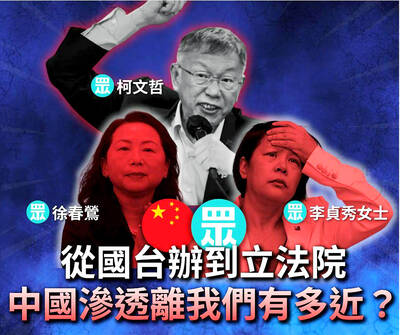
Last week saw Ko Wen-je (柯文哲), former Taipei mayor and founder of the Taiwan People’s Party (TPP), receive a 17-year sentence for crimes involving political corruption. This was only the opening round: the case is likely to drag on for several more years in appeals. Both the TPP and the Chinese Nationalist Party (KMT) are claiming that the prosecutors are engaging in a political witch hunt, green terror, fascism and so forth. It is easy to see this as a kind of compensation. After all, otherwise they would have to admit that the rather impressive collection of evidence against Ko actually


 RSS
RSS