


Her sexually explicit protests have been likened to pornography, but Ugandan activist and writer Stella Nyanzi says sex is the most effective — and entertaining — way to shake people out of their apathy.
“I learnt very early that there are some topics in Uganda that are tired and... the only way to capture attention is to introduce some shock value,” the 47-year-old said during an interview in Kampala.
And plenty of people have been shocked by Nyanzi’s methods, which range from calling President Yoweri Museveni “a pair of buttocks” to baring her breasts during a court hearing.
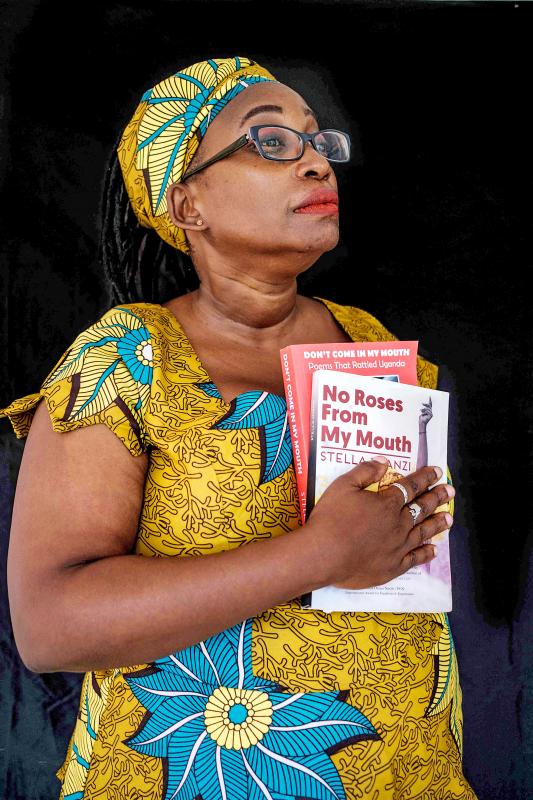
Photo: AFP
But the former university researcher, who holds a doctorate on sexuality in Africa and boasts nearly 300,000 followers on Facebook, is unrepentant.
“We don’t see or we pretend we don’t see what’s happening in society especially the excesses and the violations” under Museveni’s decades-long authoritarian rule, she said.
“To say to a violent, militant, brutal regime that you are violent, stop, does not (have) as much impact as to say ... fuck the rapist, militant penis of the dictatorship.”

Photo: AFP
She has paid a high price of her willingness to challenge authority — imprisoned for “cyber-harassment” in 2019 after she posted a profane poem on Facebook about Museveni and suffering a miscarriage after being beaten in jail.
Although she insists that her losses are “not worth writing home about,” grief is at the heart of her quest to bring down Museveni.
After losing her parents in quick succession six years ago — unable to find life-saving medicines or get an ambulance in time — Nyanzi turned to humor, in part to escape the overwhelming sadness that engulfed her.
In her hands however, humor has also become a weapon to channel her rage against a government she blames for the deaths of her parents and thousands of Ugandans who lack access to reliable health care and other public services.
RADICAL RUDENESS
A polarizing figure, Nyanzi has drawn scorn from religious conservatives, and even from some feminists, who criticize her relentless focus on sex.
“I am tired of feminists telling me how I am wrong and how I can’t do this and how this is anti-feminist,” she said.
“Just allow me to be free, to do my own thinking and my own protest,” she said, pointing out that her no-holds-barred approach to sexuality is based in pre-Christian Ugandan culture and aimed at empowering women by encouraging them to discuss taboo subjects.
Her tactics also borrow from a political tradition of “radical rudeness,” which has its roots in the country’s anti-colonial struggle.
And while her blistering online diatribes comparing Museveni’s regime to parasitic pubic lice have earned her the tag of “Uganda’s rudest woman,” the strategy has also made her a social media star outside the country.
Online threats from pro-government trolls don’t faze her.
“I am not looking for love and hugs,” she said. “I go to social media very consciously and very purposefully to speak truth to power, truth which our traditional public media no longer speaks.”
Furthermore, the toxic rhetoric she encounters pales in comparison to the very real risks faced by many activists in Uganda.
Nyanzi fled to Kenya earlier this year after her partner was allegedly abducted and tortured. Although she has since returned to Kampala, she is contemplating the possibility of a life in exile to protect her three children.
‘HOPE KEEPS ME GOING’
But the self-described optimist, who contested parliamentary elections in January and lost, has no plans to throw in the towel.
“The hope that (Uganda) can change and may become better for the next generation keeps me going,” she said.
With a median age that is less than 16, most Ugandans have no memory of life before Museveni. The former rebel seized power in 1986, after toppling two presidents.
At 77, he belongs firmly to her “father’s generation,” Nyanzi said.
“Museveni is living on borrowed time... his family and his system will one day be out of power.”
When that happens, she hopes that her compulsion to protest will also become a thing of the past.
But until then, she stands ready and armed with an arsenal of explicit imagery designed to shock and provoke change.
“What I am doing is not erotica and it’s not pornography. It’s rage and the expression of rage using my body.”

The Portuguese never established a presence on Taiwan, but they must have traded with the indigenous people because later traders reported that the locals referred to parts of deer using Portuguese words. What goods might the Portuguese have offered their indigenous trade partners? Among them must have been slaves, for the Portuguese dealt slaves across Asia. Though we often speak of “Portuguese” ships, imagining them as picturesque vessels manned by pointy-bearded Iberians, in Asia Portuguese shipping between local destinations was crewed by Asian seamen, with a handful of white or Eurasian officers. “Even the great carracks of 1,000-2,000 tons which plied
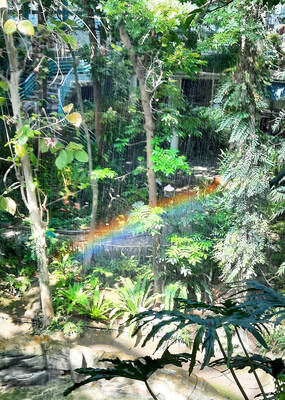
It’s only half the size of its more famous counterpart in Taipei, but the Botanical Garden of the National Museum of Nature Science (NMNS, 國立自然科學博物館植物園) is surely one of urban Taiwan’s most inviting green spaces. Covering 4.5 hectares immediately northeast of the government-run museum in Taichung’s North District (北區), the garden features more than 700 plant species, many of which are labeled in Chinese but not in English. Since its establishment in 1999, the site’s managers have done their best to replicate a number of native ecosystems, dividing the site into eight areas. The name of the Coral Atoll Zone might

On Monday morning, in quick succession, the Chinese Communist Party (CCP) and the Chinese Nationalist Party (KMT) released statements announcing “that the Central Committee of the Communist Party of China and General Secretary Xi Jinping (習近平) have invited KMT Chairwoman Cheng Li-wun (鄭麗文) to lead a delegation on a visit to the mainland” as the KMT’s press release worded it. The KMT’s press release added “Chairwoman Cheng expressed her gratitude for the invitation and has gladly accepted it.” Beijing’s official Xinhua news release described Song Tao (宋濤), head of the Taiwan Work Office of the CCP Central Committee, as
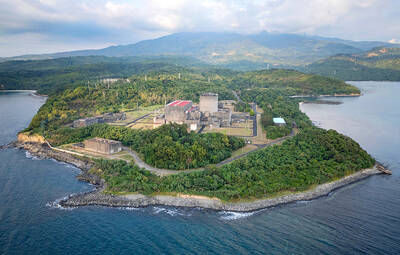
Nuclear power is getting a second look in Southeast Asia as countries prepare to meet surging energy demand as they vie for artificial intelligence-focused data centers. Several Southeast Asian nations are reviving mothballed nuclear plans and setting ambitious targets and nearly half of the region could, if they pursue those goals, have nuclear energy in the 2030s. Even countries without current plans have signaled their interest. Southeast Asia has never produced a single watt of nuclear energy, despite long-held atomic ambitions. But that may soon change as pressure mounts to reduce emissions that contribute to climate change, while meeting growing power needs. The


 RSS
RSS