


The transcontinental odyssey of Little Amal will begin its final stage this week when the giant puppet of a nine-year-old Syrian girl reaches the shores of the UK after walking thousands of miles across Europe.
Bells will chime and choirs will sing as Little Amal appears on the beach today in Folkestone, Kent, after making the same cross-Channel journey that has been taken so far this year by more than 17,000 people seeking refuge from conflict, hunger and persecution. On the last leg of her journey, Little Amal will visit Canterbury, London, Oxford, Coventry, Birmingham, Sheffield and Barnsley before the extraordinary and complex 14-week traveling street theater ends in Manchester on Nov. 3.
“It’s been challenging, it’s been difficult at times, but it’s also been amazing and incredible,” said David Lan, one of the producers of The Walk, who has been “on this journey right from the beginning three years ago, and on every step of the way” since Little Amal left Gaziantep near the Turkish-Syrian border at the end of July.
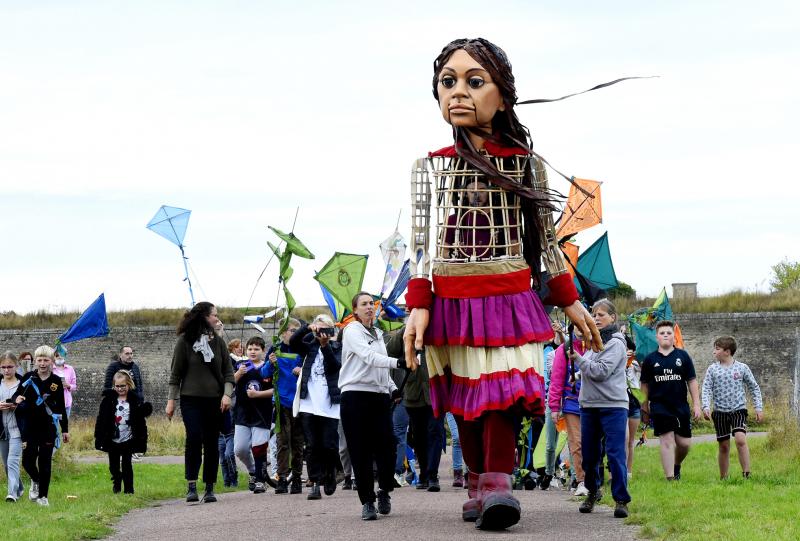
photo: AFP
The idea of Little Amal’s journey in search of her missing mother evolved from The Jungle, a highly acclaimed play about young refugees in a camp near Calais that opened at the Young Vic in London in 2017. The play’s producers, the Good Chance theatre company plus Lan, Stephen Daldry and Tracey Seaward, came up with the idea of taking its message of displacement, loss, dignity and hope to villages, towns and cities across Europe.
HOPE FOR THE MARGINALIZED
Little Amal, whose name means hope in Arabic, was created by Handspring, the company that made the equine puppets in War Horse. She stands 3.5m tall and is operated by a team of eight puppeteers working shifts to control her legs, arms and facial features. “They create the emotional life of the puppet,” said Lan.
Since leaving Gaziantep, Little Amal and her entourage of about 25 people have navigated COVID-19 border requirements to cross from Turkey to Greece and then through Italy, Switzerland, Germany, Belgium and France to the UK.
Along the way, they have taken part in concerts, parties and workshops. In Rome, Little Amal was blessed by Pope Francis. In many places, thousands of local people have walked with her through their town or village.
But the most powerful connections had been with refugees, said Lan. “People who are marginalized, shoved to the side, see a representative of themselves or their children center-stage and being celebrated. That’s very moving.”
Only in one place has the welcome been less than warm. In Kalambaka, a village in northern Greece, which is home to ancient Greek Orthodox monasteries built into rocks, the village council decided not to receive a “Muslim doll from Syria,” as the mayor described Amal. “It’s distressing, but it’s how the world is,” said Lan.
BIRTHDAY IN LONDON
In London, Little Amal will celebrate her 10th birthday on Sunday at a party at the Victoria and Albert Museum. Children from all over the capital have been invited to join in musical performances and workshops.
Yotam Ottolenghi is coordinating a team of chefs to create a giant birthday cake consisting of several hundred cupcakes in a rainbow of colors and flavors.
Ottolenghi said: “Telling the stories of refugees in general and that particular journey that Amal is taking is such a positive thing in a very bleak situation. She’s going to meet lots of London kids who are going to celebrate her birthday and get a glimpse into her journey. And what better way to do it than with a patchwork of little cakes that have been baked by different chefs?”
Lan, who described Little Amal’s journey as a theatrical show on an 8,000km stage, said there had been no major technical problems so far, but there had been many logistical challenges in traveling, rehearsing and performing across eight countries.
“It’s a travelling circus, a big touring show. So many people have wanted to be part of it. There has been tremendous goodwill directed towards us.
“We’re not politicians, we’re saying to people: remember refugees are people. We hope that the memory of this odd, beautiful child walking through a village or city or over the mountains helps change the weather a little bit.”

Yesterday, the Democratic Progressive Party (DPP) nominated legislator Puma Shen (沈伯洋) as their Taipei mayoral candidate, the Chinese Nationalist Party (KMT) put their stamp of approval on Wei Ping-cheng (魏平政) as their candidate for Changhua County commissioner and former legislator Tsai Pi-ru (蔡壁如) of the Taiwan People’s Party (TPP) has begun the process to also run in Changhua, though she has not yet been formally nominated. All three news items are bizarre. The DPP has struggled with settling on a Taipei nominee. The only candidate who declared interest was Enoch Wu (吳怡農), but the party seemed determined to nominate anyone

In a sudden move last week, opposition lawmakers of the Chinese Nationalist Party (KMT) and Taiwan People’s Party (TPP) passed a NT$780 billion special defense budget as a preemptive measure to stop either Chinese leader Xi Jinping (習近平) or US President Donald Trump from blocking US arms sales to Taiwan at their summit in Beijing, said KMT heavyweight Jaw Shaw-kong (趙少康), speaking to the Taipei Foreign Correspondents Club on Wednesday night in Taipei. The 76-year-old Jaw, a political talk show host who ran as the KMT’s vice presidential candidate in 2024, says that he personally brokered the deal to resolve
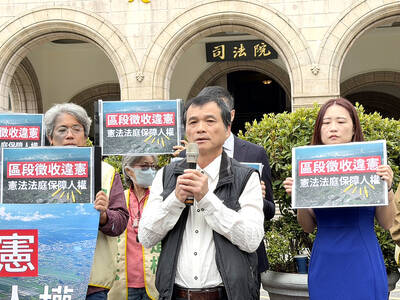
What government project has expropriated the most land in Taiwan? According to local media reports, it is the Taoyuan Aerotropolis, eating 2,500 hectares of land in its first phase, with more to come. Forty thousand people are expected to be displaced by the project. Naturally that enormous land grab is generating powerful pushback. Last week Chen Chien-ho (陳健和), a local resident of Jhuwei Borough (竹圍) in Taoyuan City’s Dayuan District (大園) filed a petition for constitutional review of the project after losing his case at the Taipei Administrative Court. The Administrative Court found in favor of nine other local landowners, but
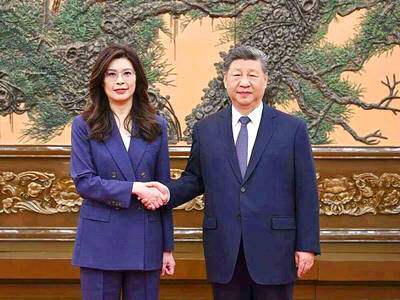
The Chinese Nationalist Party (KMT), alongside their smaller allies the Taiwan People’s Party (TPP), are often accused of acting on behalf of the Chinese Communist Party (CCP). Some go so far as to call them “traitors.” It is not hard to see why. They regularly pass legislation to stymie the normal functioning of the ruling Democratic Progressive Party’s (DPP) administration, and they have yet to pass this year’s annual budget. They slashed key elements of the government’s proposed NT$1.25 trillion (US$40 billion) special military budget, and in the smaller NT$780 billion package they did pass, it is riddled with provisions that


 RSS
RSS