


Buses are an unloved yet essential part of the transportation mix.
Even in cities with well-developed metro systems, there are numerous places where taking a bus is the only alternative to using a private vehicle, walking or hailing a taxi. The London Underground serves 270 stations, yet bus ridership in the UK capital exceeds metro ridership by over 50 percent.
If Taiwan is going to significantly reduce its dependence on cars and motorcycles — which it should try very hard to do, so as to reduce carbon emissions, air pollution, congestion and road accidents — buses will be the largest part of the solution.
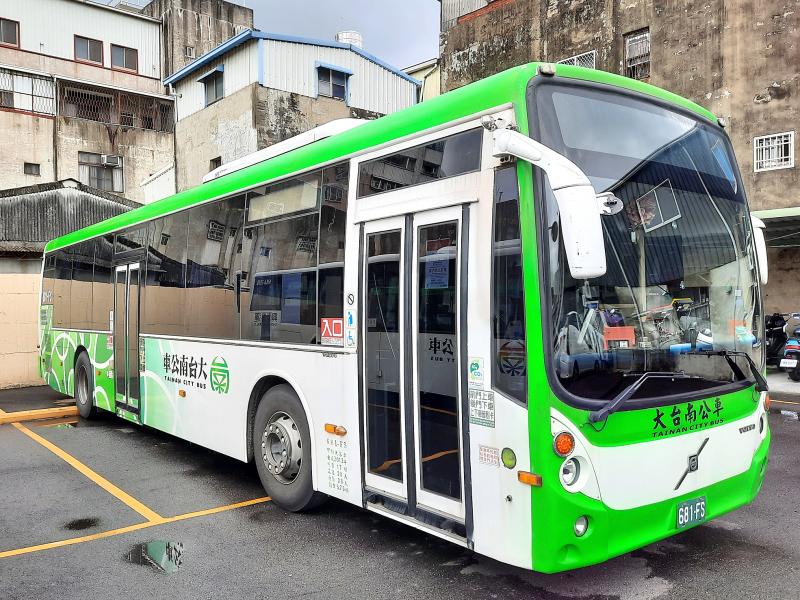
Photo: Steven Crook
According to 2019 figures from the UK’s Department for Business, Energy and Industrial Strategy, the carbon footprint per kilometer of a person traveling in a gasoline-burning car is almost double that of a bus passenger. Other sources suggest the environmental advantage of buses is much greater. Electric buses are also more energy efficient than electric or hybrid cars.
Like people throughout the richer part of the world, Taiwanese aren’t willing to cycle or walk significant distances to get to work. MRT (mass rapid transit) or LRT (light rail transit) systems offer speedy journeys, but along narrow corridors and at great expense. What’s more, completion often comes years behind schedule.
To be fair, bus services in some parts of Taiwan are better now than they were a decade or more ago.
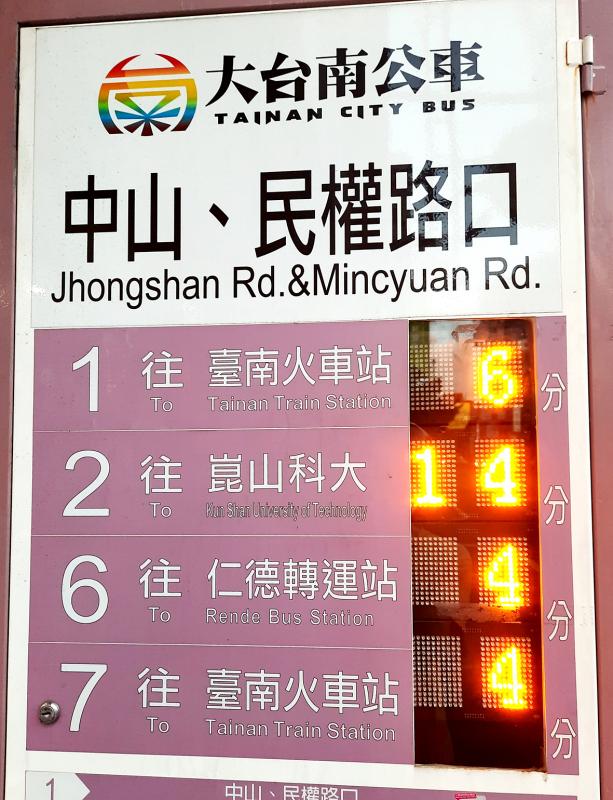
Photo: Steven Crook
In Tainan, where public transportation has long lagged behind other major cities, expanding bus routes and service frequency helped drive ridership from barely 7.5 million in 2011 to about 23 million per year before the pandemic.
Tainan’s buses are cleaner and more comfortable than they used to be. Dozens of “intelligent stops” now display estimated (and usually quite accurate) arrival times for buses, removing at a stroke some of the frustration associated with this mode of travel. Yet the city’s streets are still often clogged with cars and motorcycles.
Installing USB sockets, so bus passengers can recharge electronic devices during their journeys, won’t inspire many to ditch their scooters. Getting more people onto buses is difficult — and not just because no one wants to risk rolling up to a contract signing a few minutes late, out of sorts after strap-hanging their way across the city.
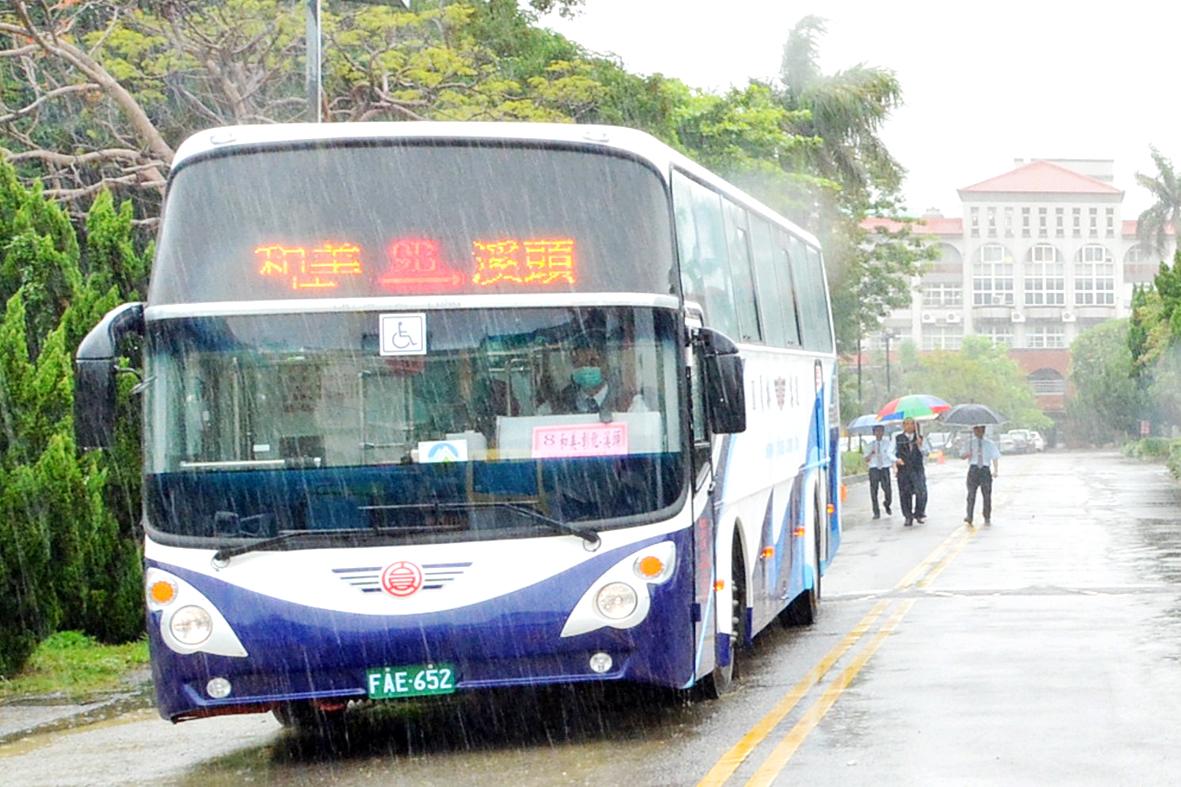
Photo: Chang Tsung-chiu, Taipei Times
Many citizens say they avoid using buses because: services are often delayed; the nearest stop is too far away; they dislike waiting in the rain or under a strong sun; or for a combination of these reasons.
FLEXIBLE FLEETS
Chiu Bing-yu (邱秉瑜) is familiar with such complaints. A PhD candidate in City and Regional Planning at the University of Pennsylvania, he has looked at policies that can draw people onto buses, as well as those which can deter them from using their own vehicles.
Saying there’s a lack of integration among the different forms of transportation that serve Taipei, Chiu argues in favor of establishing a single government agency along the lines of Transport for London (TfL). Noting that other cities have set up similar bodies, he says, “If Taiwan’s cities want to reduce transportation chaos, they should be able to learn something worthwhile from TfL.”
Chiu favors adding smaller buses to fleets, to serve additional routes and provide more frequent services.
“Deregulating the bus market to allow additional private companies to run and even design these small-bus routes would also be a good idea,” says the Taipei native.
Chiu points to the thousands of minivans in Hong Kong that provide a mix of fixed-fare/fixed-route services and more flexible share-taxi services.
Two of Chiu’s other recommendations would be much more difficult to implement, given the overbuilt character of Taiwan’s urban areas.
“All bus stops should be accessible through continuous sidewalks within, say, 300m,” he says, adding that planners in cities like Barcelona have concluded the majority of bus users aren’t willing to walk any farther.
Chiu hopes more thought can be put into the positioning of bus stops, to better attract potential riders. Streets surrounding traditional morning markets, he says, are often jammed with motorcycles, because bus travel isn’t a good option.
BRT (bus rapid transit) systems have been highly successful in Brazil, Columbia, Indonesia and some other countries. BRT lines differ from regular bus routes in that they’re segregated from (and not held back by) other traffic. The vehicles themselves may be articulated and able to carry 150 or more passengers. Some BRT stops are air-conditioned.
In Taiwan, most people associate the letters BRT with a brief experiment in Taichung. Inaugurated on July 28, 2014, when Jason Hu (胡志強) of the Chinese Nationalist Party (KMT) was mayor, the city’s 17km-long BRT line was shut down 345 days later by Hu’s successor, Lin Chia-lung (林佳龍) of the Democratic Progressive Party (DPP).
Chiu describes the Taichung BRT as, “an interesting technical case, and a very politicized one. It was the only ‘real’ BRT in Taiwan. Chiayi’s BRT has the name, but hardly any of the key features of a BRT system.”
Dedicated rights-of-way for buses on some of the capital’s major roads reduce travel times, and are a kind of “BRT lite,” he says.
Talk of establishing up to four BRT lines in Kaohsiung has come to nothing, and in recent years no other local governments have shown an interest in this type of transit.
BRT shouldn’t be seen as a better way of operating bus services, Chiu says, but instead as a lower-cost/quicker-to-build alternative to MRT and LRT lines.
REDUCING VEHICULAR TRAFFIC
Asked if eliminating city-center parking for cars and motorcycles, so as to force people to take the bus, would be a good move, Chiu says he would prefer to increase parking charges, or more strictly limiting the amount of time a vehicle can stay parked at one spot.
He also thinks Taiwan’s bigger cities should look into tolling systems like London’s Congestion Charge and Singapore’s Electronic Road Pricing. These not only discourage car use; they also generate revenue that can be reinvested in public transportation.
There’s no reason why a bus should follow precisely the same route every time, if it means more people can be served. Current technology could make booking and planning detours to pick up or let off passengers straightforward.
Flexible pricing, akin to the pricing algorithms employed by ride-hailing services, could be applied to win over those whose journeys might become a little longer as a result — and to encourage people to use buses when they’re half empty.
The people who’d benefit most from what are called demand-responsive transportation services (DRTS) are those who live far from urban centers. In some rural townships in east Taiwan, such as Yuli (玉里), taxis contracted by the local authorities already provide this kind of service.
In thinly populated areas, the government should look at whether bus routes can be consolidated with other public services.
In several parts of Europe, postbuses have provided both public transportation and mail delivery services. In mountainous parts of Switzerland, where conventional bus services would be uneconomic, there are still hundreds of routes.
A network of post office minibuses serving remote upland communities like Wujie (武界) in Nantou or Lijia (里佳) in Chiayi would reduce duplicated journeys and give more options to citizens who deserve public transportation just as much as the residents of Taipei.
Steven Crook, the author or co-author of four books about Taiwan, has been following environmental issues since he arrived in the country in 1991. He drives a hybrid and carries his own chopsticks.
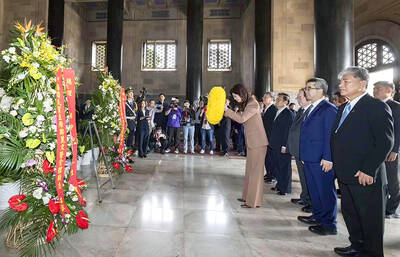
The problem with Marx’s famous remark that history repeats itself, first as tragedy, the second time as farce, is that the first time is usually farce as well. This week Chinese Nationalist Party (KMT) Chair Cheng Li-wun (鄭麗文) made a pilgrimage to the People’s Republic of China (PRC) “to confer, converse and otherwise hob-nob” with Chinese Communist Party (CCP) officials. The visit was an instant international media hit, with major media reporting almost entirely shorn of context. “Taiwan’s main opposition leader landed in China Tuesday for a rare visit aimed at cross-strait ‘peace’”, crowed Agence-France Presse (AFP) from Shanghai. Rare!

What is the importance within the Chinese Nationalist Party (KMT) of the meeting between Xi Jinping (習近平), the leader Chinese Communist Party (CCP), and Cheng Li-wun (鄭麗文), the leader of the KMT? Local media is an excellent guide to determine how important — or unimportant — a news event is to the public. Taiwan has a vast online media ecosystem, and if a news item is gaining traction among readers, editors shift resources in near real time to boost coverage to meet the demand and drive up traffic. Cheng’s China trip is among the top headlines, but by no means

Sunflower movement superstar Lin Fei-fan (林飛帆) once quipped that the Democratic Progressive Party (DPP) could nominate a watermelon to run for Tainan mayor and win. Conversely, the DPP could run a living saint for mayor in Taipei and still lose. In 2022, the DPP ran with the closest thing to a living saint they could find: former Minister of Health and Welfare Chen Shih-chung (陳時中). During the pandemic, his polling was astronomically high, with the approval of his performance reaching as high as 91 percent in one TVBS poll. He was such a phenomenon that people printed out pop-up cartoon
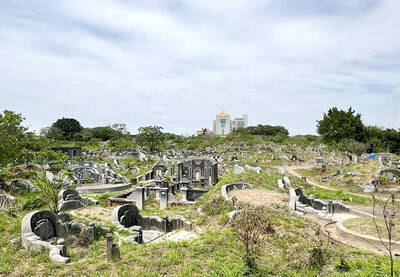
Apr. 13 to Apr. 19 From 17th-century royalty and Presbyterian missionaries to White Terror victims, cultural figures and industrialists, Nanshan Public Cemetery (南山公墓) sprawls across 95 hectares, guarding four centuries of Taiwan’s history. Current estimates show more than 60,000 graves, the earliest dating to 1642. Besides individual tombs, there are also hundreds of family plots, one of which is said to contain around 1,000 remains. As the cemetery occupies valuable land in the heart of Tainan, the government in 2018 began asking families to relocate the graves to make way for development. That


 RSS
RSS