


Several years ago I was involved in a travel show that paid a visit to Wuling Farm (武陵農場), a lovely tourist spot high up in the central mountains, famous for hosting a small population of the Formosan landlocked salmon, one of the world’s rarest fish. We had missed the cherry blossoms, another attraction of the farm, and I queried our guide, a farm official, about the effect of climate change on the blossom schedule. He shook his head. “Everything has become unpredictable.”
This unpredictability is at the heart of the paradoxes of human warming of the earth: its effects are at once inevitable and uncertain, straightforward and variegated, local and global. Yet there is one constant in all this change: the changing sea.
Scary prospect for an island nation.
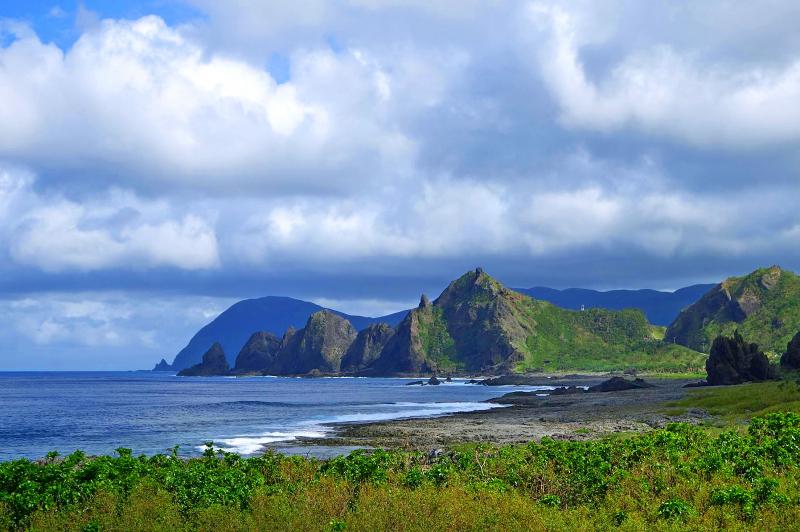
Photo: Michael Turton
Heating the earth has three major effects on the ocean: sea level rise, increased ocean temperatures, and ocean acidification. The first two are widely known to the public, but the third, just as devastating, is often left out of major media presentations.
Sea level rise is the most familiar to the public. Depending on which path humans take to ameliorate greenhouse gas outputs, the oceans will rise at least 0.3 to 1 meter by the end of the century (remember, sea level rises don’t stop in 2100, only the calculations do).
Of course Taiwan will suffer from this. According to a recent paper from Chiu Ming-chih (丘明智), Pan Ching-wen (潘靖汶) and Lin Hsing-juh (林幸助), by 2039, the sea level will rise over 3cm all around Taiwan, the ocean surface temperature will rise around 0.7 degrees Celcius, and the pH of coast waters will fall by 0.05 to 0.07. These changes will have powerful effects on coastal ecosystems that many Taiwanese depend on for incomes and leisure.
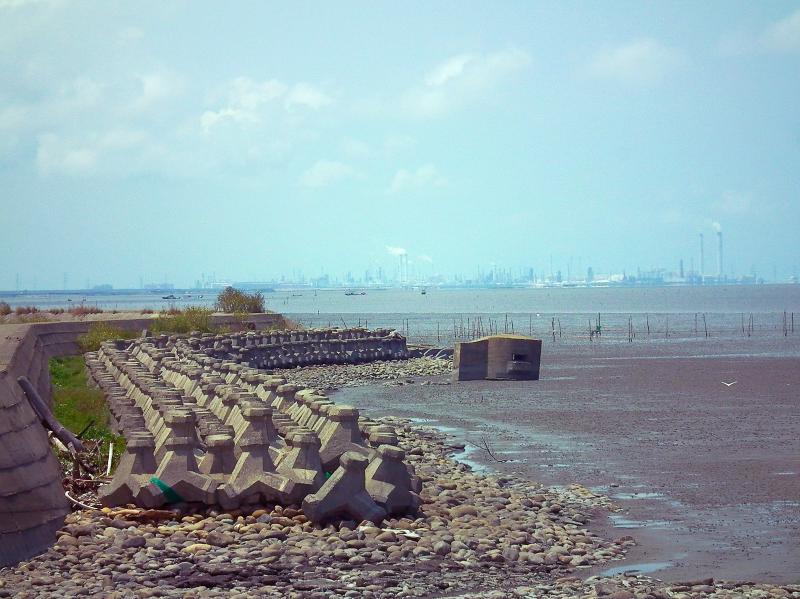
Photo: Michael Turton
SEA LEVEL RISE
Certain parts of Taiwan are especially vulnerable to sea level rise. In Yunlin County, for example, there are over 100,000 wells, “more than 90 percent of which were dug without confirming water rights or applying for permission to build hydraulic facilities, as required by the Irrigation Act,” a commentary on them several years ago noted.
This frenetic groundwater pumping for agriculture and aquaculture has caused massive subsidence along the south-central coast of Taiwan, up to a meter every five years near the coast. Because of this, sea level rises will top 5cm by 2039 along the south-central coast, according to a recent study. This will cause waves driven by storm surges to rise an average of nearly 36 percent, with large rises in maximum deviations from this average.
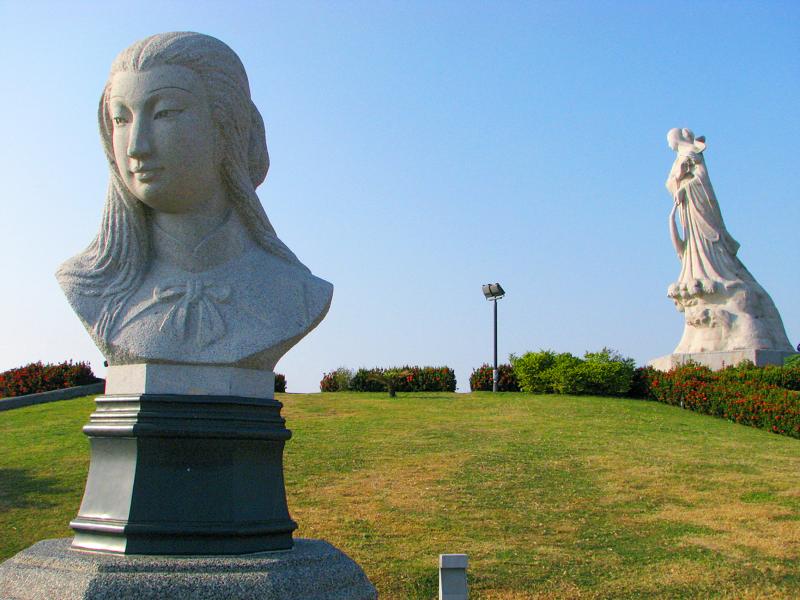
Photo: Michael Turton
Essentially, the waters will rise in predictable ways, and the nasty waves will get nastier, in less predictable ways. The result, according to the study, will be that seawalls will be overtopped, though not seriously in this period, especially in Wuqi (梧棲), Lukang (鹿港), Mailiao (麥寮), and Taisi (台西) townships.
Mailiao is the site of the massive oil refinery on reclaimed land jutting out into the ocean, while Wuqi and Lukang are ports with significant tourism.
Southwestern Taiwan is just as vulnerable. For years the center of the island’s aquaculture industry (in its heyday in the 1990s, 1.5 percent of the island’s land area was given over to aquaculture), groundwater extraction has caused widespread subsidence. Typhoon Morakot in 2009 threw a spotlight on the problem with its massive flooding, but climate change will inexorably result in greater frequency of flooding and eventual drowning of much of the area near the sea if nothing is done.
But again, this sea level rise doesn’t stop in 2100 when the calculations do. Taiwan’s coastal flooding problems will only worsen as time goes on.
Flooding is just one effect — as the rising ocean reshapes Taiwan’s coastline, it also reshapes the invasion risk from China. One expert I talked to pointed out that higher sea levels will require reconstruction and raising of sea walls. This will compel closer civil-military cooperation in construction.
“Breakwater projects in areas like Linyuan Beach near Kaohsiung Airport and farther south around Fangliao (枋寮), for example, have already made them a much tougher target for amphibious landings,” he said.
It goes without saying that like the naval bases of every other nation, Taiwan’s ports and naval bases will eventually have to be reconstructed or relocated as the ocean consumes them.
OCEAN HEATING AND ACIDIFICATION
Then there is ocean heating. As humans cook the oceans, Taiwan will face food security issues. According to a study by Japanese and Taiwanese scholars, ocean heating is already affecting Taiwan’s fish catch. Accelerated sea surface warming has reduced the catch of winter and spring fish, meaning that spring and autumn fish are now the dominant take. The 20 degrees centigrade line in the Taiwan Strait in the winter has shifted in latitude from around 23 degrees north in 1958 to north of 25 degrees north in 1998. It will continue to move north, pushing cold water fish further north.
Coastal and offshore fisheries account for just under 20 percent of Taiwan’s total seafood supply, with imports supplying the bulk (a share that is growing over time). Taiwan’s distant-water fishing fleet exports almost all of its catch, bringing back just over 5 percent of Taiwan’s seafood supply. Since seafood accounts for 37 percent of the animal protein intake of Taiwanese, it follows that the changing ocean will mean greater food insecurity for Taiwan, which is dependent on imports for most of its food (recall that much animal feed is imported as well).
Moreover, as the aforementioned study points out, among the major seafood exporters to Taiwan are China, India, Vietnam, Thailand, Indonesia, and Chile, all located in the hot zone where warming will have powerfully negative effects on local fish catches.
The heating ocean will also bring us devastating storms whose effects on trade and tourism are at present difficult to foresee. But they will not be good for an island dependent on trade.
Intensifying the effects of warming is ocean acidification. Carbon dioxide produced by humans interacts with sea water to form carbonic acid, some of which disassociates to form bicarbonate and hydrogen ions, slowly making the oceans more acidic. Acidification reduces the ability of shellfish and other organisms that make calcium carbonate shells to form shells. Ocean acidification has already been linked to at least one mass extinction event in the planet’s history.
Scholarly work in Australian waters shows that the impact of acidification will be greatest in areas that are already intensively fished. Such areas supply Taiwan with seafood for both home and export uses. It will also clobber Taiwan’s coastal ecosystems.
“For most of history, man has had to fight nature to survive; in this century he is beginning to realize that, in order to survive, he must protect it,” remarked famed oceanic explorer Jacques-Yves Cousteau. It is easy to dismiss Taiwan as a mere pebble in the path of a flood, but as the island nation’s remarkable performance in reining in COVID-19 shows, our little island has the potential for outsized global impact on urgent international issues. Time to turn our experts loose on the island’s intolerable levels of carbon production, and show the world that Taiwan can lead on that issue as well.
Because just off our shores, a monster is rising.
Long-time resident Michael Turton provides incisive commentary informed by three decades of living in and writing about Taiwan.

May 18 to May 24 Gathered on Yangtou Mountain (羊頭山) on Dec. 5, 1972, Taiwan’s hiking enthusiasts formally declared the formation of the “100 Peaks Club” (百岳俱樂部) and unveiled the final list of mountains. Famed mountaineer Lin Wen-an (林文安) led this effort for the Chinese Alpine Association (中華山岳協會). Working with other experienced climbers, he chose 100 peaks above 10,000 feet (3,048m) that featured triangulation points and varied in difficulty and character. The list sparked an alpine hiking craze, inspiring many to take up mountaineering and competing to “conquer” the summits. A common misconception is that the 100 Peaks represent Taiwan’s 100 tallest

Yesterday, the Democratic Progressive Party (DPP) nominated legislator Puma Shen (沈伯洋) as their Taipei mayoral candidate, the Chinese Nationalist Party (KMT) put their stamp of approval on Wei Ping-cheng (魏平政) as their candidate for Changhua County commissioner and former legislator Tsai Pi-ru (蔡壁如) of the Taiwan People’s Party (TPP) has begun the process to also run in Changhua, though she has not yet been formally nominated. All three news items are bizarre. The DPP has struggled with settling on a Taipei nominee. The only candidate who declared interest was Enoch Wu (吳怡農), but the party seemed determined to nominate anyone

In a sudden move last week, opposition lawmakers of the Chinese Nationalist Party (KMT) and Taiwan People’s Party (TPP) passed a NT$780 billion special defense budget as a preemptive measure to stop either Chinese leader Xi Jinping (習近平) or US President Donald Trump from blocking US arms sales to Taiwan at their summit in Beijing, said KMT heavyweight Jaw Shaw-kong (趙少康), speaking to the Taipei Foreign Correspondents Club on Wednesday night in Taipei. The 76-year-old Jaw, a political talk show host who ran as the KMT’s vice presidential candidate in 2024, says that he personally brokered the deal to resolve

The Chinese Nationalist Party (KMT), alongside their smaller allies the Taiwan People’s Party (TPP), are often accused of acting on behalf of the Chinese Communist Party (CCP). Some go so far as to call them “traitors.” It is not hard to see why. They regularly pass legislation to stymie the normal functioning of the ruling Democratic Progressive Party’s (DPP) administration, and they have yet to pass this year’s annual budget. They slashed key elements of the government’s proposed NT$1.25 trillion (US$40 billion) special military budget, and in the smaller NT$780 billion package they did pass, it is riddled with provisions that


 RSS
RSS