


What sort of science fiction does Xi Jinping (習近平) like? How can China’s weathermen use the president’s political philosophy to improve their forecasts? In what ways can “Xi Thought” help prepare the country for the next big earthquake?
These are the sorts of questions Communist Party cadres are now pondering as they prepare for the next big milestone in the president’s effort to cement control: Elevating Xi Thought alongside Maoism. The esoteric concept is expected to be written into the five-year development blueprint that will be unveiled after party meetings later this month.
Everyone from diplomats to executives to sci-fi writers are under pressure to incorporate the broad, often fuzzy tenets of Xi Thought into their policies.
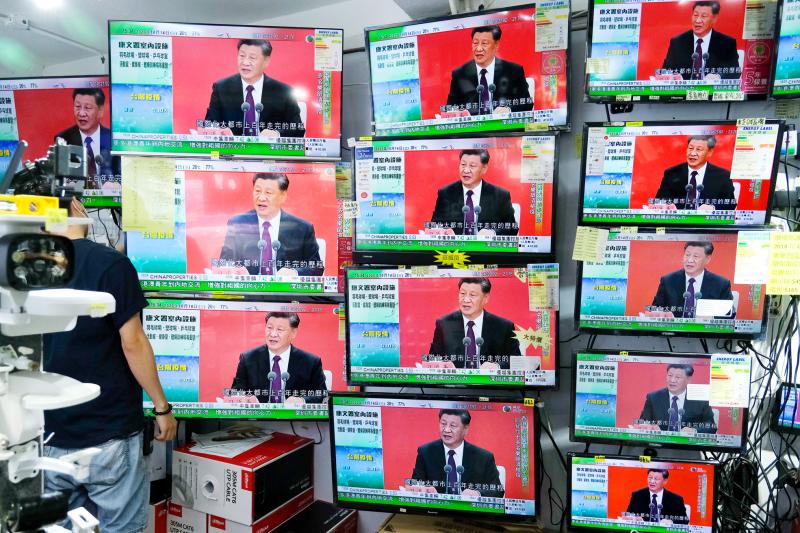
photo: Bloomberg
The project is central to Xi’s effort to quiet opposition and to stay on past 2022, when he’s expected to seek a third five-year term as party chief.
Once Xi has his own “-ism,” the theory goes, he’ll be elevated to a political standing on par with Mao Zedong (毛澤東), whose portrait hangs over Tiananmen Square and is printed on the currency. It will also make it all-the-more difficult to question his edicts.
“Its importance lies in prominently raising Xi’s personal profile,” said Carl Minzner, a professor at Fordham Law School who specializes in Chinese law and governance. “Every time the command to study it is uttered on TV, and every time is written in a party document, it is a highly visible signal to both party officials and citizens at large as to who is on top, and whose orders actually matter.”
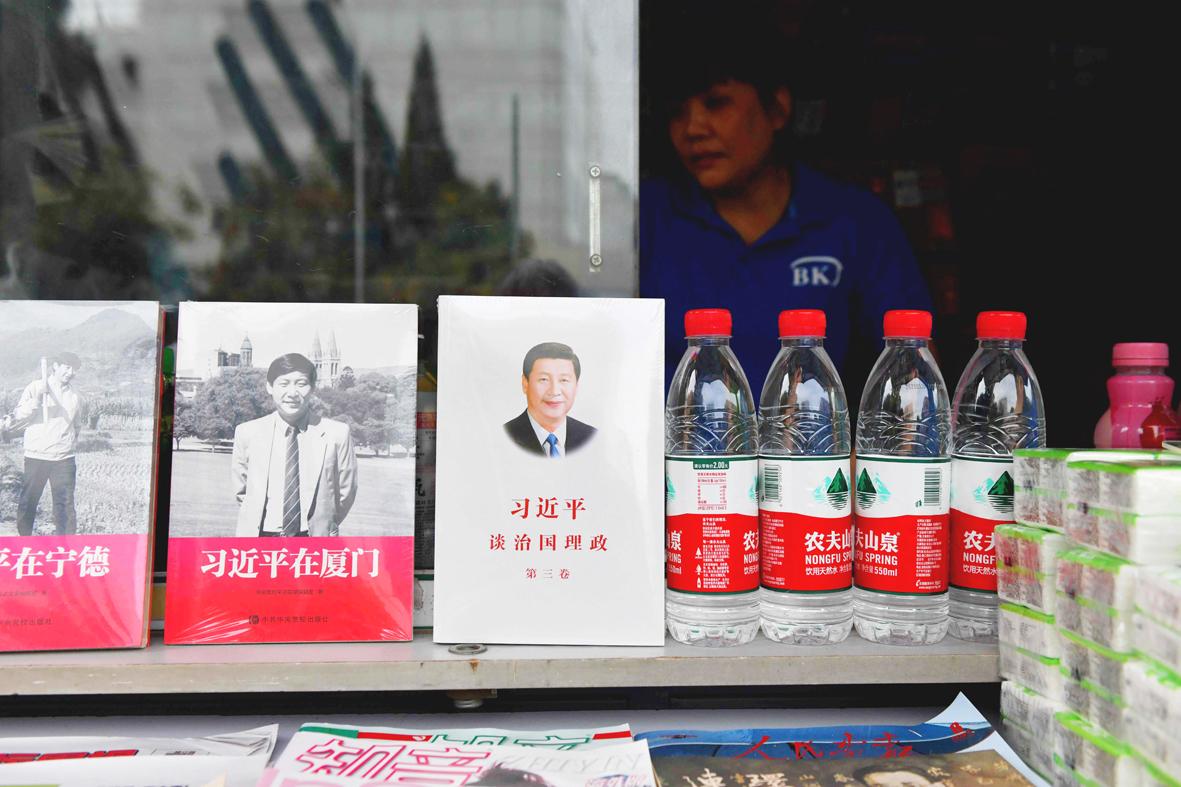
photo: AFP
TAKING SHAPE
While some key tenets of Mao’s philosophy are included in the iconic Little Red Book, Xi Thought is still being shaped and yet to be compiled in one place, although the three-volume Xi Jinping: The Governance of China — a collection of his speeches, writings, sayings and ideas — contains clues.
More than 20 applications of Xi Thought on everything from economic management and military reform to controlling the media and the arts that have appeared in state media since 2018, according to Qian Gang (錢鋼), director of University of Hong Kong’s China Media Project.
The more tangible examples of Xi Thought include his views on the environment, encapsulated in the slogan: “Green hills and clear rivers are gold and silver mountains.”
Chinese foreign policy-related statements are typically sprinkled with another phrase that amplifies the goal of building a global “community with a shared future for mankind” — referring to more countries, including China, having their say in world affairs. His ambition for the military: “Building a strong army.”
The effort to make Xi Thought a guiding principle for nearly every aspect of Chinese life will loom over a conclave of some 300 top party leaders slated to begin Monday in Beijing. For the first time they’ll also draft a longer-term blueprint that runs until 2035, in the latest indication of how long Xi, 67, could lead.
He Lifeng (何立峰), the chairman of the National Development and Reform Commission, wrote in the party-run People’s Daily newspaper last month that Xi’s thinking on the economy was a “powerful weapon to withstand major risks and challenges, and solve major problems.” The leader’s ideas should be studied and adopted as guidance when drafting five-year plans, He said.
COMPANIES GET IN LINE
That’s forcing companies, agencies and schools to contemplate what Xi-ism means for them. Where Mao Zedong Thought was geared toward adapting Marxist-Leninism to a pre-industrial society, Xi Thought is concerned with maintaining party control more than four decades after China opened to the world and began to experiment with market forces. Almost 400 of some 3,900 listed companies in China paid homage to the Communist Party and its leader in their annual reports this year, the Economist reported.
The push began three years ago, when Xi got the unwieldy “Xi Jinping Thought on Socialism With Chinese Characteristics for a New Era” written into the party charter and Chinese constitution. Around the same time, he pushed through an amendment scrapping constitutional provisions that would’ve forced him to hand over the presidency in 2023.
During a visit by Xi last week to the southern manufacturing hub of Guangdong, provincial party secretary Li Xi (李希) vowed to “raise high the great banner” of Xi’s thinking, making him the latest Politburo member to pledge loyalty in similar terms.
“Xi Thought is a way to cement a hold on power by signaling allegiance to his policy objectives in as many places as possible,” said Martin Chorzempa, research fellow at the Peterson Institute for International Economics. “The hallmark of its impact in the business-economic sphere is an increased role for party committees in companies, a resurgence of state companies in terms of getting access to capital, and tighter controls on especially tech companies to manage content in line with government thinking.”
REASSERTING PARTY INFLUENCE
Xi wants a stronger, more disciplined party to reassert influence it had ceded to the government and private sector after leader Deng Xiaoping (鄧小平) began his “reform and opening up” movement in 1978. Xi Thought envisions a China that’s more self-reliant in key areas including technology and food security and is more assertive in securing its place in the world.
The process prioritizes conformity with the leader’s views over immediate results in any given field. Foreign Minister Wang Yi (王毅) declared “Xi Jinping Thought on Diplomacy” a total success in the August issue of the party journal Seeking Truth, even as negative views of China surged after its handling of the coronavirus outbreak and crackdowns on dissent in places like Hong Kong and Xinjiang.
No other leader besides Mao has had his ideology raised to the level of “thought,” which carries a special meaning in Communist Party propaganda. Deng’s reforms are described as “Deng Xiaoping Theory,” while concepts advanced by Xi’s immediate predecessors, Presidents Jiang Zemin (江澤民) and Hu Jintao (胡錦濤), don’t even carry their names.
Rana Mitter, director of the University of Oxford’s China Center, said Xi was seeking “not just a set of ideas, but a way to think about them as a complete package” to shape his ideology. “Language matters: ‘Maoism’ is an idea, ‘Dengism’ is not, even though Deng was an influential leader,” Mitter said.
Criticism of Xi Thought is not an option, as the leader maintains his unprecedented wave of disciplinary investigations against party officials. The country’s top anti-graft body, the National Supervisory Commission, has so far warned 20 central government agencies that they were “not doing enough” to master and implement Xi’s thinking, according to statements posted on the agency’s Web site.
The China Meteorological Administration was found in August to have some gaps to bridge in applying Xi’s idea of domestic and international situations into their work while the China Earthquake Administration got rapped for not fully reflecting Xi’s Thought into their disaster prevention work. Writers and producers in the nation’s burgeoning science fiction scene were urged by an official industry association to take Xi Thought on board and transform China into a sci-fi powerhouse.
Ultimately, Xi Thought can be whatever Xi thinks he needs to ensure his own rule.
“It seems quite obvious from all signals, that he wants to serve beyond 10 years, perhaps for 20 years,” said Willy Lam (林和立), an adjunct professor at the Chinese University of Hong Kong’s Centre for China Studies, who has authored numerous books on Chinese politics. “To remain in power for that long, he needs to consolidate his power base.”
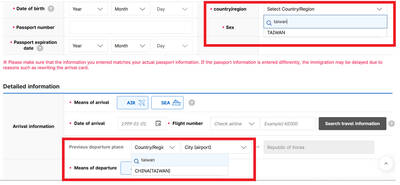
Jason Han says that the e-arrival card spat between South Korea and Taiwan shows that Seoul is signaling adherence to its “one-China” policy, while Taiwan’s response reflects a reciprocal approach. “Attempts to alter the diplomatic status quo often lead to tit-for-tat responses,” the analyst on international affairs tells the Taipei Times, adding that Taiwan may become more cautious in its dealings with South Korea going forward. Taipei has called on Seoul to correct its electronic entry system, which currently lists Taiwan as “China (Taiwan),” warning that reciprocal measures may follow if the wording is not changed before March 31. As of yesterday,

The Portuguese never established a presence on Taiwan, but they must have traded with the indigenous people because later traders reported that the locals referred to parts of deer using Portuguese words. What goods might the Portuguese have offered their indigenous trade partners? Among them must have been slaves, for the Portuguese dealt slaves across Asia. Though we often speak of “Portuguese” ships, imagining them as picturesque vessels manned by pointy-bearded Iberians, in Asia Portuguese shipping between local destinations was crewed by Asian seamen, with a handful of white or Eurasian officers. “Even the great carracks of 1,000-2,000 tons which plied

It’s only half the size of its more famous counterpart in Taipei, but the Botanical Garden of the National Museum of Nature Science (NMNS, 國立自然科學博物館植物園) is surely one of urban Taiwan’s most inviting green spaces. Covering 4.5 hectares immediately northeast of the government-run museum in Taichung’s North District (北區), the garden features more than 700 plant species, many of which are labeled in Chinese but not in English. Since its establishment in 1999, the site’s managers have done their best to replicate a number of native ecosystems, dividing the site into eight areas. The name of the Coral Atoll Zone might

Nuclear power is getting a second look in Southeast Asia as countries prepare to meet surging energy demand as they vie for artificial intelligence-focused data centers. Several Southeast Asian nations are reviving mothballed nuclear plans and setting ambitious targets and nearly half of the region could, if they pursue those goals, have nuclear energy in the 2030s. Even countries without current plans have signaled their interest. Southeast Asia has never produced a single watt of nuclear energy, despite long-held atomic ambitions. But that may soon change as pressure mounts to reduce emissions that contribute to climate change, while meeting growing power needs. The


 RSS
RSS