


Under a portrait of President Xi Jinping (習近平), Ashibusha sits in her freshly painted living room cradling her infant daughter beside a chair labeled a “gift from the government.” The mother of three is among 6,600 members of the Yi ethnic minority who were moved out of 38 mountain villages in China’s southwest and into a newly built town in an anti-poverty initiative.
Farmers who tended mountainside plots were assigned jobs at an apple plantation. Children who until then spoke only their own tongue, Nuosu, attend kindergarten in Mandarin, China’s official language.
“Everyone is together,” said Ashibusha, 26.
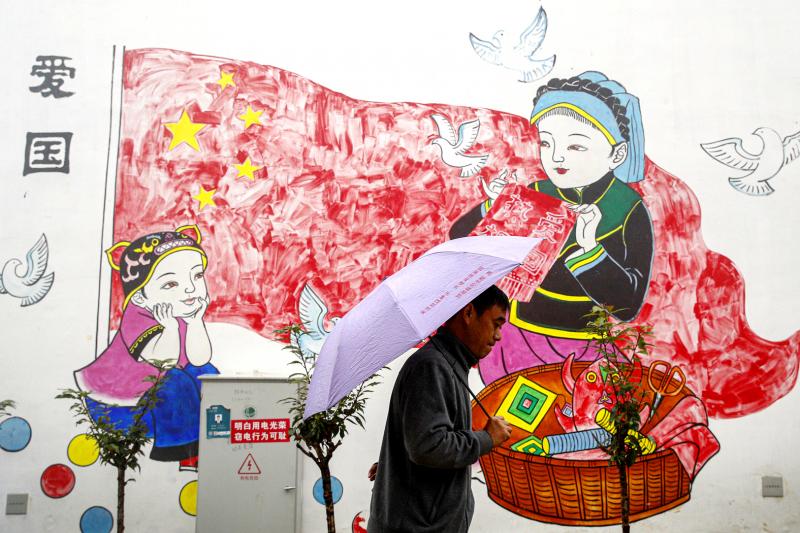
Photo: AP
While other nations invest in developing poor areas, Beijing doesn’t hesitate to operate on a more ambitious scale by moving communities wholesale and building new towns in its effort to modernize China. The ruling Chinese Communist Party has announced an official target of ending extreme poverty by the end of the year, ahead of the 100th anniversary of its founding next year.
POVERTY REDUCTION
The party says such initiatives have helped to lift millions of people out of poverty. But they can require drastic changes, sometimes uprooting whole communities. They fuel complaints the party is trying to erase cultures as it prods minorities to embrace the language and lifestyle of the Han, who make up more than 90 percent of China’s population.
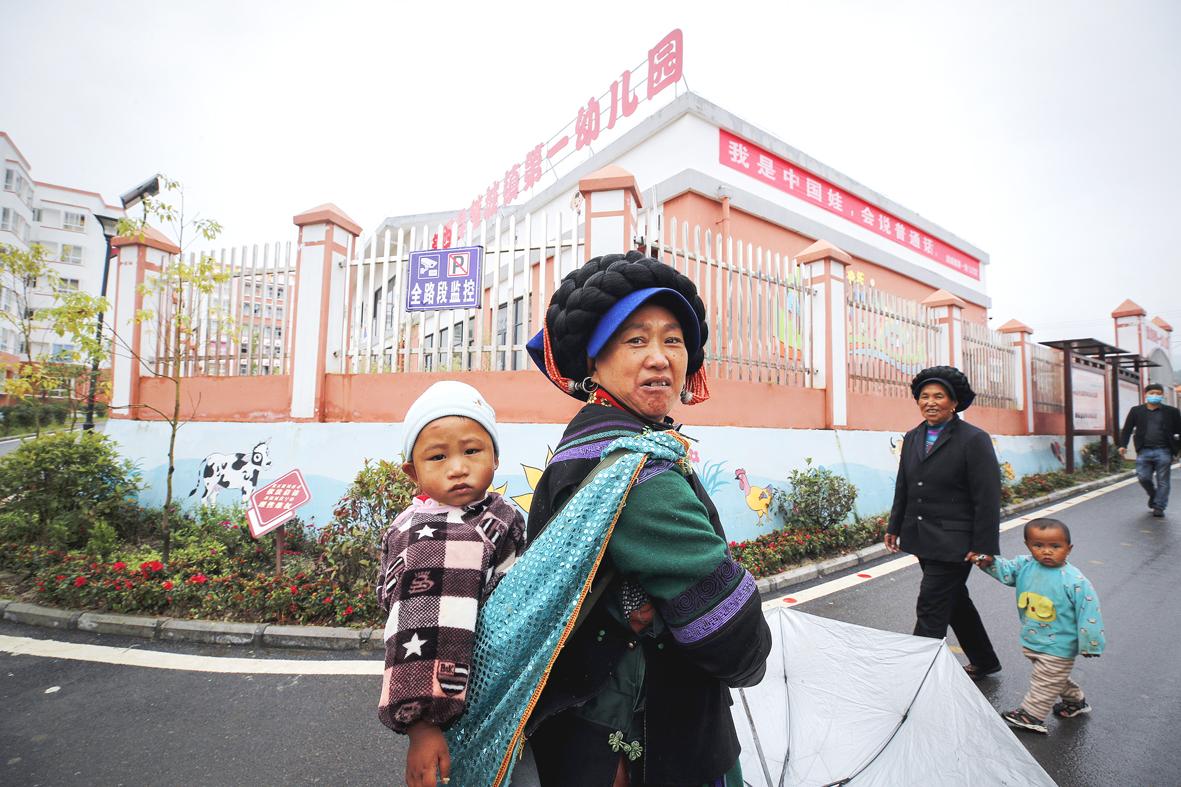
Photo: AP
At a time when the party faces protests by students in China’s northern region of Inner Mongolia over plans to reduce the use of the Mongolian language in schools, officials want to show they are sensitive to minority cultures.
They invited reporters to visit Chengbei Ganen and four other villages — Xujiashan, Qingshui, Daganyi and Xiaoshan — that are part of what authorities see as a successful development project for the Yi in Sichuan Province’s Liangshan prefecture.
The initiative is one of hundreds launched over the past four decades to spread prosperity from China’s thriving east to the countryside and west.
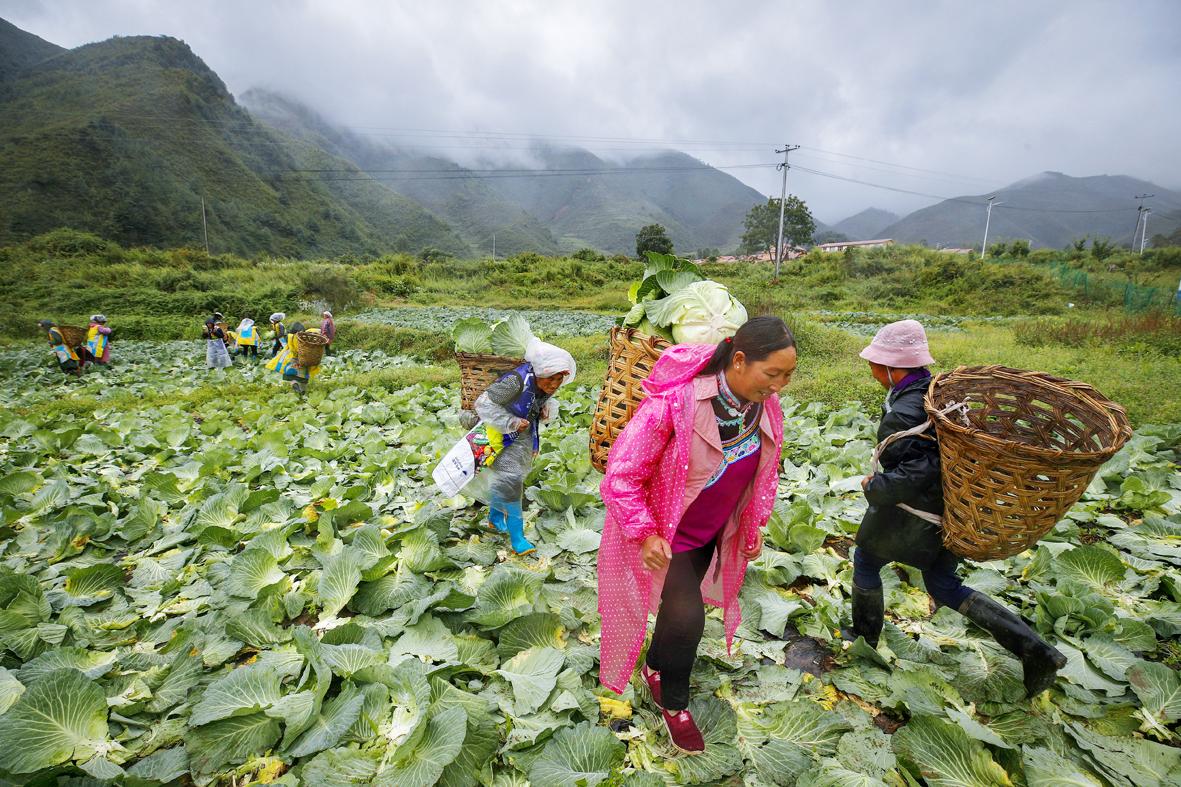
Photo: AP
Mass relocations still are carried out because some mountainous and other areas are too isolated, said Wang Sangui (汪三桂), president of the China Poverty Alleviation Research Institute of Renmin University in Beijing.
“It is impossible to solve the problem of absolute poverty without relocation,” he said.
In Sichuan, which includes some of China’s poorest areas, 80 billion yuan (US$12 billion) has been spent to date to relocate 1.4 million people, according to Peng Qinghua, the provincial party secretary. He said that included building 370,000 new homes and over 110,000km of rural roads.
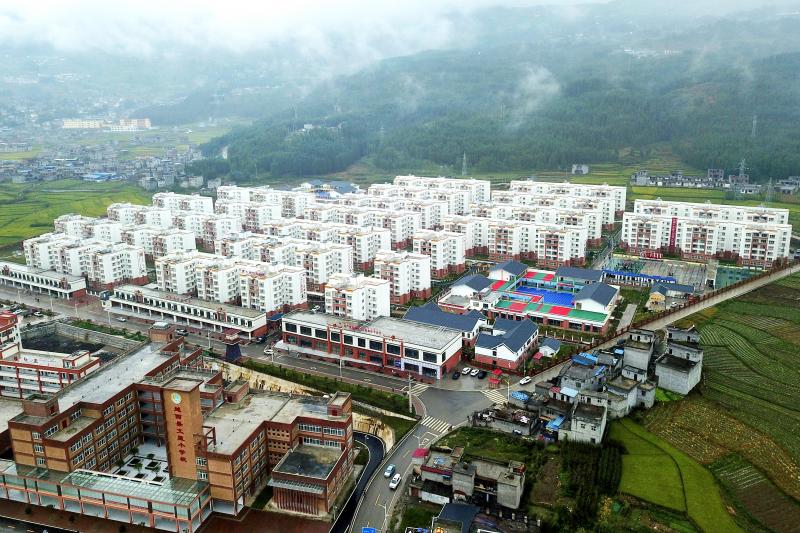
Photo: AP
In Chengbei Ganen, 420 million yuan (US$60 million) was spent to build 1,440 apartments in 25 identical white buildings, a clinic, a kindergarten and a center for the elderly.
Craftspeople sell silver jewelry, painted cow skulls and traditional clothing that are popular with Han tourists. Yi women can study to become nannies, a profession in demand in urban China, in classes taught with pink plastic dolls.
Roadside signs call on people to speak the official language. “Mandarin, please, after you enter kindergarten.” “Speak Mandarin well, it’s convenient for everyone.” “Everyone speaks Mandarin, flower of civilization blooms everywhere.” Murals on buildings depict the Yi with members of the Han majority in amicable scenes. One shows a baby holding a heart emblazoned with the ruling party’s hammer-and-sickle symbol. In one village, Xujiashan, annual household income has risen from 1,750 yuan (US$260) in 2014 to 11,000 yuan (US$1,600), according to its deputy secretary, Zhang Lixin.
Development initiatives can lead to political tension because many have strategic goals such as strengthening control over minority areas by encouraging nomads to settle or diluting the local populace with outsiders.
PROTESTS
In Inner Mongolia, students boycotted classes this month over plans to replace Mongolian-language textbooks with Chinese ones.
The party faces similar complaints that it is suppressing local languages in Tibet and the Muslim region of Xinjiang in the northwest. Xinjiang’s Han party secretary said in 2002 the language of the Uighurs, its most populous ethnic group, was “out of step with the 21st century” and should be abandoned in favor of Mandarin.
The party boss for Liangshan prefecture acknowledged its initiative isn’t purely economic.
Authorities want to eliminate “outdated habits,” said the official, Lin Shucheng. He listed complaints about extravagant dowries, too many animals butchered for funerals and poor hygiene.
“We are fighting against traditional forces of habit,” he said. At the same time, ruling party officials say they are preserving Nuosu, a Yi language, through bilingual education in schools and government support for a Nuosu newspaper and TV show.
“We protect and promote the learning, use and development of the Yi language,” the provincial party secretary, Peng, told reporters.
The party might be willing to promote Nuosu because, unlike in Tibet or Xinjiang, the Yi demand no political change, said Stevan Harrell, a University of Washington anthropologist who has spent more than three decades visiting and studying the region.
“There is no ‘splittism’ in Liangshan,” Harrell said, using the party’s term for activists who want more autonomy for Tibet and Xinjiang. “So it is kind of safe to have the Yi language as a medium of education,” Harrell said. “And it scores points for the government against those people who rightly point out that Uighur and Tibetan languages are being severely suppressed.” The region, like the rest of China, reeled from the coronavirus outbreak, said Lin, the Liangshan party boss. But he said anti-poverty work was back on track and authorities were confident they could meet official deadlines. Older villagers welcome the jump in living standards.
“You can eat whatever you like now,” said Wang Deying, an 83-year-old grandmother of five. “Now even the pigs eat rice.”

Taiwan’s English education system is being pulled apart by three opposing forces. Bilingual Nation 2030 pulls students toward English and global communication. Artificial Intelligence (AI) readiness pulls them toward digital judgment, verification and AI-mediated work. But Taiwan’s old exam culture pulls them back toward memorization, grammar drills, timed reading and correct answers. If the education system keeps using old exams to define success, it risks producing graduates who are neither genuinely bilingual nor genuinely AI-ready, but trained for tasks machines can already perform. The first force is Bilingual Nation 2030. Launched in 2018, the policy aimed to “help Taiwan’s workforce connect

It seems every few days one bumps into one of those “real man” comments in which Taiwan is urged to “face reality” or similar, and “make a deal,” with the speaker implying that soon it will be too late. “Deal” advocates always present themselves as having a superior grip on reality, and the manly ability to make the “hard choice.” Their testosterone-laden language often echoes that of Taiwan sellout advocates. Note that such commentary always specifies a process (“make a deal, work with, make progress”), never the end state of what occupation by a violent authoritarian colonialist state will entail. In

There are shadowy cabals plotting to sell out Taiwan to be annexed by China, by invasion if necessary. Fortunately, they are buffoons. In 2019, former Bamboo Union gangster and founder of the China Unification Promotion Party (CUPP), Chang An-le (張安樂, colorfully known as “White Wolf”), led a protest at the Legislative Yuan against comments made by then-premier Su Tseng-chang (蘇貞昌) that in the event of an attack by China, he would never surrender, but would protect the nation by fighting to the end, even if he only had a broom. Chang had party members bring a wooden casket that they
June 1 to June 7 "If all Taiwanese were as afraid of dying as you, then what would happen?” Physician Shih Chiang-nan (施江南) reportedly said this to his wife Chen Chiao-tung (陳焦桐) after she urged him to stop intervening on behalf of Taiwanese soldiers stranded overseas after serving in the Japanese Army during World War II. Shih had clashed with high-ranking officials over the issue, engaged in several heated arguments with Taiwan governor-general Chen Yi (陳儀) and allegedly shouted at general Ko Yuan-fen (柯遠芬), chief of staff of the Taiwan Garrison Command, over


 RSS
RSS