


Bordered by China and South Korea, two early victims of coronavirus, Kim Jong-un’s North Korea claims it has evaded the pandemic with no cases of infection. Diplomats and experts piecing together the clues see a different picture.
Kim brought his already isolated country to a near standstill by sealing the borders in January to stop the virus, which halted the trickle of legal trade and tourism. But even that may not have been enough. The US is “fairly certain” there are coronavirus cases in North Korea because of a noticeable lack of military activity, General Robert Abrams, commander of US Forces Korea, told reporters in a teleconference briefing last Friday.
“Their armed forces has been fundamentally — been on lockdown for about 30 days, and only recently have they started routine training again,” Abrams said March 13. “They didn’t fly an airplane for 24 days.”
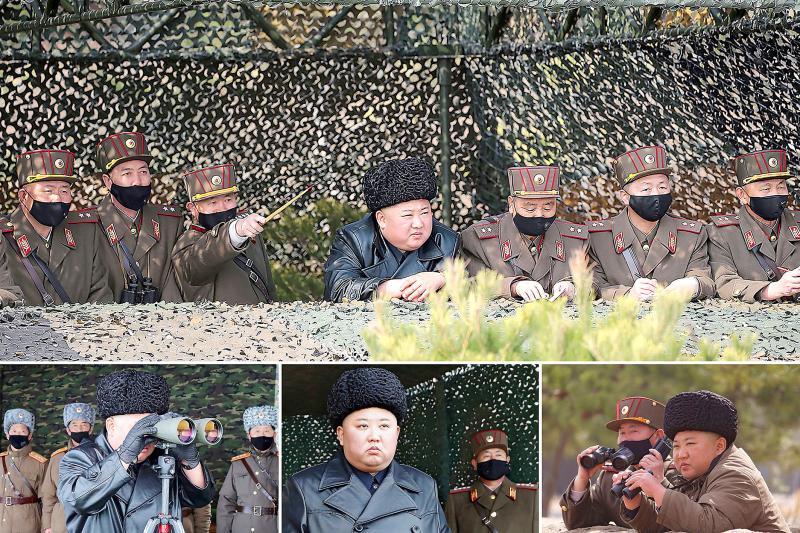
Photo: AFP
POTENTIAL CATASTROPHE
Due to a crumbling medical system, sanctions restricting trade and decades of economic mismanagement that have left more than 40 percent of its population chronically undernourished and vulnerable to disease, North Korea runs enormous risks of a coronavirus outbreak turning into a humanitarian disaster that could lead to mass deaths and leave it as a disease reservoir as the tide turns in Asia.
Those concerns have prompted aid organizations and North Korean allies like Russia to rush in medical supplies and others to offer help.
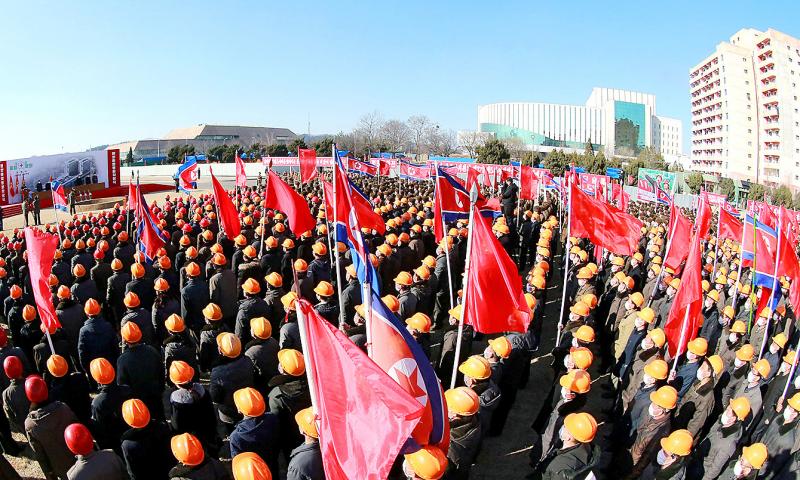
Photo: KCNA/ via Reuters
While there is little chance of the virus crossing the fenced-off, heavily militarized border with South Korea, the 1,420km border with China is porous, and the black-market traders who have crossed for years from both sides could be a source bringing the virus into North Korea. The case count in the two biggest Chinese provinces bordering North Korea — Liaoning and Jilin — have been relatively low so far at about 225 total as of last week, according to the WHO.
North Korea is largely a black box to the outside world and what it has said in its official media is that it has kept the virus from entering the country through mass disinfection and by placing thousands of people into quarantine. So far, more than 5,400 have been released and no infections found, it said, but a doctor in South Korea who heads the Association of Healthcare for Korean Unification said he suspects the vigorous denials could be masking a real problem.
“Since the tone of the reporting is so strong, North Korea probably does have its own patients of the virus,” said Kim Sin-gon, a professor at Korea University’s Department of Internal Medicine in Seoul.
He added the malnutrition could facilitate the spread of the disease.
North Korea has demonstrated it can stamp out a virus effectively, and the WHO in 2018 praised it for successfully eliminating measles. If the coronavirus that has infected more than 166,000 people worldwide has spilled into North Korea, leader Kim can use his authoritarian powers to round up and isolate the infected, lock down affected regions and seal off information about what is going on. Death tolls from the virus may not have much of an impact on a regime with such total control that it was able to weather a famine in the 1990s that killed an estimated 240,000 to 3.5 million people.
“There’s no human rights or social freedom concerns, there’s probably no concern for people starving to death,” said Thomas Byrne, president of the Korea Society, who teaches international affairs at Columbia University. “They can really enforce social distancing.”
READY TO HELP
Kim’s military hasn’t been totally silent. The country fired what appeared to be five short-range ballistic missiles off its eastern coast earlier this month in two volleys a week apart, a move denounced by officials in Japan and South Korea. Some analysts saw that as an effort to ensure the country remains on the agenda for other nations amid the virus outbreak.
Officials at North Korea’s mission to the UN didn’t respond to a request for comment. South Korea’s Unification Ministry said Tuesday that it won’t comment beyond what has been reported in North Korea’s state media about infections.
North Korea isn’t adverse to receiving overseas aid in times of need, often framing the donations in its domestic propaganda as tributes from abroad to its leaders — not as charity.
Russia has delivered virus test kits to Pyongyang while the International Federation of Red Cross and Red Crescent Societies have called for sanctions exemptions so it can transfer money into its North Korea office. South Korea also stands ready to help.
WHO officials say they aren’t aware of any cases though they are planning to send equipment and supplies to North Korea as well. Even the US State Department offered to send aid and work with international organizations to prevent a humanitarian crisis there.
A spokesperson for Doctors Without Borders said in response to an e-mail query that the group received an official request from North Korea in February to “strengthen the national capacity should there be an outbreak of COVID-19 (coronavirus).”
The UN Security Council, which is responsible for enforcing stringent sanctions on North Korea, recently made humanitarian exemptions to allow for medical supplies. German Ambassador Christoph Heusgen, who heads the committee in charge of UN sanctions, said the key now is to allow equipment in so that the population “can be protected.”
Despite the denials, North Korea may be facing its biggest public health challenge since Kim took power in late 2011.
“It’s hard to imagine that North Korea could dodge the COVID-19 bullet,” said Keith Luse, executive director of the National Committee on North Korea who, in his previous role as a Senate staff member, visited the country five times to review the distribution of U.S. aid.
Google unveiled an artificial intelligence tool Wednesday that its scientists said would help unravel the mysteries of the human genome — and could one day lead to new treatments for diseases. The deep learning model AlphaGenome was hailed by outside researchers as a “breakthrough” that would let scientists study and even simulate the roots of difficult-to-treat genetic diseases. While the first complete map of the human genome in 2003 “gave us the book of life, reading it remained a challenge,” Pushmeet Kohli, vice president of research at Google DeepMind, told journalists. “We have the text,” he said, which is a sequence of
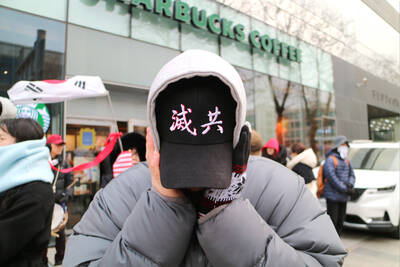
On a harsh winter afternoon last month, 2,000 protesters marched and chanted slogans such as “CCP out” and “Korea for Koreans” in Seoul’s popular Gangnam District. Participants — mostly students — wore caps printed with the Chinese characters for “exterminate communism” (滅共) and held banners reading “Heaven will destroy the Chinese Communist Party” (天滅中共). During the march, Park Jun-young, the leader of the protest organizer “Free University,” a conservative youth movement, who was on a hunger strike, collapsed after delivering a speech in sub-zero temperatures and was later hospitalized. Several protesters shaved their heads at the end of the demonstration. A

Every now and then, even hardcore hikers like to sleep in, leave the heavy gear at home and just enjoy a relaxed half-day stroll in the mountains: no cold, no steep uphills, no pressure to walk a certain distance in a day. In the winter, the mild climate and lower elevations of the forests in Taiwan’s far south offer a number of easy escapes like this. A prime example is the river above Mudan Reservoir (牡丹水庫): with shallow water, gentle current, abundant wildlife and a complete lack of tourists, this walk is accessible to nearly everyone but still feels quite remote.
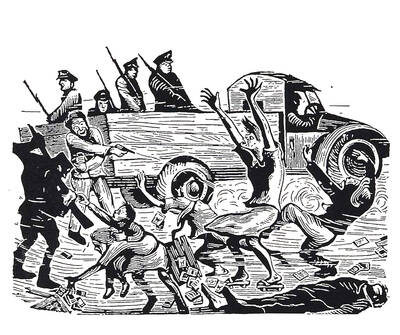
In August of 1949 American journalist Darrell Berrigan toured occupied Formosa and on Aug. 13 published “Should We Grab Formosa?” in the Saturday Evening Post. Berrigan, cataloguing the numerous horrors of corruption and looting the occupying Republic of China (ROC) was inflicting on the locals, advocated outright annexation of Taiwan by the US. He contended the islanders would welcome that. Berrigan also observed that the islanders were planning another revolt, and wrote of their “island nationalism.” The US position on Taiwan was well known there, and islanders, he said, had told him of US official statements that Taiwan had not


 RSS
RSS