


If not for Dcard (狄卡), Lee Tai-yu (李岱佑) would not have participated in the demonstration against pro-China media in Taipei last month.
Clad in a white T-shirt — symbolizing opposition to “red” media — Lee was among the thousands of protesters who took over Ketagalan Boulevard on June 23. Led by Internet celebrity Holger Chen (陳之漢) and New Power Party legislator Huang Kuo-chang (黃國昌), protesters demanded regulations to curb the spread of misleading news by pro-China media outlets.
Lee told the Taipei Times that anti-extradition bill demonstrations in Hong Kong have “sparked anxiety” about cross-strait relations among teenagers in Taiwan. They have taken to Dcard to repost stories written by protesters, share ways to support the demonstrations and call out pro-China media.

Photo: Candice Chiang
“It was through Dcard that I realized our generation has to fight for democracy. That’s why I’m here,” Lee said.
Most millennial protesters learned about the rally through Chen’s and Huang’s Facebook pages. But Dcard has also played an essential role by helping many recognize how important it is to be politically conscious and engaged.
Initially designed for the sole purpose of helping university students expand their social circles and find romantic partners, Dcard has transformed into a medium for them to engage in conversations on a variety of topics, most notably politics.
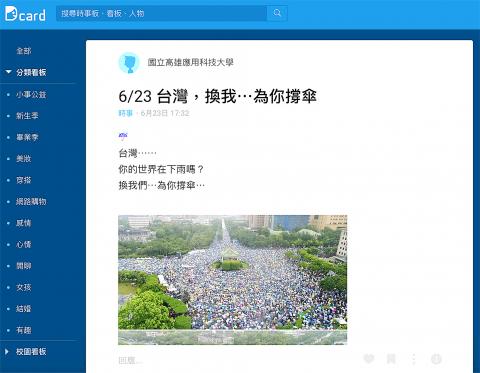
Photo: Candice Chiang
POLITICS ON DCARD
Like most millennials around the world, teenagers here use Facebook and Instagram. But Dcard, a uniquely Taiwanese platform, is their real go-to.
The Web site is designed to be a community where users can be comfortable publishing and commenting on articles anonymously. Topics range from casual matters like ranting about life, seeking relationship advice and sharing daily outfits, to more serious ones such as raising social awareness and discussing politics.
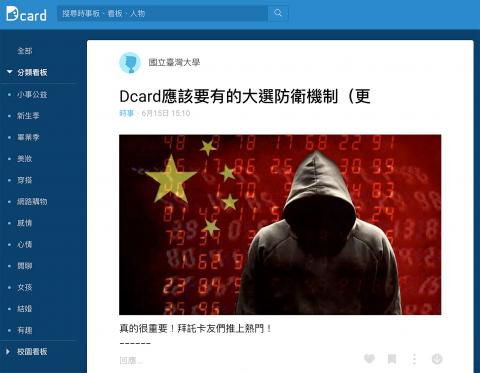
Photo: Candice Chiang
As demonstrations unfolded in Hong Kong last month, an article titled “Hong Kong streets flooded by anti-extradition bill protesters” (香港反送中遊行,爆滿) was the most popular on Dcard, receiving over 31,000 likes.
The author points out the significance of the anti-extradition bill demonstrations for Taiwan, namely the illegitimacy of China’s “one country, two systems” framework, and how passage of the bill could put Taiwanese citizens in Hong Kong at risk of extradition by Beijing for making pro-Taiwanese independence statements.
Dcard’s founders declined to comment on how their Web site has contributed to facilitating a political awakening among teenagers.
But with the presidential election coming up next year, Dcard’s politics and current events panel has repeatedly been top-trending on the platform for the past few months.
When CtiTV News (中天新聞) airs broadcasts about Kaohsiung Mayor and presidential hopeful Han Kuo-yu (韓國瑜), posts analyzing and debunking them often take over Dcard’s feed.
One example was an article in May addressing reports that “Marvel is creating a superhero based on Han Kuo-yu” (漫威要求創作韓國瑜故事). It includes a screenshot of a message from Marvel’s official Facebook account confirming that there are no such plans.
After the rally against pro-China media, a post titled “6/23 Taiwan, I will hold an umbrella over you” (6/23 台灣,換我為你撐傘) was top-trending on Dcard, receiving over 23,500 likes. Comprising photos of the demonstration and simple captions, the post pays tribute to all who participated.
ANONYMITY AND CONTROVERSIES
What distinguishes Dcard from other social media platforms is its policy of anonymity. This makes it a safe haven to discuss cross-strait relations — although not without concerns and controversies.
“An anonymous social media site like Dcard is a double-edged sword,” said Wu Shao-ting (吳少庭), who attended the June 23 demonstration, based on his experience as a Dcard user. “It has facilitated relatively open discussions about politics recently, but the fear that the platform may be used to manipulate public opinion remains.”
Users of an anonymous social media site tend to feel less exposed — Lee is one of them.
“Dcard’s anonymity makes me feel somewhat secure when posting and commenting on political matters,” he said. “Especially with the anti-extradition bill demonstrations going on in Hong Kong, I have come to realize how important privacy is.”
Dcard is available exclusively for university students — users must have a university e-mail address to create an account. For that same reason, it has been criticized for nurturing an echo chamber, where millennials exchange similar opinions and reinforce each other’s views while doing so.
The platform has a fairly strict screening system. But according to user Chen I-hui (陳奕慧), one can easily purchase a university e-mail address on Shopee for NT$100 to NT$200 and create a Dcard account.
“To be honest, Dcard might have already been infiltrated by Internet trolls — but because of its anonymity, nobody knows whether it’s true or not,” she said.
Chen is not alone in her concerns about anonymity. On June 15, an article titled “Dcard should have defense mechanisms prepared for the presidential election” (Dcard 應該要有的大選防衛機制) was top-trending on the Web site’s feed.
The author argues that Dcard should have mechanisms in place to minimize the amount of fake news and counter political spam on the platform leading up to next year’s election.
“I know Dcard’s anonymity is its unique selling point, but it has also made the platform particularly vulnerable to manipulation… displaying every user’s IP address and nationality will allow everyone to be able to judge whether an account is legitimate,” he writes.
Although the platform was not designed for politics, teenagers in Taiwan have found that in order to make their voices heard, they first need a place to discuss their ideas, beliefs and values.
Dcard has become a convenient forum for millennials to engage in that conversation, motivating them to remain politically aware and active.
“I cried reading some of the stories about the anti-extradition bill protests,” said Wang Chao-yu (汪昭妤), a protester at the June 23 demonstrations. “That’s when I decided I have to stand my ground and make my opinion count.”

Taiwan’s English education system is being pulled apart by three opposing forces. Bilingual Nation 2030 pulls students toward English and global communication. Artificial Intelligence (AI) readiness pulls them toward digital judgment, verification and AI-mediated work. But Taiwan’s old exam culture pulls them back toward memorization, grammar drills, timed reading and correct answers. If the education system keeps using old exams to define success, it risks producing graduates who are neither genuinely bilingual nor genuinely AI-ready, but trained for tasks machines can already perform. The first force is Bilingual Nation 2030. Launched in 2018, the policy aimed to “help Taiwan’s workforce connect
It seems every few days one bumps into one of those “real man” comments in which Taiwan is urged to “face reality” or similar, and “make a deal,” with the speaker implying that soon it will be too late. “Deal” advocates always present themselves as having a superior grip on reality, and the manly ability to make the “hard choice.” Their testosterone-laden language often echoes that of Taiwan sellout advocates. Note that such commentary always specifies a process (“make a deal, work with, make progress”), never the end state of what occupation by a violent authoritarian colonialist state will entail. In
June 1 to June 7 "If all Taiwanese were as afraid of dying as you, then what would happen?” Physician Shih Chiang-nan (施江南) reportedly said this to his wife Chen Chiao-tung (陳焦桐) after she urged him to stop intervening on behalf of Taiwanese soldiers stranded overseas after serving in the Japanese Army during World War II. Shih had clashed with high-ranking officials over the issue, engaged in several heated arguments with Taiwan governor-general Chen Yi (陳儀) and allegedly shouted at general Ko Yuan-fen (柯遠芬), chief of staff of the Taiwan Garrison Command, over

“Taiwan’s Opposition Leader Comes to US With a Message Straight Out of Beijing” read a May 31 headline in the Wall Street Journal. Top US administration officials and members of Congress almost certainly read the WSJ, and if there was a bullet point takeaway that people in Washington should absorb ahead of Chinese Nationalist Party (KMT) Chair Cheng Li-wun’s (鄭麗文) arrival in DC on June 9, that headline is it. The last few columns have discussed this very topic, and the timing is not coincidental. While those top officials likely do not read the Taipei Times, judging by the number


 RSS
RSS