


Life lesson No. 1: Never pick up mysterious notebooks that apparently just fall at your feet.
That sentence will probably only make sense to the nation’s manga aficionados, who have been counting down the days until opening of Death Note The Musical (死亡筆記本) on July 21.
National Taichung Theater’s Grand Theater is hosting the tale of a high school student who finds a supernatural notebook, decides he wants to create a world cleansed of all evil by killing off all the criminals, and the detective who is trying to stop him.

photo Courtesy of Tsugumi Ohba,Takeshi Obata/Shueisha
The musical is based on the Death Note manga series written by Tsugumi Ohba — the pen name of an author who zealously guards his privacy — and illustrated by Takeshi Obata.
The immensely popular series ran from 2003 to 2006, with more than 30 million volumes in circulation, and spawned an entire industry in Japan with an anime television show, a young adult novel by Nisio Isin, several video games, four live-action films and two more TV shows.
In the latest development, Netflix is set to release a US-made film based on the series on Aug. 25.
The Netflix movie is not the only US connection for Death Note. The creative trio behind the musical are Americans, the show was written in English and then translated into Japanese, and it was workshopped in New York City the year before the show opened in Tokyo.
The musical’s “book” is by playwright/scriptwriter Ivan Menchell; the music by composer Frank Wildhorn, whose credits include Jekyll and Hyde, The Count of Monte Crist and Carmen and the Whitney Houston hit Where Do Broken Hearts Go; and lyrics by composer/lyricist and frequent Wildhorn collaborator Jack Murphy.
The rest of the production team was Japanese, led by director Tamiya Kuriyama, a former head of the New National Theater in Tokyo, who has a slew of theater, musical and opera credits in his resume.
At the heart of the original manga — and the musical — is an issue that philosophers have pondered for centuries: how power can corrupt even the best intentioned.
While the storyline of the musical is far too convoluted to detail here, the plot revolves around high-school student Light Yagami, who discovers a notebook left by a shinigami — a supernatural death spirit — named Ryuk, who is bored and wants to create a bit of trouble for humans.
The notebook gives the user the ability to kill anyone whose name is written in it, as long as the user knows the person’s face. When Light discovers its powers — by writing the name of a criminal in the book — he decides to cleanse the world of evil and become its new savior.
His killings, ascribed to a person known as “Kira,” come to the attention of Interpol and a famous detective known only as “L,” who forms a task force to hunt the murderer. One of the members of the task force is Light’s father, Soichiro Yagami.
Light also comes to the attention of a famous model, Misa Amane, who turns out to have a shinigami of her own, named Rem, and a past with several murders linked to it.
Light and Misa join forces to foil the task force and “L,” and there are all sorts of subplots, mysterious identities and yet another shinigami, not to mention the involvement of Light’s younger sister, Sayu Yagami, and several FBI agents.
If only there were Cliff Notes for manga tales.
Appearing in Taichung for the four-show run will be Kenji Urai and Hayato Kakizawa, who originated the shared role of Light and share the same carefully coiffed “boy idol” hairdos; Teppei Koike as L; Fuka Yuzuki as Misa; Megumi Hamada as Rem; and Ami Maeshima as Sayu.
Non-original cast members include Kazutaka Ishii as Ryuk; Karin Takahashi as Sayu and Tetsuya Bessho as Soichiro.
Death Note The Musical runs 170 minutes, with one intermission. It will be performed in Japanese with Chinese surtitles and comes with a program note that it is not recommended for children younger than 10.
This story has been updated since it was first published to correct the performance dates.

The Portuguese never established a presence on Taiwan, but they must have traded with the indigenous people because later traders reported that the locals referred to parts of deer using Portuguese words. What goods might the Portuguese have offered their indigenous trade partners? Among them must have been slaves, for the Portuguese dealt slaves across Asia. Though we often speak of “Portuguese” ships, imagining them as picturesque vessels manned by pointy-bearded Iberians, in Asia Portuguese shipping between local destinations was crewed by Asian seamen, with a handful of white or Eurasian officers. “Even the great carracks of 1,000-2,000 tons which plied

It’s only half the size of its more famous counterpart in Taipei, but the Botanical Garden of the National Museum of Nature Science (NMNS, 國立自然科學博物館植物園) is surely one of urban Taiwan’s most inviting green spaces. Covering 4.5 hectares immediately northeast of the government-run museum in Taichung’s North District (北區), the garden features more than 700 plant species, many of which are labeled in Chinese but not in English. Since its establishment in 1999, the site’s managers have done their best to replicate a number of native ecosystems, dividing the site into eight areas. The name of the Coral Atoll Zone might

On Monday morning, in quick succession, the Chinese Communist Party (CCP) and the Chinese Nationalist Party (KMT) released statements announcing “that the Central Committee of the Communist Party of China and General Secretary Xi Jinping (習近平) have invited KMT Chairwoman Cheng Li-wun (鄭麗文) to lead a delegation on a visit to the mainland” as the KMT’s press release worded it. The KMT’s press release added “Chairwoman Cheng expressed her gratitude for the invitation and has gladly accepted it.” Beijing’s official Xinhua news release described Song Tao (宋濤), head of the Taiwan Work Office of the CCP Central Committee, as
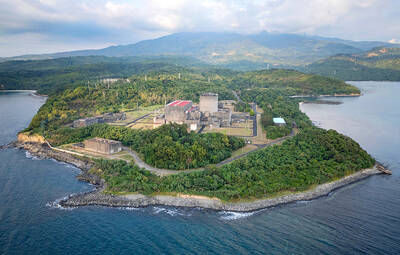
Nuclear power is getting a second look in Southeast Asia as countries prepare to meet surging energy demand as they vie for artificial intelligence-focused data centers. Several Southeast Asian nations are reviving mothballed nuclear plans and setting ambitious targets and nearly half of the region could, if they pursue those goals, have nuclear energy in the 2030s. Even countries without current plans have signaled their interest. Southeast Asia has never produced a single watt of nuclear energy, despite long-held atomic ambitions. But that may soon change as pressure mounts to reduce emissions that contribute to climate change, while meeting growing power needs. The


 RSS
RSS