


Oct.16 to Oct. 22
Having just been received by Taiwan’s governor-general for becoming the first Taiwanese aviator two years earlier, Hsieh Wen-ta (謝文達) set out on a mission in early 1923 that would cause the Japanese colonial government much embarrassment and lead to two decades of self-imposed exile from his homeland.
At that time, Taiwanese democracy pioneers and anti-Japanese activists such as Chiang Wei-shui (蔣渭水) and Lin Hsien-tang (林獻堂) had submitted the third petition to the Japanese Imperial Diet to establish a Taiwanese representative assembly. To support this movement, Hsieh flew his plane directly to the empire’s heart of Tokyo and dropped about 20,000 leaflets with messages such as “Taiwanese have long been suffering under tyrannical rule,” “Give Taiwan a representative assembly” and “The totalitarianism of the colonial government is a disgrace to the constitutional country of Japan!”
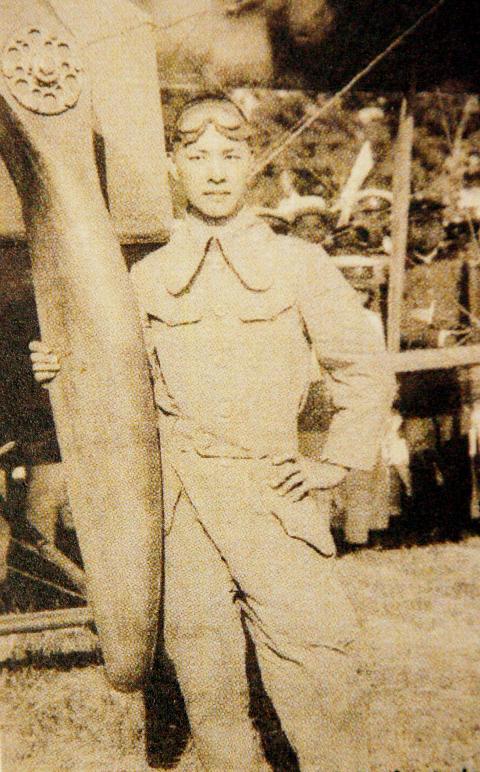
Photo courtesy of Chuang Yung-ming
Several months earlier, Hsieh had won a round-trip race between Tokyo and Osaka. But now, he was in big trouble.
Even before Hsieh’s daring exploit, his family already had a history of resisting the Japanese. His grandfather Hsieh Tao-lung (謝道龍) was second-in-command of the Republic of Formosa army, which attempted to defend Taipei in 1895. The elder Hsieh fled with his family to China after the fall of Taipei, but returned a year later. The younger Hsieh was born in 1901.
In 1916 and 1917, American pilot Art Smith made two trips to Asia, showcasing his aerobatic skills in a series of demonstrations. In Korea, he is said to have inspired both the country’s first male and female aviators, and he did the same for Taiwan when a 16-year-old Hsieh attended Smith’s airshow in his native Taichu (today’s Taichung).
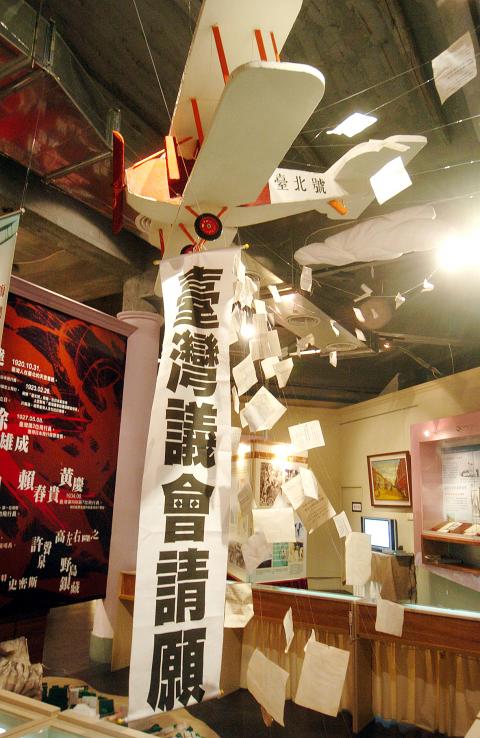
Photo: Chang Chia-ming, Taipei Times
With the support of his principal at Taichu Senior High School, Hsieh traveled to Japan and graduated from the Ito Aviation Academy with honors. In August 1920, he won third place in an aerobatic competition in Tokyo and returned to Taiwan the next month to great fanfare as its first pilot.
Historian Tai Pao-tsun (戴寶村) writes in Newsletter on Taiwan Studies (台灣學通訊) that only seven more Taiwanese would receive commercial pilot licenses during the rest of Japanese rule, which ended in 1945.
Hsieh held three aerobatic demonstrations in Taiwan — the first one took place on Oct. 17, 1920 in Taichung. His achievement fostered great pride among Taiwanese, and local donations started pouring in, raising enough money to buy Hsieh his own airplane. It was named Taipei (台北號) and was the one he used to make his flight over Tokyo.
One of the main forces behind the fundraising was Chiang Wei-shui (蔣渭水), an important figure in Taiwan’s nonviolent resistance against Japanese rule. Historian Chuang Yung-ming (莊永明) writes in Flying in the Blue Skies of the Native Land (飛翔於鄉土藍天上) that this endeavor united various student organizations around Taiwan, and soon the resistance movement would be born. It is likely no coincidence that Chiang chose Oct. 17, 1921 as the founding date of the Taiwan Cultural Association (台灣文化協會), which aimed to foster a sense of Taiwanese nationalism.
Incidentally, in 1934, Taiwan’s fifth aviator Yang Ching-hsi (楊清溪) would also use this date to begin an aerial demonstration tour around Taiwan. Unfortunately, Yang died when his plane crashed while taking several passengers on a flight less than a month later.
Chuang writes that by that time, Hsieh was living in China as a businessman and anti-Japanese activist, having fled Taiwan shortly after the leaflet incident. When he first arrived in China, he served in the Republic of China Air Force until he was severely injured in an aerial battle in 1930. No longer able to fly, he retired two years later as a Lieutenant Colonel. Hsieh returned to Taiwan in 1946 along with the Chinese Nationalist Party, where he ran a machinery factory and also served on the Taiwan Provincial Consultative Council.
Hsieh’s entry in the National Central Library’s Taiwan Memory Web site states that he kept a low profile for the final two decades of his life, dying quietly in his Taipei home in 1983.
“He never talked about his past glories,” the entry concludes.
Taiwan in Time, a column about Taiwan’s history that is published every Sunday, spotlights important or interesting events around the nation that have anniversaries this week.
Ahead of incoming president William Lai’s (賴清德) inauguration on May 20 there appear to be signs that he is signaling to the Chinese Communist Party (CCP) and that the Chinese side is also signaling to the Taiwan side. This raises a lot of questions, including what is the CCP up to, who are they signaling to, what are they signaling, how with the various actors in Taiwan respond and where this could ultimately go. In the last column, published on May 2, we examined the curious case of Democratic Progressive Party (DPP) heavyweight Cheng Wen-tsan (鄭文燦) — currently vice premier

On Facebook a friend posted a dashcam video of a vehicle driving through the ash-colored wasteland of what was once Taroko Gorge. A crane appears in the video, and suddenly it becomes clear: the video is in color, not black and white. The magnitude 7.2 earthquake’s destruction on April 3 around and above Taroko and its reverberations across an area heavily dependent on tourism have largely vanished from the international press discussions as the news cycle moves on, but local residents still live with its consequences every day. For example, with the damage to the road corridors between Yilan and

May 13 to May 19 While Taiwanese were eligible to take the Qing Dynasty imperial exams starting from 1686, it took more than a century for a locally-registered scholar to pass the highest levels and become a jinshi (進士). In 1823, Hsinchu City resident Cheng Yung-hsi (鄭用錫) traveled to Beijing and accomplished the feat, returning home in great glory. There were technically three Taiwan residents who did it before Cheng, but two were born in China and remained registered in their birthplaces, while historians generally discount the third as he changed his residency back to Fujian Province right after the exams.
Few scenes are more representative of rural Taiwan than a mountain slope covered in row upon row of carefully manicured tea plants. Like staring at the raked sand in a Zen garden, seeing these natural features in an unnaturally perfect arrangement of parallel lines has a certain calming effect. Snapping photos of the tea plantations blanketing Taiwan’s mountain is a favorite activity among tourists but, unfortunately, the experience is often rather superficial. As these tea fields are part of working farms, it’s not usually possible to walk amongst them or sample the teas they are producing, much less understand how the


 RSS
RSS