


What is your memory of being 17? For film director Chou Ko-tai (周格泰), it represents an age of teenage disillusionment and unfulfilled love. All of this is fleshed out in his debut film named after the Bee Gees’ 1969 song First of May.
Weaving two stories set 30 years apart, First of May (五月一號) is about a middle-aged man looking back at his teenage years, dreaming of his first and possibly only love.
At the center of the drama is Bai (Lyan Cheng, 程予希), a 17-year-old student living with her single mother, Wong Lei (Alyssa Chia, 賈靜雯), and her grandmother. Bai gradually falls for her admirer/stalker, Yeh (Anderson Cheng, 鄭暐達), who is always walking behind her and her best friend Wen Wen (Shao Yu-wei, 邵雨薇) wherever they go.

Photo courtesy of South of the Road Production House
Bai’s carefree life is shattered, however, when her pianist mother falls into a coma after a car accident.
There is also a 45-year-old interior designer Lin Ke-ming (Richie Jen, 任賢齊), a man who appears to have everything: a successful career, affluent lifestyle and a beautiful, younger girlfriend. Yet, he remains void and callous, even when his young lover leaves him because he doesn’t want to get married.
Thirty years ago, 15-year-old Lin, played by new talent Shih Chih-tien (石知田), spends his days goofing around with friends and getting into trouble. He falls for a quiet schoolmate who turns out to be the younger Wong, also played by Lyan Cheng. Yet, the budding romance between the two is prematurely brought to an end after Lin stabs the school’s military training instructor and is sent away by his parents to Hong Kong.
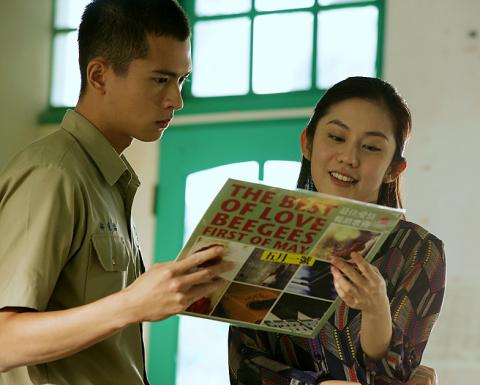
Photo courtesy of South of the Road Production House
Back in the present day, Bai accidentally bumps into Wen Wen making a pass at Yeh and feels deeply betrayed. At home, an unsent letter by her mother addressed to Lin catches Bai’s attention. Posing as Wong, the daughter reaches Lin by the Internet and asks him to meet up.
Outside a busy MRT station where they plan to meet, Lin suddenly sees, from a distance, a familiar face that encapsulates his lost youth and faded love.
TOO VOYEURISTIC
The portion of the film set in the 1980s possesses a nostalgic charm made possible by Yuan Chiung-chiung’s (袁瓊瓊) eloquent script, Lee Cin-cin’s (李欣芸) lyrical music and Shih Shu-ming’s (施書銘) delicate cinematography.
First of May boasts a strong technical crew. Content-wise, however, it is uneven and elliptic, with some elements left undeveloped, and others redundant.
The present-day half of the film is particularly feeble. Jen looks tedious and fatigued, not because he delivers a good performance, but because the character is poorly defined, often by lifeless babbles and negligible gestures.
When the film turns to its youthful protagonists, it suddenly becomes vigorous. While social and political turbulence leading up to the lifting of martial law in 1987 is dealt too lightly to give their teenage rebellion a deeper meaning, the actors invest enough vitality into the restless characters.
Among them, Lyan Cheng deserves special mention for her capability to play two girls of different generations — one more docile and reserved, the other more confident and sexy.
There is also an engaging performance by the late model and actress Peng Hsin-yi (彭馨逸), better known by her stage name, Cindy Yang (楊又穎), who committed suicide earlier this month as a result of cyber-bullying.
For the adolescent protagonists, sexual awakening is a catalyst for entering adulthood and reacting with the world around them. However, the director fails to delve deeper into the subject — he instead lingers on Lin’s 17-year-old self in a way that is too voyeuristic.

If a leisurely afternoon of high-end dining and watching the scenery roll by from the comfort of a plush armchair sounds like a good time to you, consider a trip on the Sea Breeze (海風號). This culinary, cultural and scenic experience is the perfect setting for a date, a celebratory outing with a small group of friends or a relaxing solo ride. The price tag is steep, especially if you consider the short distance the train actually covers over the 3.5-hour journey. But what you’re paying for on the Sea Breeze isn’t transportation; it’s the comfort, the service, the exclusivity, the
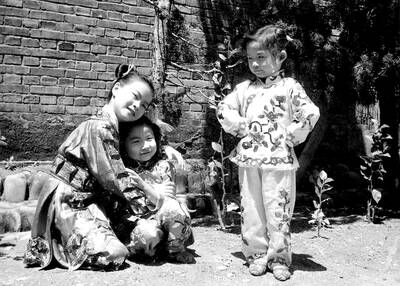
Audiences in Leicester, Cardiff, London and Sheffield will this month gather to watch a series of black-and-white Taiwanese-language films made more than 70 years ago. On the surface, these screenings commemorate the seventieth anniversary of taiyupian (台語片) — Taiwanese-language cinema. Yet the significance of these events extends far beyond nostalgia or film history. They represent a remarkable chapter in Taiwan’s ongoing effort to recover, preserve and reinterpret a cultural heritage that was once thought to have largely disappeared. The centerpiece of the program is the Ho Chi-ming (何基明) directed Xue Pinggui and Wang Baochuan (薛平貴與王寶釧), a film produced in 1955 and

In December of 2008 Lee E-tin (李乙廷), a Miaoli county legislative hopeful, was convicted of vote-buying. Rather than buy votes retail, voter by voter, in the usual manner, Lee had done it wholesale, in a commendably efficient manner: he had visited local temples and made donations to gain their support. Because he did not normally make donations to temples, the court ruled he was attempting to improperly influence voter behavior. The case indicates how important temples are in influencing political life. Both judge and politician appeared to see them in the same way. Beijing sees them that way as well. Democratic Progressive

One of the wildest things about the reception of Chinese Nationalist Party (KMT) Chair Cheng Li-wun (鄭麗文) in the international media is the way her words are presented without being contextualized, let alone challenged. The Financial Times, for example, interviewing her during her visit to New York, said that she blamed the halt to exchanges between Taiwan and the People’s Republic of China (PRC) for raising tensions. “There has been no dialogue, so you can see that the situation is almost on the brink of war,” the Financial Times quoted her as saying, without any hint that the PRC, not


 RSS
RSS