


US President Joe Biden on Saturday affirmed his willingness to protect the US’ allies and reiterated that peace in the Taiwan Strait should be upheld, as Washington again called on Beijing to restrain itself after it conducted two-day military drills around Taiwan.
“I’ve always been willing to use force when required to protect our nation, our allies, our core interests. When anyone targets American troops, we will deliver justice to them,” Biden said in a speech to cadets graduating from the US Military Academy in West Point, New York.
He touted US security cooperation in the Indo-Pacific region, including the AUKUS security pact with Australia and the UK, trilateral cooperation with Japan and South Korea, and recent engagement with Japan and the Philippines.
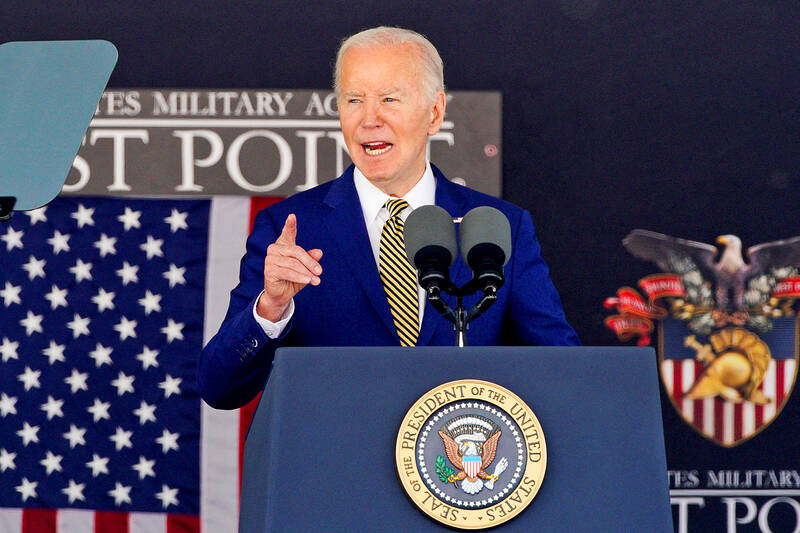
Photo: Reuters
The US also elevated the Quadrilateral Security Dialogue with Australia, India and Japan to support a “free, open, secure and prosperous Indo-Pacific,” Biden said.
“We’re standing up for peace and stability across the Taiwan Strait,” he said.
Thanks to US military forces, the country is able to defend its values “by standing up to tyrants,” he said.
“Anyone who thinks they can threaten us, think again,” he added.
On the same day as Biden’s address, the US Department of State issued a statement to “strongly urge Beijing to act with restraint” after its drills around Taiwan.
After President William Lai’s (賴清德) inauguration on Monday, Beijing said his speech was an attempt to promote Taiwanese independence, in particular his statement that Taiwan and the People’s Republic of China (PRC) are not subordinate to one another.
On Thursday and Friday, China conducted a large-scale military exercise, codenamed “Joint Sword-2024A,” around Taiwan, sparking concern and condemnation among the international community.
The US was “deeply concerned” about the military drills in the Strait and around Taiwan, US Department of State spokesman Matthew Miller said.
“We are monitoring PRC activities closely and coordinating with allies and partners regarding our shared concerns,” Miller said.
Beijing is “using a normal, routine, and democratic transition as an excuse for military provocations,” he said, adding that peace and stability across the Taiwan Strait “is critical for regional and global security and prosperity.”
The Ministry of Foreign Affairs in a statement yesterday thanked Biden and the US government for supporting Taiwan.
At a time when democracies around the globe are facing challenges, like-minded partners have unanimously demanded that China exercise restraint, stop coercing Taiwan and cease any actions that undermine peace and stability across the Taiwan Strait, the ministry said.
The international community would not approve of Beijing’s attempts to blatantly interfere with Taipei’s democratic process, and would consider them provocative actions that aim to disrupt the “status quo,” it said.
The ministry called on China to resume exchanges and dialogue with Taiwan based on the principles of equality and dignity, and to jointly safeguard peace and stability across the Taiwan Strait.
Meanwhile, a group of US representatives, led by Republican Michael McCaul, who chairs the US House of Representatives Committee on Foreign Affairs, yesterday arrived in Taipei.
The delegation includes Republicans Young Kim, Joe Wilson and Andy Barr, and Democrats Jimmy Panetta and Chrissy Houlahan, the American Institute in Taiwan (AIT) said in a statement.
Their four-day visit to Taiwan is part of a trip to the wider Indo-Pacific region, the AIT said.
The six representatives would be the first group of serving US officials to meet with Lai after his inauguration and China’s two-day drills.
“I think it’s very important that we show our strong support for Taiwan. I think it is a deterrent,” McCaul told NBC News before arriving in Taiwan.
Additional reporting by CNA
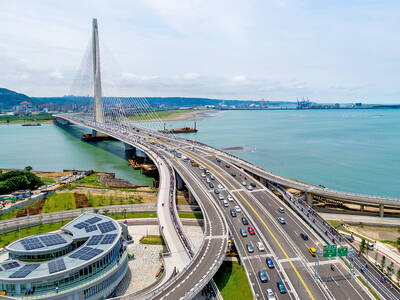
The Ministry of Transportation and Communications yesterday inaugurated the Danjiang Bridge across the Tamsui River in New Taipei City, saying that the structure would be an architectural icon and traffic artery for Taiwan. Feted as a major engineering achievement, the Danjiang Bridge is 920m long, 211m tall at the top of its pylon, and is the longest single-pylon asymmetric cable-stayed bridge in the world, the government’s Web site for the structure said. It was designed by late Iraqi-British architect Zaha Hadid. The structure, with a maximum deck of 70m, accommodates road and light rail traffic, and affords a 200m navigation channel for boats,
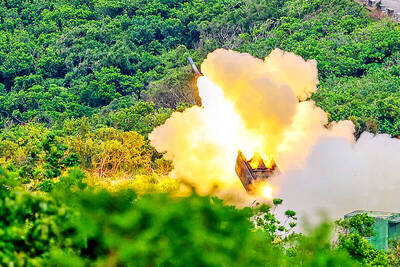
PRECISION STRIKES: The most significant reason to deploy HIMARS to outlying islands is to establish a ‘dead zone’ that the PLA would not dare enter, a source said A High Mobility Artillery Rocket System (HIMARS) would be deployed to Penghu County and Dongyin Island (東引) in Lienchiang County (Matsu) to force the Chinese military to retreat at least 100km from the coastline, a military source said yesterday. Taiwan has been procuring HIMARS and Army Tactical Missile Systems (ATACMS) from the US in batches. Once all batches have been delivered, Taiwan would possess 111 HIMARS units and 504 ATACMS, which have a range of 300km. Considering that “offense is the best defense,” the military plans to forward-deploy the systems to outlying islands such as Penghu and Dongyin so that
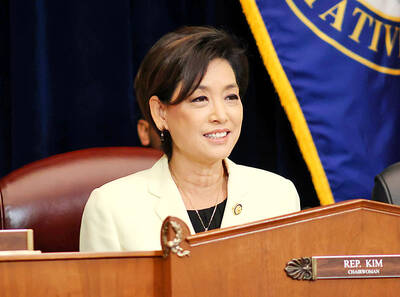
‘CLEAR MESSAGE’: The bill would set up an interagency ‘tiger team’ to review sanctions tools and other economic options to help deter any Chinese aggression toward Taiwan US Representative Young Kim has introduced a bill to deter Chinese aggression against Taiwan, calling for an interagency “tiger team” to preplan coordinated sanctions and economic measures in response to possible Chinese military or political action against Taiwan. “[Chinese President] Xi Jinping [習近平] has directed the People’s Liberation Army to be ready to invade Taiwan by 2027. China has a plan. America should have one too,” Kim said in a news release on Thursday last week. She introduced the “Deter PRC [People’s Republic of China] aggression against Taiwan act” to “ensure the US has a coordinated sanctions strategy ready should

Taiwan Semiconductor Manufacturing Co (TSMC, 台積電), the world’s largest foundry service provider, yesterday said that global semiconductor revenue is projected to hit US$1.5 trillion in 2030, after the figure exceeds US$1 trillion this year, as artificial intelligence (AI) demand boosts consumption of token and compute power. “We are still at the beginning of the AI revolution, but we already see a significant impact across the whole semiconductor ecosystem,” TSMC deputy cochief operating officer Kevin Zhang (張曉強) said at the company’s annual technology symposium in Hsinchu City. “It is fair to say that in the past decade, smartphones and other mobile devices were


 RSS
RSS