


For New York native Will Kern, working at the Taipei Times 15 years ago as a copy editor, page designer and foreign desk editor influenced his decision to start an international news translation service based in Manhattan that serves as a cross-cultural bridge between the US and other countries.
Kern, who used the surname Mittler during his stint at the Taipei Times, says his interest in global affairs started with an internship with the UN as a teenager, where he worked on global environmental challenges. A brief stint at the International Herald Tribune also impacted his decision to launch the service — although the seeds were sewn in Taiwan.
reading america
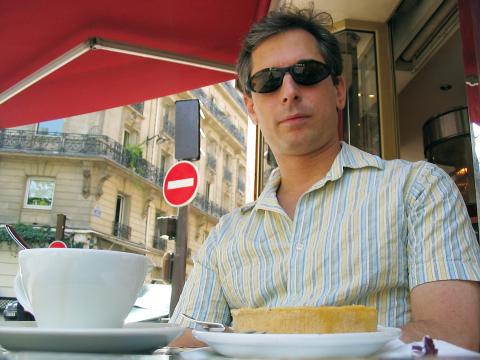
Photo Courtesy of Will Kern
Kern is now focused on a personal journalism project, the WorldMeets.US Web site, which was set up as an educational non-profit operation.
Since 2005 he has been translating content about the US from newspapers around the globe — Le Monde in Paris, Corriere della Sera in Rome and La Jornada in Mexico — to give Americans a glimpse of how the world sees America.
“My time at the Taipei Times was critical to my career,” he said in an e-mail.
“The Taipei Times was created as a great experiment in Western newspapering in a Chinese-speaking country. Almost the entire editorial staff was drawn from around the world to put out a newspaper that would cover one of [Asia’s] great metropolises in the Western style — and it was a very exciting time for me to be there then.”
In 2002, Kern worked an editorial job for the International Herald Tribune based in Paris. He returned to New York in 2003.
‘TRANS-COPY EDITING’
After his experience abroad, Kern felt he wanted to create a Drudge-like Web site with daily coverage of what the rest of the world thinks of the US.
“That’s how an early version of WorldMeets.US was born,” he said. “But I quickly realized that in order to do this properly, we had to translate huge amounts of content into English.”
It was at this point that Kern came up with the concept of what he calls “trans-copy editing.”
“It’s a system for checking the accuracy of translated copy into multiple languages,” he said.
Kern says his ultimate goal with WorldMeet.US is to create a wave of citizen diplomacy and a global community that promotes peace, cross-cultural understanding and positive relationships between Americans and people of other nations.
Kern is the managing editor of his news service and brings to the site over a decade of experience as a journalist and editor in Taiwan and France.
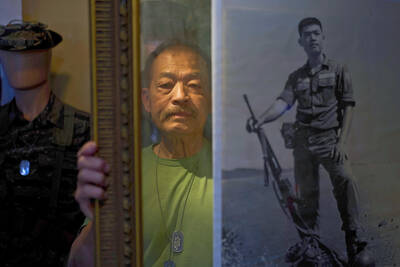
When the South Vietnamese capital of Saigon fell to the North Vietnamese forces 50 years ago this week, it prompted a mass exodus of some 2 million people — hundreds of thousands fleeing perilously on small boats across open water to escape the communist regime. Many ultimately settled in Southern California’s Orange County in an area now known as “Little Saigon,” not far from Marine Corps Base Camp Pendleton, where the first refugees were airlifted upon reaching the US. The diaspora now also has significant populations in Virginia, Texas and Washington state, as well as in countries including France and Australia.

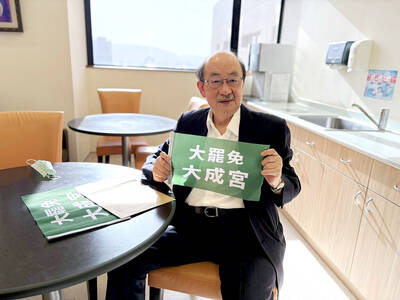
On April 17, Chinese Nationalist Party (KMT) Chairman Eric Chu (朱立倫) launched a bold campaign to revive and revitalize the KMT base by calling for an impromptu rally at the Taipei prosecutor’s offices to protest recent arrests of KMT recall campaigners over allegations of forgery and fraud involving signatures of dead voters. The protest had no time to apply for permits and was illegal, but that played into the sense of opposition grievance at alleged weaponization of the judiciary by the Democratic Progressive Party (DPP) to “annihilate” the opposition parties. Blamed for faltering recall campaigns and faced with a KMT chair
Article 2 of the Additional Articles of the Constitution of the Republic of China (中華民國憲法增修條文) stipulates that upon a vote of no confidence in the premier, the president can dissolve the legislature within 10 days. If the legislature is dissolved, a new legislative election must be held within 60 days, and the legislators’ terms will then be reckoned from that election. Two weeks ago Taipei Mayor Chiang Wan-an (蔣萬安) of the Chinese Nationalist Party (KMT) proposed that the legislature hold a vote of no confidence in the premier and dare the president to dissolve the legislature. The legislature is currently controlled
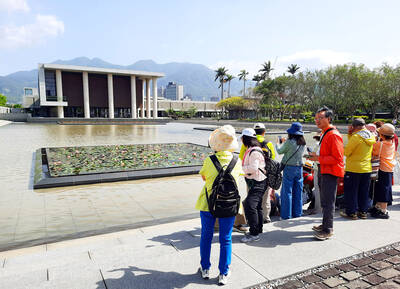
Dull functional structures dominate Taiwan’s cityscapes. But that’s slowly changing, thanks to talented architects and patrons with deep pockets. Since the start of the 21st century, the country has gained several alluring landmark buildings, including the two described below. NUNG CHAN MONASTERY Dharma Drum Mountain (法鼓山, DDM) is one of Taiwan’s most prominent religious organizations. Under the leadership of Buddhist Master Sheng Yen (聖嚴), who died in 2009, it developed into an international Buddhist foundation active in the spiritual, cultural and educational spheres. Since 2005, DDM’s principal base has been its sprawling hillside complex in New Taipei City’s Jinshan District (金山). But


 RSS
RSS