


"Billions of bilious blue blistering barnacles!” As Tintin prepares to take on the world in Steven Spielberg’s blockbuster, the fearless boy reporter’s adventures are hotting up at home.
Thirty years in the making, the Avatar-style film hits screens worldwide this week as the Belgium-born comic-book hero fends off racism charges, squabbles over his legacy, and whisperings over his sexuality and morals.
A children’s bedside classic in much of Europe, the movie and its sequels by Lord of the Rings director Peter Jackson, look set to fire up sales of Tintin’s 24 adventures from Tibet to the Moon that have left heirs to their author, Herge, sitting pretty on a pot of gold.
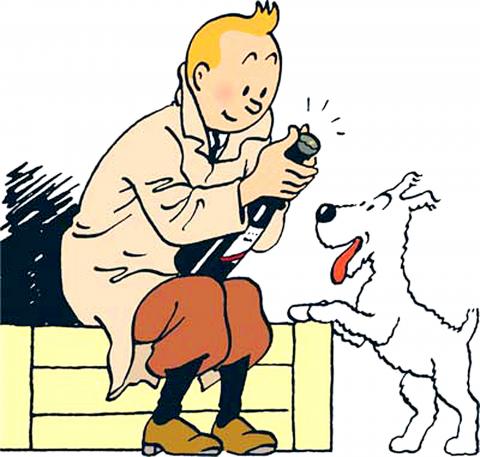
Photo: Bloomberg
But the couple overseeing his legacy — worth almost as much as Sean Connery and far more than Hugh Grant according to this year’s Sunday Times “Rich List” — are under a barrage of “thundering typhoons” from Tintinophiles over the merchandising of the intrepid boy crusader.
If the movie, as expected, turns out to be a box-office hit in tune with the spirit of the original comic character, the Tintin revival may soothe the squabblings and turn the page on his creator’s controversial dealings with the wartime far right.
Herge, real name Georges Remi and one of Belgium’s most beloved sons, died childless in 1983 at age 75, leaving the estate to his widow Fanny Vlamynck, a coloring artist 28 years his junior.
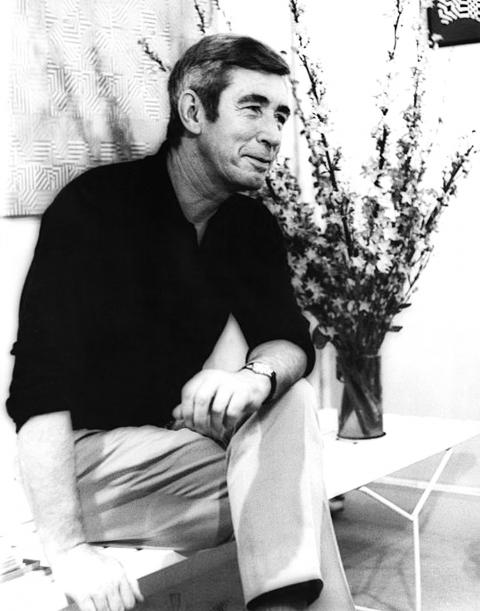
Photo: Bloomberg
By all accounts more interested in Buddhism than business, and more focused on Herge’s groundbreaking graphics than his art as storyteller, Vlamynck for the past decade has left business dealings in the hands of second husband, Nick Rodwell.
The controversial Briton, 18 years her junior, has slowly but surely taken Tintin’s face off mustard pots and the like to refocus the brand in line with his belief that “Tintin is the Rolls Royce of comic books.”
The couple to that end gifted an original Herge plate to Paris’ contemporary Pompidou Centre art house, and in 2009 opened a US$20 million museum to his glory, designed by a Pritzker prize-winning architect and largely dedicated to Herge’s art, rather than best-selling cartoon character.
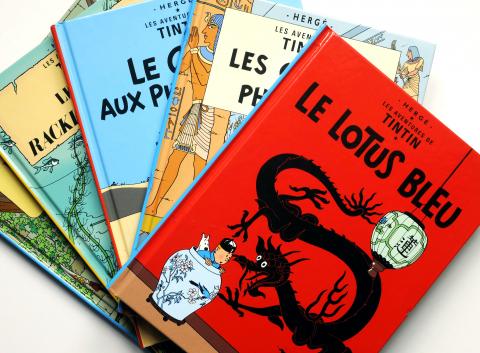
Photo: AFP
Rodwell, said Hugues Dayez, author of a book on the Tintin legacy, “has completely cut Tintin off from children and from popular culture.”
While Brussels’ official Tintin boutique does offer small figures at around US$5.50 a shot, prints go for US$76 and collectors’ items such as the iconic red rocket range from US$61 to US$417.
The couple moreover have irked the press as well as the Tintinophiles.
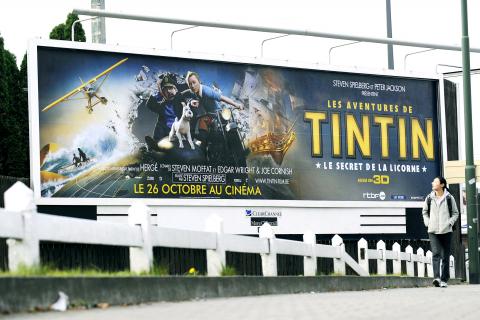
Photo: Bloomberg
In 2009, Rodwell kicked off a local storm after branding a journalist “a liar” and attacking two others on the official Tintin.com Web site. With Belgians already smarting over Rodwell’s increasing restrictions over the use of the image of their favorite cartoon, the Web site shut down Rodwell’s blog.
Worth US$101 million, according to the Sunday Times, the couple will be under strict scrutiny by critics over the movie’s treatment of Tintin under a deal between the pair and Hollywood.
“There’s a risk that Spielberg’s vision will undermine Herge’s,” Jean-Claude Jouret, a former manager of the estate said. “It’s undoubtedly good business but perhaps it won’t help the long-term preservation of his work.”
Belgian critics, however, hailed a sneak preview of The Adventures of Tintin — The Secret of the Unicorn as “a bull’s-eye” earlier this month.
And Dominique Maricq, an old-timer at Herge Studios, said that Hollywood appeared bent “on respecting the spirit of Tintin’s world, of not turning him into an American super-hero.”
Meanwhile, a years-long racism case against Tintin in Congo wound up on Oct. 14 in a Brussels court with Congolese citizen Bienvenu Mbutu Mondondo demanding the album be pulled off shelves as “a justification of colonization and white supremacy.”
The 1931 book’s childlike savages with their blubbery lips and poor French would offend any African child, he said.
Herge was anything but racist, retorted lawyers for his publishers and heirs. The neatly turned-out boy reporter with the quiff was a pure product of Herge’s long involvement with the do-gooders of the Boy Scouts movement, he said.
A fresh-faced 23-year-old when he wrote the strip that became his second album, Herge had never traveled beyond his native Belgium, drawing inspiration as in all his works from books, museums, chance encounters and reports in the press.
“Herge reflected the times, it wasn’t racism but kind paternalism,” said lawyer Alain Berenboom, urging the judge, who will rule early next year, not to ban the book.
A similar appeal in Sweden against the album, published when Belgium ruled what is today the Democratic Republic of Congo, was thrown out. But in 2007 US bookstore chain Borders said it would pull copies from the children’s shelves.
Britain’s Commission for Racial Equality the same year deemed it contained imagery and words “of hideous racial prejudice,” sending sales rocketing up.
Through his lifetime, Herge was no stranger to political controversy.
Arrested after World War II for collaborating with the Nazis after his wartime Tintin strips appeared in a German mouthpiece newspaper, Herge subsequently faced finger-pointing over anti-Semitism, notably over Tintin’s enemy in The Shooting Star — a greedy American financier originally called Blumenstein.
Like other cartoon superheros, Tintin has become a literary legend, with academics, psychiatrists, journalists and culture buffs alike exploring his persona — and his author’s — in hundreds of learned articles and almost as many books.
Herge’s political leanings aside, one age-old mystery remains Tintin’s sexuality.
“Of course Tintin’s gay. Ask Snowy,” said the Times journalist Matthew Parris when the boy reporter turned 80 in 2009.
“What debate can there be when the evidence is so overwhelmingly one-way? A callow, androgynous blond-quiffed youth in funny trousers and a scarf moving into the country mansion of his best friend, a middle-aged sailor,” he wrote, referring to foul-mouthed whisky aficionado Captain Haddock.
The near absence of women in the Herge universe too has intrigued — only eight of some 350 characters are identifiably female — as well as Tintin’s lack of a love interest, a trait respected by the Spielberg-Jackson duo.
Snowy on the other hand is “unambiguously heterosexual,” said Parris, adding that his tendency to be distracted by lady dogs “is consistently foiled by his master.”
“Pity this dog, wretchedly straight and trapped in a ghastly web of gay human males.”
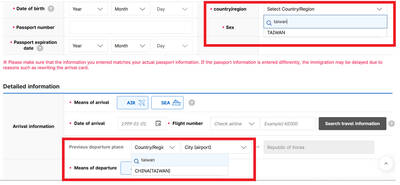
Jason Han says that the e-arrival card spat between South Korea and Taiwan shows that Seoul is signaling adherence to its “one-China” policy, while Taiwan’s response reflects a reciprocal approach. “Attempts to alter the diplomatic status quo often lead to tit-for-tat responses,” the analyst on international affairs tells the Taipei Times, adding that Taiwan may become more cautious in its dealings with South Korea going forward. Taipei has called on Seoul to correct its electronic entry system, which currently lists Taiwan as “China (Taiwan),” warning that reciprocal measures may follow if the wording is not changed before March 31. As of yesterday,
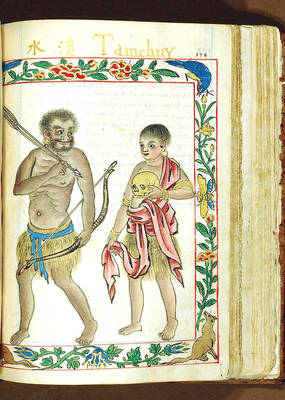
The Portuguese never established a presence on Taiwan, but they must have traded with the indigenous people because later traders reported that the locals referred to parts of deer using Portuguese words. What goods might the Portuguese have offered their indigenous trade partners? Among them must have been slaves, for the Portuguese dealt slaves across Asia. Though we often speak of “Portuguese” ships, imagining them as picturesque vessels manned by pointy-bearded Iberians, in Asia Portuguese shipping between local destinations was crewed by Asian seamen, with a handful of white or Eurasian officers. “Even the great carracks of 1,000-2,000 tons which plied
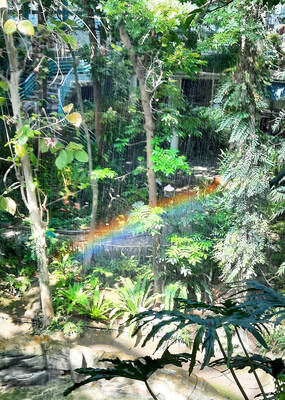
It’s only half the size of its more famous counterpart in Taipei, but the Botanical Garden of the National Museum of Nature Science (NMNS, 國立自然科學博物館植物園) is surely one of urban Taiwan’s most inviting green spaces. Covering 4.5 hectares immediately northeast of the government-run museum in Taichung’s North District (北區), the garden features more than 700 plant species, many of which are labeled in Chinese but not in English. Since its establishment in 1999, the site’s managers have done their best to replicate a number of native ecosystems, dividing the site into eight areas. The name of the Coral Atoll Zone might

Nuclear power is getting a second look in Southeast Asia as countries prepare to meet surging energy demand as they vie for artificial intelligence-focused data centers. Several Southeast Asian nations are reviving mothballed nuclear plans and setting ambitious targets and nearly half of the region could, if they pursue those goals, have nuclear energy in the 2030s. Even countries without current plans have signaled their interest. Southeast Asia has never produced a single watt of nuclear energy, despite long-held atomic ambitions. But that may soon change as pressure mounts to reduce emissions that contribute to climate change, while meeting growing power needs. The


 RSS
RSS