


Hard on the coattails of the Oscar and box-office success of Black Swan comes an initiative to revamp ballet’s image for a more pop and style-conscious audience.
The English National Ballet will this month stage a catwalk show of tutus created by leading fashion designers. Erdem, Giles Deacon, Moschino and Bruce Oldfield are among those who have designed tutus that will be worn on the catwalk by star ballerinas. The tutus will then be auctioned to raise money for the company.
The evening, to be held at the Orangery in Kensington Palace in London, is intended as “a gear change in terms of what ballet is,” according to Craig Hassall, managing director of the English National Ballet. The party will capitalize on “this season’s obsession with all things ballet.”
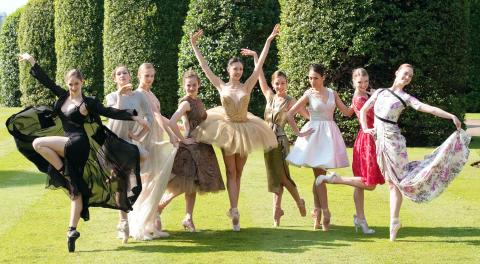
Photo: AFP
This is not the first time ballet has used fashion to maneuver itself closer to the cutting edge. In the 1920s, Sergei Diaghilev collaborated with Coco Chanel, and the simple, modernist silk-jersey costumes she created for the 1924 ballet Le Train Bleu played a role in Diaghilev’s audacious strategy to place his Ballets Russes at the center of fashionable life in Paris.
Links between ballet and fashion have remained strong ever since, with designers including Christian Lacroix and Jasper Conran designing tutus for major ballets. The costumes of the Ballets Russes have in turn inspired many fashion designs, including Yves Saint Laurent’s autumn 1976 collection and the current collection by the London-based designer Erdem.
“In France or Spain, going to the ballet is not seen as so elitist. It’s more like going to the football. It’s part of the culture. That’s what I want for ballet here,” says Hassall, who ran the cultural program for the Sydney Olympics and has recently signed up as associate director of cultural celebrations for next year’s London Games. “The point is to make young people realize that ballet is fun and glamorous — that it might be for them, after all.”
Lauretta Summerscales, a 20-year-old rising star of the corps de ballet, will model a tutu by Agent Provocateur at the fundraising event on 29 June. She describes the costume as “very sexy. It kind of lures you in. I feel great in it, very in control.”
While the focus on fashion is targeting younger women, the more muscular side of ballet is also reaching new audiences, boosted by the success of the recent UK television documentary Agony and Ecstasy.
Max Westwell, a 25-year-old English National Ballet dancer who featured in the program, was inundated by Facebook messages from new converts to ballet after the broadcast.
“The response was incredible. People tend to think of ballet as a bit dainty and a bit ethereal, but the program showed its physicality, the working as a team, the levels of stress. I’ve got rugby player friends who come and watch me now. It’s becoming quite cool to be a dancer.”
The avant-garde credentials of ballet will be further boosted this September with the opening of Degas and the Ballet, an exhibition at the Royal Academy in London, that aims to challenge the “chocolate box” reputation of Degas and show the painter as “a conceptual and extremely radical, highly innovative artist”, according to the curator, Ann Dumas.
Last year, London’s Victoria and Albert Museum’s exhibition Sergei Diaghilev and the Ballets Russes drew 100,000 visitors, and ballet has seeped into popular culture.
But not everyone welcomes ballet forging closer links with the fashion world. The English National Ballet experimented with designer tutus two years ago, when Karl Lagerfeld designed a costume for Elena Glurdjidze to dance The Dying Swan.
Lagerfeld’s involvement gave the show top billing in glossy magazines and delivered a paparazzi-friendly crowd to the opening night, but dance critics were less impressed. The high ostrich-feather neck ruff, which was felt to obscure the graceful lines central to the role, came in for particular criticism.
Perhaps in reaction to this, the new tutus will be shown on a catwalk, not a stage.
“Ballet is a very technical art form and one with a very strong tradition,” says Hassall. “There is no doubt that we run the risk of upsetting people. But it’s a risk we have to take.”
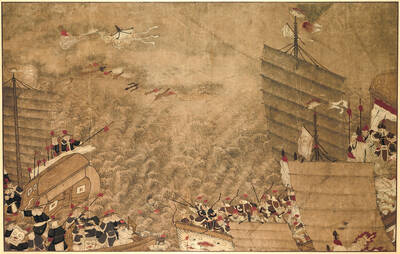
For many centuries from the medieval to the early modern era, the island port of Hirado on the northwestern tip of Kyushu in Japan was the epicenter of piracy in East Asia. From bases in Hirado the notorious wokou (倭寇) terrorized Korea and China. They raided coastal towns, carrying off people into slavery and looting everything from grain to porcelain to bells in Buddhist temples. Kyushu itself operated a thriving trade with China in sulfur, a necessary ingredient of the gunpowder that powered militaries from Europe to Japan. Over time Hirado developed into a full service stop for pirates. Booty could

Politically charged thriller One Battle After Another won six prizes, including best picture, at the British Academy Film Awards on Sunday, building momentum ahead of Hollywood’s Academy Awards next month. Blues-steeped vampire epic Sinners and gothic horror story Frankenstein won three awards each, while Shakespearean family tragedy Hamnet won two including best British film. One Battle After Another, Paul Thomas Anderson’s explosive film about a group of revolutionaries in chaotic conflict with the state, won awards for directing, adapted screenplay, cinematography and editing, as well as for Sean Penn’s supporting performance as an obsessed military officer. “This is very overwhelming and wonderful,” Anderson

Social media addiction has been compared to casinos, opioids and cigarettes. While there’s some debate among experts about the line between overuse and addiction, and whether social media can cause the latter, there is no doubt that many people feel like they can’t escape the pull of Instagram, TikTok, Snapchat and other platforms. The companies that designed your favorite apps have an incentive to keep you glued to them so they can serve up ads that make them billions of dollars in revenue. Resisting the pull of the endless scroll, the dopamine hits from short-form videos and the ego boost and validation

When sifting through the seemingly endless collection of documents in the Epstein files gets to be too much and Ellie Leonard needs a break, she takes a walk outside. Then it’s back to the computer. The New Jersey mother of four is among hundreds of citizen-journalists, or sleuths, absorbed by the material connected to the late Jeffrey Epstein. She’s determined to learn the stories behind his illicit sex ring and relationships with some of the world’s most powerful people, and publish what she finds on Substack. “I like a good puzzle,” Leonard said. “I like an investigation. I like things that we


 RSS
RSS