


It is such a drag to look forward to a return to a much-loved restaurant, go there and find it’s gone. So imagine this reviewer’s disappointment in walking down the alley to Sababa in Tianmu for hummus, falafels and gyros, only to discover the restaurant is no more. Happily, however, shining back from a glossy menu at the same location were mouthwatering photographs of enchiladas, burritos, chimichangas and other beloved Tex-Mex fare, as well as the Eddy’s Cantina (艾迪墨西哥餐廳) logo.
Eddy’s, which began life as a burrito stand in Tamsui’s night market before opening its mortar-and-bricks restaurant a few blocks away in 2008, opened its second branch right off Zhongshan North Road Section 6 on May 2.
Owners Eddy Gonzalez and his wife have kept Sababa’s basic table layout and color scheme, only there are now Mexican flags and a mix of family and historical photographs for decor, while a large part of their Tamsui menu — tacos (soft or hard shell), burritos (classic and “wet”), quesadillas, chimichangas and enchiladas — has made the move to Tianmu and kiddie portions are available on request. The dessert menu is not as extensive, just tortilla dulce, which is similar to a crepe, cinnamon sweet chips and ice cream, and not all the vegetarian options are available, but Gonzalez said he will try to meet requests.
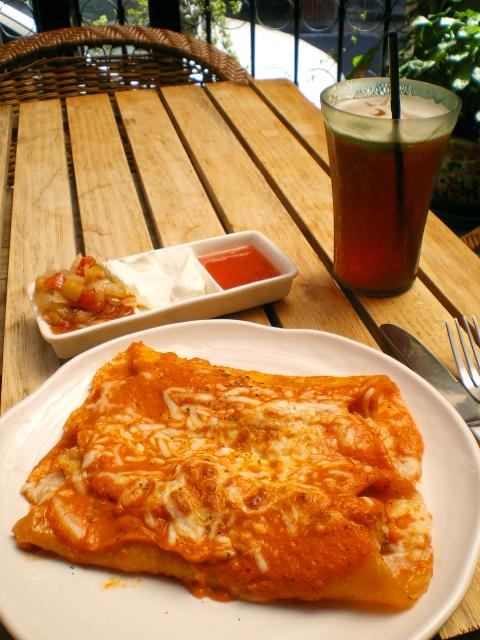
Photo: Diane Baker, Taipei Times
Eddy has left the Tamsui operations in the hands of long-time staffers for now so he can focus on getting his Tianmu crew up to speed.
Most of the entrees are offered in a choice of four fillings: chicken, steak, carnitas (pork) or vegetarian — either potatoes or refried beans (made without lard) — while there are also fish tacos (soft shelled) or seasoned ground beef for the hard shell tacos. The prices are mostly between NT$200 and NT$289, though a five-taco plate will take you to the NT$450 mark. For NT$95 more, you can turn an entree into a full meal with a soft drink or tea and a choice of two of the following: beans, rice, chips or salad and potatoes.
The tortillas, chips and salsas are all homemade. While the vegetarian chimichanga was filling, it was a bit dry and the small servings of salsa, salsa verde and sour cream didn’t go far. The enchilada plate, however, was perfect.
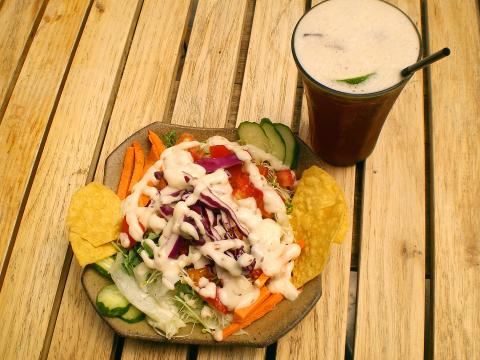
Photo: Diane Baker, Taipei Times
Since Eddy is trying to convert Taiwanese to Mexican cuisine, he’s trying not to scare away people by making anything too spicy, so if you like your Tex-Mex hot, you’ll have to spice it up yourself with extra helpings of the more fiery salsas.
The drinks menu runs the gamut from standard soft drinks (including imports such as A&W Root Beer and Dr Pepper), ice tea or rooibos tea to a choice of Taiwan Beer or eight imported beers and ales (including Corona, Anchor Steam and Dead Guy) and a few cocktails (margaritas, horchatas, tequila sunrises).
Eddy’s Web site (www.eddyscantina.com) has menus for both locations and provides delivery information for people living outside Taipei who have a hankering for chicken/pork/steak burritos, enchiladas or quesadillas.
By the way, for fans of Sababa, there are just two locations left in Taipei, one at 8, Alley 54, Ln 118, Heping E Rd Sec 2, Taipei City (台北市和平東路二段118巷54弄8號), the other at 17, Ln 283, Roosevelt Rd Sec 3, Taipei City (台北市羅斯福路三段283巷17號). For more on Sababa, visit www.sababapita.com.
If one asks Taiwanese why house prices are so high or why the nation is so built up or why certain policies cannot be carried out, one common answer is that “Taiwan is too small.” This is actually true, though not in the way people think. The National Property Administration (NPA), responsible for tracking and managing the government’s real estate assets, maintains statistics on how much land the government owns. As of the end of last year, land for official use constituted 293,655 hectares, for public use 1,732,513 hectares, for non-public use 216,972 hectares and for state enterprises 34 hectares, yielding
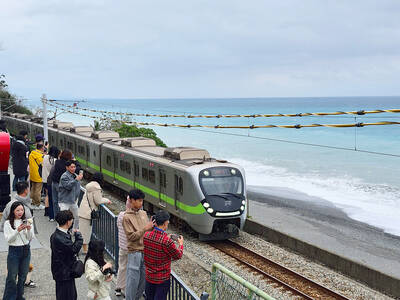
The small platform at Duoliang Train Station in Taitung County’s Taimali Township (太麻里) served villagers from 1992 to 2006, but was eventually shut down due to lack of use. Just 10 years later, the abandoned train station had become widely known as the most beautiful station in Taiwan, and visitors were so frequent that the village had to start restricting traffic. Nowadays, Duoliang Village (多良) is known as a bit of a tourist trap, with a mandatory, albeit modest, admission fee of NT$10 giving access to a crowded lane of vendors with a mediocre view of the ocean and the trains

The March/April volume of Foreign Affairs, long a purveyor of pro-China pablum, offered up another irksome Beijing-speak on the issues and solutions for the problems vexing the People’s Republic of China (PRC) and the US: “America and China at the Edge of Ruin: A Last Chance to Step Back From the Brink” rang the provocative title, by David M. Lampton and Wang Jisi (王緝思). If one ever wants to describe what went wrong with US-PRC relations, the career of Wang Jisi is a good place to start. Wang has extensive experience in the US and the West. He was a visiting
One of the challenges with the sheer availability of food in today’s world is that lots of us end up spending many of our waking hours eating. Whether it’s full meals, snacks or desserts, scientists have found that it’s not uncommon for us to be mindlessly grazing at some point during all of our 16 or so waking hours. The problem? As soon as this food hits the bloodstream in the form of glucose, it initiates the release of the hormone insulin. This in turn activates a switch present in every one of our cells, which is responsible for driving cell


 RSS
RSS