


The glamorous romance between Richard Li (李澤楷), the youngest son of business tycoon Li Ka-shing (李嘉誠), and starlet Isabella Leong (梁洛施) has hit the rocks in a spectacular smashup over which Hong Kong media have been licking their lips. What had originally been seen as a fairy-tale relationship has now been dubbed by the Chinese-language media as “the breakup of the century” (世紀分手). Papa Li, chairman of Hutchison Whampoa and Cheung Kong Holdings, is widely acknowledged as the richest person in Asia and is ranked the 14th richest person in the world, and this background of great wealth has fueled intense media speculation about the reasons for the separation and the amount of any settlement.
Earlier this week Li junior announced that he would separate from the Macau-born singer and actress also known as Luisa Isabella Nolasco da Silva. In the statement he categorically denied that a “third party” was involved, and stated that there was no financial dispute.
Both parties are keeping tight-lipped about the reasons for the breakup, which has only encouraged speculation. The most popular of the theories is the suggestion that Li formed a connection with 25-year-old model Mandy Lieu (劉碧麗). Lieu has vehemently denied suggestions that she is involved with Li, and Now.com, after extensive coverage of Lieu’s possible part in the breakup, says that the “third party” might be another woman called Mandy but surnamed “Cheung” or “Chong.”
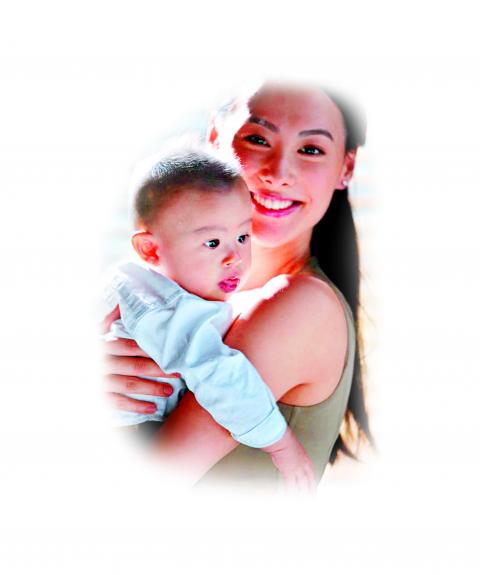
Photo: Taipei times
When Leong was first linked to Li, the relationship was dubbed a “capitalist Cinderella dream” (資本主義的灰姑娘傳奇) come true, and whatever the truth of the allegations, Lieu has now acquired the nickname of the “Cinderella killer” (灰姑娘殺手).
Rumors of a separation payment of US$3.4 million have been reported, though there has been no confirmation. Although unmarried, Leong gave birth to three children by Li junior.
Leong’s prospects, however, are far from bleak. A return to the silver screen is widely rumored and industry insiders estimate her appearance fee would be second only to Cecilia Cheung’s (張柏芝). The Liberty Times (the Taipei Times’ sister paper) goes so far as to suggest she could easily pick up US$1.2 million for a feature appearance. Stay tuned.
Speaking of financial settlements, some details of a compensation payment for former S.H.E member Selina Jen (任家萱), who suffered severe burns to more than 50 percent of her body while filming the TV adaptation of the 1994 movie I Have a Date With Spring (我和春天有個約會) in Shanghai last year, have been released.
The United Daily News quoted unnamed Chinese media sources as saying a settlement worth US$1.5 million has brought the whole tragic incident to a close. This is regarded as a relatively low sum, with estimates based on Jen’s marketability at the time of the accident putting the appropriate figure at US$3.3 million. The paper speculates that the parties involved wanted to draw a line under the matter.
On a happier note, pop singer Fan Fan (范瑋琪) and basketball star-turned-entertainer Charles Chen (陳建州), better known as Blackie (黑人), will tie the knot in May. Earlier this week, the Apple Daily caught the couple at their wedding photo in Taipei’s Xinyi District. Celebrity rags are already drooling at the prospect of the nuptials as rumors are circulating that pop star Wang Lee-hom (王力宏) will be best man, Aboriginal musician Biung (王宏恩) will provide the music and the whole thing will be organized by Chang Hui-mei’s (張惠妹, aka A-mei, 阿妹) agent Edward Chan (陳鎮川). The Apple Daily estimates that the banquet, already booked for the recently opened W Hotel, will run to 50 tables at least.
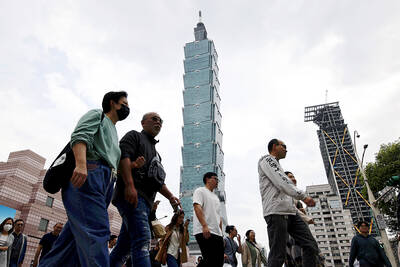
In the March 9 edition of the Taipei Times a piece by Ninon Godefroy ran with the headine “The quiet, gentle rhythm of Taiwan.” It started with the line “Taiwan is a small, humble place. There is no Eiffel Tower, no pyramids — no singular attraction that draws the world’s attention.” I laughed out loud at that. This was out of no disrespect for the author or the piece, which made some interesting analogies and good points about how both Din Tai Fung’s and Taiwan Semiconductor Manufacturing Co’s (TSMC, 台積電) meticulous attention to detail and quality are not quite up to

April 21 to April 27 Hsieh Er’s (謝娥) political fortunes were rising fast after she got out of jail and joined the Chinese Nationalist Party (KMT) in December 1945. Not only did she hold key positions in various committees, she was elected the only woman on the Taipei City Council and headed to Nanjing in 1946 as the sole Taiwanese female representative to the National Constituent Assembly. With the support of first lady Soong May-ling (宋美齡), she started the Taipei Women’s Association and Taiwan Provincial Women’s Association, where she
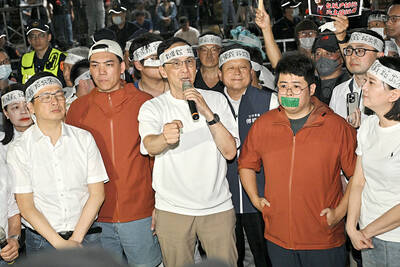
Chinese Nationalist Party (KMT) Chairman Eric Chu (朱立倫) hatched a bold plan to charge forward and seize the initiative when he held a protest in front of the Taipei City Prosecutors’ Office. Though risky, because illegal, its success would help tackle at least six problems facing both himself and the KMT. What he did not see coming was Taipei Mayor Chiang Wan-an (將萬安) tripping him up out of the gate. In spite of Chu being the most consequential and successful KMT chairman since the early 2010s — arguably saving the party from financial ruin and restoring its electoral viability —
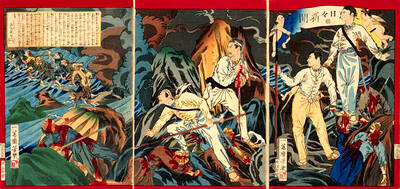
It is one of the more remarkable facts of Taiwan history that it was never occupied or claimed by any of the numerous kingdoms of southern China — Han or otherwise — that lay just across the water from it. None of their brilliant ministers ever discovered that Taiwan was a “core interest” of the state whose annexation was “inevitable.” As Paul Kua notes in an excellent monograph laying out how the Portuguese gave Taiwan the name “Formosa,” the first Europeans to express an interest in occupying Taiwan were the Spanish. Tonio Andrade in his seminal work, How Taiwan Became Chinese,


 RSS
RSS