


Pop Stop can see it now: Child star breaks into acting, age three. Adored by audiences for his chatty personality and precocious behavior, by age five he’s a fixture on the variety and talk show circuit, raking in big bucks from endorsements and special appearances. And then, well just ask Gary Coleman or Macaulay Culkin.
Recent comments by child star Hsiao Hsiao Bin (小小彬), 5, the stage name of Wen Hsuan-yeh (溫玄燁), suggest that his innocent exterior may already be cracking.
While other prepubescent kids are calling girls yucky, a “mature”
Hsiao Hsiao Bin seems to have the ladies on his mind, according to a NOWnews report.
“Did you see any pretty chicks?” he asked Blue Lan (藍正龍), referring to the latter’s recent trip to the Cannes Film Festival. Lan, caught off guard, quickly changed the subject. Perhaps it’s time for Hsiao Hsiao Bin to follow the example set by his Autumn’s Concerto (下一站,幸福) costar Van Ness Wu (吳建豪), and sign a “celibacy card.”
In other Hsiao Hsiao Bin news, the little tyke appeared last week at an event promoting road safety tips. He even received a “driver’s license.”
But perhaps a little more walking is in order. The Apple Daily reports that the muppet wanted to go on a diet after his grandmother complained that he looked fat on television.
His father chipped in with a lone voice of reason amid the fame-hungry, moneygrubbing denizens of the entertainment industry, with words to the effect that five-year-olds shouldn’t need to go on a diet.
Of course, much of the little rascal’s on-screen antics are prompted by his handlers, which could be cause for concern because as he grows up, who knows what kind of behavior he’ll be parroting?
And speaking of exotic birds, Sina.com reports that Cecilia Cheung (張柏芝) will return to work at the end of this month, six weeks after giving birth to her second son, Quintus. The Hong Kong beauty, who featured prominently in a sex photo scandal in 2008 involving Edison Chen (陳冠希), will head off to Shanghai to promote a bedding company, which seems all too appropriate.
Her ability to parlay the tarnish of a sex scandal into an honest day’s graft is to be lauded. And why stop at bedding? Watch out for Cheung plugging feminine hygiene products, condoms and lingerie in the near future.
Meanwhile, leggy supermodel and “actress” Lin Chi-ling (林志玲), 35, took top honors in FHM’s sexiest woman in the world contest. This follows her win late last year for having the best boobs in Taiwan.
Apple was quick to point out that in light of her struggling movie career (Lin’s most recent film, The Treasure Hunter (刺陵), flopped) she should stick to the catwalk.
Pop diva Jolin Tsai (蔡依林) came in fourth, followed by Patty Hou (侯佩岑) and Amber An (安心亞), who took sixth and eighth places, respectively.
Another Taiwanese star who might want to stick to one career is singer, producer, actor and director Jay Chou (周杰倫). His recent television series Pandamen (熊貓人) bombed. But the Chairman said in a recent interview with U Weekly (優1周) that his greatest problem in the entertainment industry is not with directing, but crying, going so far to say that he’d “rather shed blood than tears.”
If thinking about Pandamen’s abysmal reception isn’t enough to make him blubber, Chou might consider taking lessons from Hsiao Hsiao Bin, who is said to be able to cry at the drop of a hat.



Taiwan’s English education system is being pulled apart by three opposing forces. Bilingual Nation 2030 pulls students toward English and global communication. Artificial Intelligence (AI) readiness pulls them toward digital judgment, verification and AI-mediated work. But Taiwan’s old exam culture pulls them back toward memorization, grammar drills, timed reading and correct answers. If the education system keeps using old exams to define success, it risks producing graduates who are neither genuinely bilingual nor genuinely AI-ready, but trained for tasks machines can already perform. The first force is Bilingual Nation 2030. Launched in 2018, the policy aimed to “help Taiwan’s workforce connect
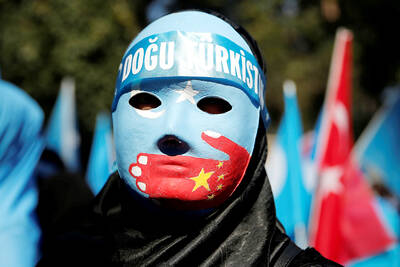
It seems every few days one bumps into one of those “real man” comments in which Taiwan is urged to “face reality” or similar, and “make a deal,” with the speaker implying that soon it will be too late. “Deal” advocates always present themselves as having a superior grip on reality, and the manly ability to make the “hard choice.” Their testosterone-laden language often echoes that of Taiwan sellout advocates. Note that such commentary always specifies a process (“make a deal, work with, make progress”), never the end state of what occupation by a violent authoritarian colonialist state will entail. In

“Taiwan’s Opposition Leader Comes to US With a Message Straight Out of Beijing” read a May 31 headline in the Wall Street Journal. Top US administration officials and members of Congress almost certainly read the WSJ, and if there was a bullet point takeaway that people in Washington should absorb ahead of Chinese Nationalist Party (KMT) Chair Cheng Li-wun’s (鄭麗文) arrival in DC on June 9, that headline is it. The last few columns have discussed this very topic, and the timing is not coincidental. While those top officials likely do not read the Taipei Times, judging by the number
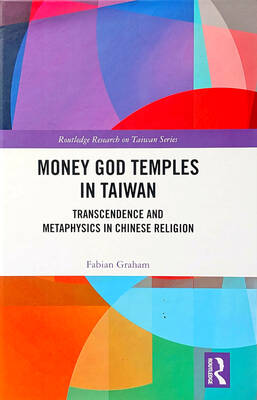
As someone who normally steers clear of books with “transcendence” or “metaphysics” in their subtitles, this reviewer — a casual observer of local belief systems since the 1990s — found Fabian Graham’s Money God Temples in Taiwan a challenging read. Those who’ve only dipped their toes into temple culture will likely need to parse several sections with special care if they’re to keep up with the author, a British ethnographic researcher whose previous books have investigated religious practices among ethnic Chinese in Southeast Asia. This scholarly volume examines a facet of Taiwan’s religious landscape that didn’t exist a century ago, and


 RSS
RSS