


In the age of MP3s, the album isn’t dead — at least not as an art form. This idea partly inspires a new book that aims to canonize the finest in Taiwanese pop and rock with a list of the 200 best albums released since 1975.
Taiwan Popular Music — 200 Best Albums (台灣流行音樂 200最佳專輯) is one of the first attempts to cull together a definitive list of classic Taiwanese pop and rock albums, complete with background information on each album and artist.
The book, a project conceived by a group of National Taiwan University (NTU) students, is divided into two parts: the first half is a revised edition of a book first printed in 1994 that ranks albums released from 1975 to 1992, and the second half ranks albums released from 1993 to 2005.
At the top of the lists are Lo Ta-yu’s (羅大佑) Pedantry (之乎者也) for 1975 to 1992 and Puyuma musician Pau-dull’s (陳建年) Ocean (海洋) for 1993 to 2005.
TIMES A’ CHANGIN’
For each time period, many of the top contenders mirrored the changes in society and popular music in Taiwan.
It was no surprise that Lo took the top spot for his 1982 debut album, according to Ma Shih-fang (馬世芳), a radio DJ at News 98 (98.1 FM) and one of the founding editors of the book.
“He was such a key figure in the evolution of Taiwanese pop music history,” Ma said in an interview with the Taipei Times.
Indeed, Lo was Taiwan’s first rock rebel. He stepped into the scene at a time when Taiwanese pop was dominated by, as the book puts it, a mindless “gaiety” that remained from the 1970s folk singer movement. “Even his love songs were different — they [always had] a certain degree of bitterness,” said Ma.
On Pedantry, Lo veiled social commentary behind his rock ’n’ roll, much to the consternation of the Government Information Office (新聞局), which put his songs on a radio airplay blacklist.
Then there was his “coarse” voice. “Before Lo Ta-yu, everyone thought you could only [make] an album if you had a beautiful voice,” said Ma. “But [his voice] was perfect for rock singers.”
Other albums topping the list from 1975 to 1993 were released during pivotal and politically turbulent times.
Chinese rocker Cui Jian’s Nothing to My Name (一無所有), which is ranked eighth, came out just two months before the Tiananmen Square incident in 1989 (Cui was included as all albums sung in a Mandarin or Aboriginal language from Taiwan were considered).
Albums like Blacklist Studio’s (黑名單工作室), Songs of Madness (抓狂歌) and Lim Giong’s (林強) Marching Forward (向前走) — both notable as albums sung entirely in Hoklo (commonly known as Taiwanese) and which proudly celebrate a “native Taiwanese” identity — came out in 1989 and 1990, respectively.
“These albums also reflected a certain time … the so-called ‘post-martial law era,’” said Ma, referring to the lifting of martial law in Taiwan in 1987. “During those few years a lot of things were happening, politically, culturally, economically. It’s all reflected in this music and those albums.”
ABORIGINAL MUSIC: THE NEW TAIWANESE POP
The 1993 to 2005 list shows how major labels began to lag creatively while independent artists, Aboriginal musicians in particular, started to thrive, said Ma.
He noted that Pau-dull’s Ocean was an important album not only for its novel fusion of early Taiwanese folk pop and traditional Aboriginal music, but also for its sudden popularity.
Virtually unknown at the time, Pau-dull won the Golden Melody Award’s Best Album accolade in 2000 for Ocean, which “gained a lot of attention in the mainstream media and opened the gates for a lot of musicians with similar backgrounds,” said Ma.
Those musicians include Samingad (紀曉君), Pau-dull’s niece, whose album The Sounds of the Sun, Wind and Grass (太陽風/草原的聲音), ranked fourth, and Puyuma folk legend Kimbo Hu (胡德夫), who took the number two spot with In a Flash (匆匆).
Also rounding out the top is the most famous Puyuma musician of all, A-mei (阿妹), whose 1996 debut album Sisters (姊妹) ranked 10th.
SELECTION CRITERIA
For the 1975 to 1992 list, the top albums were chosen, submitted, then voted upon by over 100 voters consisting of Taiwanese music critics, writers, industry representatives and musicians.
For the 1993 to 2005 list, the voting panel was whittled down to 26 people chosen by the Association of Music Workers In Taiwan (中華音樂人交流協會), a music industry advocacy group, which organized and produced the book.
The criteria for selecting albums were: the album had to be full length (EPs and singles were not considered); the songs had to have lyrics; the language had to be one of the major languages spoken in Taiwan, which include Mandarin, Hoklo, Hakka or an Aboriginal language.
Voters included musical luminaries such as Jonathan Lee (李宗盛), Tsai Chin (蔡琴) and Ma Nien-hsien (馬念先).
A LABOR OF LOVE
For Ma Shih-fang, Taiwan Popular Music — 200 Best Albums is a labor of love that started during his university days at NTU. He points to a particular issue of Rolling Stone from 1987 as his major inspiration. The issue listed the top 100 rock albums of the preceding 20 years for the magazine’s 20th anniversary.
“I thought it was so cool and so good that you could put a whole 20 years of history into a list of 100 albums,” said Ma. “You have these descriptions of every album, [their] cultural impact, the stories behind this music, the character of the musicians — you could get a lot from the list.”
It also pointed to something sorely missing in Taiwan. “While we had all these great artists, great albums, great songs, and they sold very well … we didn’t discuss — seriously discuss — this music, these works,” he said.
Starting in his senior year at NTU, in 1993, Ma and a dozen schoolmates spent several years between classes and military service compiling data from the first vote and researching and writing essays on each album.
Ma also received help from his mother, renowned radio DJ Cora Tao (陶曉清), who served as a co-editor of the book and helped him with industry contacts. They chose to start their list from 1975, under the belief that Taiwanese pop music was born out of the folk movement, which took off in the mid-1970s.
Their time and toil paid off. The original edition of the 1975 to 1992 list, which had a print run of 2,000 copies, sold out within months after its release in 1994, and bootleg copies have found their way to China. The new edition, which hit bookstores at the beginning of the year, has already sold out of its first run of 6,000 copies, according to Ma.
WhITHER THE ALBUM?
Ma concedes that in the age of iTunes, the album, as purchased in the physical form, is becoming a thing of the past. “Which is not necessarily a bad thing … but the album as an art form — if that [disappears], I’ll still feel sad,” he said.
True to the rock n’ roll spirit, Ma is looking to younger generations as a target audience. “I hope this book makes them interested in some good music they’ve never heard before … I hope this can be a kind of a road map for them,” he said.
And Ma is the first to admit the rankings can only mean so much. “Even I don’t agree with a lot of choices on this chart. But it’s just natural. With all these thousands of albums … a lot of brilliant works will be left off.”
He says the book’s greatest value lies in the essays and background information for each album, written in Mandarin by figures in the music industry, radio DJs and prominent writers.
“A pop music artist is like any artist. They deserve to be seriously discussed,” said Ma.
Top 20 Taiwan popular music albums, from 1975 to 1992
[Title, Artist, Year]
1 Pedantry, Lo Ta-yu, 1982 (之乎者也 / 羅大佑 / 1982)
2 Su Rui, Julie Su, 1983 (蘇芮專輯 / 蘇芮 / 1983)
3 Olive Tree, Qi Yu, Xinge, 1979 (橄欖樹 / 齊豫 / 1979)
4 Blue Skies Every Day, Michelle Pan, 1982 (天天天藍 / 潘越雲 / 1982)
5 Spirit of Life, Jonathan Lee, 1986 (生命中的精靈 / 李宗盛 / 1986)
6 Marching Forward, Lim Giong, 1990 (向前走 / 林強 / 1990)
7 Descendants of the Dragon, Li Jian-fu, 1980 (龍的傳人 / 李建復 / 1980)
8 Nothing to My Name, Cui Jian, 1989, (一無所有 / 崔健 / 1989)
9 Masters of the Future, Lo Ta-yu, 1983 (未來的主人翁 / 羅大佑/ 1983)
10 Songs of Madness, Blacklist Studio, 1989 (抓狂歌 / 黑名單工作室 / 1989)
11 Echoes, Qi Yu and Michelle Pan, 1985 (回聲 / 齊豫潘越雲 / 1985)
12 Christine Hsu, Christine Hsu, 1987 (許景淳專輯 /許景淳 / 1987)
13 The Chiu Chiu Singers, The Chiu Chiu Singers, 1982 (丘丘合唱團 / 1982)
14 Golden Rhythm Awards, Vol. 1, Compilation, 1977 (金韻獎第一輯 / 合輯 /1977)
15 Modern Chinese Folk Songs, Yang Hsien, 1975 (中國現代民歌集 / 楊弦 / 1975)
16 Da Jiao Jie Zi, Chen Hsiao-hsia, 1991 (大腳姐仔 / 陳小霞 / 1991)
17 These Feelings Can Wait, Tsai Chin, 1984 (此情可待 / 蔡琴 / 1984)
18 The Red Ants I, The Red Ants, 1985 (紅螞蟻1 / 紅螞蟻 / 1985)
19 Busy and Blind, Sylvia Chang, 1985 (忙與盲 / 張艾嘉 / 1985)
20 Childhood, Sylvia Chang, 1981 (童年 / 張艾嘉 / 1981)
Top 20 Taiwan popular music albums, from 1993 to 2005
[Title, Artist, Year]
1 Ocean, Pau-dull, 1999 (海洋 / 陳建年 / 1999)
2 In a Flash, Kimbo, 2005 (匆匆 / 胡德夫 / 2005)
3 Wanderer’s Love Song, Wu Bai, 1994 (浪人情歌 / 伍佰 / 1994)
4 The Sounds of the Sun, Wind and Grass, Samingad, 2000 (太陽風 / 草原的聲音 / 紀曉君 /2000 )
5 Lonely Bird on a Tree Branch, Wu Bai and China Blue, 1998 (樹枝孤鳥 / 伍佰 and China Blue / 1998)
6 Walking to Danshui, King of Kinmen and Lee Bin-hui, 1997 (流浪到淡水 / 金門王與李炳輝 / 1997)
7 Tao Zhe, David Tao, 1997 (陶吉吉 / 陶吉吉 /1997)
8 Come Home, Shunza, 1997 (回家 / 順子 / 1997)
9 A Fabulous Adventure, Cheer Chen, 2005 (華麗的冒險 / 陳綺貞 / 2005)
10 Sisters, A-Mei, 1996 (姊妹 / 張惠妹 / 1996)
11 Let Me Think, Cheer Chen, 1998 (讓我想一想 / 陳綺貞 / 1998)
12 First Album, Mayday, 1999 (第一張創作專輯 / 五月天 / 1999)
13 Sister Drum, Chu Che-chin, 1995 (阿姐鼓 / 朱哲琴 / 1995)
14 Fantasy, Jay Chou, 2001 (范特西 / 周杰倫 / 2001)
15 One, Faith Yang, 1998 (ONE / 楊乃文 / 1998)
16 Sky, Faye Wong, 1994 (天空 / 王靖雯 / 1994)
17 Lullabies, Blacklist Studio, 1996 (搖籃曲 / 黑名單 / 1996)
18 Yan Zi, Stefanie Sun, 2000 (孫燕姿 / 孫燕姿 / 2000)
19 Goodbye Kiss, Jacky Cheung, 1993 (吻別 / 張學友 / 1993)
20 Ni Wa Wa, Panai, 2000 (泥娃娃 / 巴奈 / 2000)
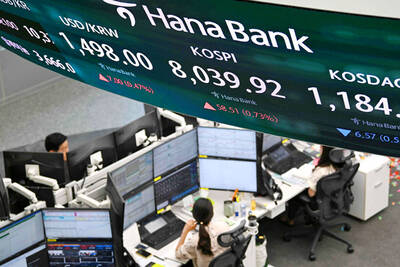
Taiwan’s overtaking of South Korea in GDP per capita is not a temporary anomaly, but the result of deeper structural problems in the South Korean economy says Chang Young-chul, the former CEO of Korea Asset Management Corp. Chang says that while it reflects Taiwan’s own gains, it also highlights weakening growth momentum in South Korea. As design and foundry capabilities become more important in the AI era, Seoul risks losing competitiveness if it relies too heavily on memory chips. IMF forecasts showing Taiwan widening its lead over South Korea have fueled debate in Seoul over memory chip dependence, industrial policy and
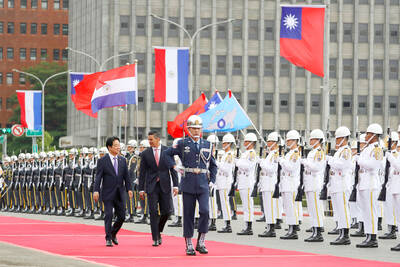
“China wants to unify with Taiwan at the lowest possible cost, and it currently believes that unification will become easier and less costly as time passes,” wrote Amanda Hsiao (蕭嫣然) and Bonnie Glaser in Foreign Affairs (“Why China Waits”) this month, describing how the People’s Republic of China (PRC) is playing the long game in its quest to seize Taiwan. This has been a favorite claim of many writers over the years, easy to argue because it is so trite. Very obviously, if the PRC isn’t attacking Taiwan, it is waiting. But for what? Hsiao and Glaser’s main point is trivial,
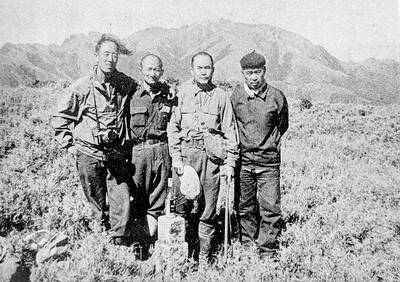
May 18 to May 24 Gathered on Yangtou Mountain (羊頭山) on Dec. 5, 1972, Taiwan’s hiking enthusiasts formally declared the formation of the “100 Peaks Club” (百岳俱樂部) and unveiled the final list of mountains. Famed mountaineer Lin Wen-an (林文安) led this effort for the Chinese Alpine Association (中華山岳協會). Working with other experienced climbers, he chose 100 peaks above 10,000 feet (3,048m) that featured triangulation points and varied in difficulty and character. The list sparked an alpine hiking craze, inspiring many to take up mountaineering and competing to “conquer” the summits. A common misconception is that the 100 Peaks represent Taiwan’s 100 tallest

Yesterday, the Democratic Progressive Party (DPP) nominated legislator Puma Shen (沈伯洋) as their Taipei mayoral candidate, the Chinese Nationalist Party (KMT) put their stamp of approval on Wei Ping-cheng (魏平政) as their candidate for Changhua County commissioner and former legislator Tsai Pi-ru (蔡壁如) of the Taiwan People’s Party (TPP) has begun the process to also run in Changhua, though she has not yet been formally nominated. All three news items are bizarre. The DPP has struggled with settling on a Taipei nominee. The only candidate who declared interest was Enoch Wu (吳怡農), but the party seemed determined to nominate anyone


 RSS
RSS