


She fought her first cow at 12, killed her first bull at 16 and now this shy, young Frenchwomen is set on facing another adversary — the very macho, closed, ritualized world of bullfighting.
This Easter weekend, 19-year-old Marie Barcelo will walk into a top-class arena to fight a bull, on foot, in her first major holiday corrida.
"In the arena you come alive," said Barcelo, who readily admits to a moment of panic before the bull — which can weigh 480kg to 600kg — enters the ring. But when it does, all fear evaporates.
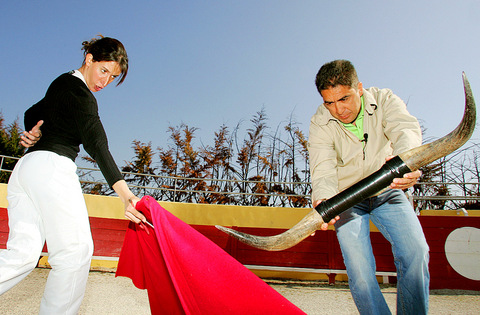
PHOTO: AP
"It's a pure moment, you shed all pretense and face the truth," she said ahead of what will be a closely watched performance in the Roman amphitheatre in Arles, the southern town that hosts some of France's most spectacular bullfights.
"To become a matador, you must overcome enormous difficulties," bullfighting specialist and chaplain for the amphitheatre in nearby Nimes, Jacques Teissier, said.
"For a woman, entering this still very male chauvinist world is even more difficult."
But Barcelo, whose fine features are framed by shoulder-length chestnut hair, is not fazed.
"This is a man's world but there are women who have proven that we are capable of bullfighting, like Cristina Sanchez," she said.
Sanchez, the most famous female matador in Spain, enjoyed a high profile career in the 1990s before dropping out to retire, mainly over her frustration at some of her male colleagues' refusal to fight alongside a woman.
In France, no woman has yet passed, on foot like Sanchez, the critical "alternative" — a rite of passage that separates amateurs from professionals.
France's best-know female matador, Marie Sara, made it past the test in 1991, but on horseback.
"So far I haven't had any trouble at my level. Afterwards, if I take the 'alternative,' it will be more difficult, but I'm ready to face all that," Barcelo said.
In the classic bullfight, six beasts are successively battled then put to death by the matadors, with the help of mounted lancers or picadors and pages.
The duel as a show of male force and virility is embodied in the Spanish phrase to describe the moment a matador dons his costly "suit of lights": apretarse los machos, which literally means "squeeze the testicles."
But Barcelo's trainer Paquito Leal, himself a former bullfighter, insists "the corrida has begun to evolve," noting that more and more women were entering the sport in Spain.
His protege's passion was sparked at a young age on the farm of her bullfight-loving parents, who make goat's cheese and breed bulls for the Provencal-style bull runs known as the courses camarguaises, in the Herault department west of Arles.
"One day, I was having fun fighting the cows during a branding when Marie told me, 'I want to try.' She was 12 years old," recalled her father Michel.
"She wasn't afraid," he said, showing a picture he still carries in his wallet capturing that moment.
By the end of 2003, Barcelo was enrolled in the bullfighting school in Nimes, where she killed her first bull. It was "impressive," she said.
Corrida opponents claim the practice is barbaric and amounts to animal torture. They doubt matadors' claims that they "love" the bulls they fight. But Barcelo, who is transformed when she enters the ring, eyes blazing and body radiating confidence as she struts through the passes, insists it is true.
"You love the bull so much that you want to help them show off their courage and their grandeur in battle. It is painful for us to send them off anonymously, without glory, to die at the slaughter house," she said.
Unlike many other bullfighters, Barcelo holds a high school diploma but dropped out of university to concentrate on bullfighting. Today, she is enrolled in the corrida school in Arles, has fought several bullfights in Spain, limits her social life and conducts rigorous daily training.
"She is raising the bar for the boys," her trainer said.
She takes on odd jobs to survive financially, mindful that only the world's top 50 bullfighters actually make a living at their trade. And she has the wholehearted support of her parents who, with relatives, offered Barcelo her first "suit of lights" on her 18th birthday.
They admit they fear for her every time she enters the ring but accept that "this is her passion."
Barcelo knows she must "do the best possible" at this weekend's novillada de la feria, a holiday bullfight using animals under four years old, to land future engagements.
Her mantra when she steps into the ring, she said, will be comments from two of today's most famous matadors, Morante de la Puebla and Sebastian Castella, applauding her bravery during a recent training session in Spain.

Taiwan’s English education system is being pulled apart by three opposing forces. Bilingual Nation 2030 pulls students toward English and global communication. Artificial Intelligence (AI) readiness pulls them toward digital judgment, verification and AI-mediated work. But Taiwan’s old exam culture pulls them back toward memorization, grammar drills, timed reading and correct answers. If the education system keeps using old exams to define success, it risks producing graduates who are neither genuinely bilingual nor genuinely AI-ready, but trained for tasks machines can already perform. The first force is Bilingual Nation 2030. Launched in 2018, the policy aimed to “help Taiwan’s workforce connect

It seems every few days one bumps into one of those “real man” comments in which Taiwan is urged to “face reality” or similar, and “make a deal,” with the speaker implying that soon it will be too late. “Deal” advocates always present themselves as having a superior grip on reality, and the manly ability to make the “hard choice.” Their testosterone-laden language often echoes that of Taiwan sellout advocates. Note that such commentary always specifies a process (“make a deal, work with, make progress”), never the end state of what occupation by a violent authoritarian colonialist state will entail. In

June 1 to June 7 "If all Taiwanese were as afraid of dying as you, then what would happen?” Physician Shih Chiang-nan (施江南) reportedly said this to his wife Chen Chiao-tung (陳焦桐) after she urged him to stop intervening on behalf of Taiwanese soldiers stranded overseas after serving in the Japanese Army during World War II. Shih had clashed with high-ranking officials over the issue, engaged in several heated arguments with Taiwan governor-general Chen Yi (陳儀) and allegedly shouted at general Ko Yuan-fen (柯遠芬), chief of staff of the Taiwan Garrison Command, over

“Taiwan’s Opposition Leader Comes to US With a Message Straight Out of Beijing” read a May 31 headline in the Wall Street Journal. Top US administration officials and members of Congress almost certainly read the WSJ, and if there was a bullet point takeaway that people in Washington should absorb ahead of Chinese Nationalist Party (KMT) Chair Cheng Li-wun’s (鄭麗文) arrival in DC on June 9, that headline is it. The last few columns have discussed this very topic, and the timing is not coincidental. While those top officials likely do not read the Taipei Times, judging by the number


 RSS
RSS