


Sometime in early 2005, a mustachioed Kazakh journalist known as Borat Sagdiyev slipped into America with the intention of making a documentary for the alleged good of his Central Asian nation. Many months later, the funny bruised fruits of his labor, Borat: Cultural Learnings of America for Make Benefit Glorious Nation of Kazakhstan, hit the collective American conscience with a juicy splat. The Minutemen, those self-anointed guardians of American sovereignty, were watching the wrong border.
Borat, who just recently invited the "mighty warlord" US President George W. Bush to the premiere of his film before a gaggle of excited news crews, is the dim brainchild of Sacha Baron Cohen, the British comic best known until now for another of his pseudonymous identities, Ali G. Described by his creator as a "wannabe gangsta," Ali G was the host of a British television show, starting in 2000, where, as the voice of "the yoof," he interviewed serious and self-serious movers and shakers, including "Boutros Boutros Boutros-Ghali," Sam Donaldson and Richard Kerr, a former deputy director of the Central Intelligence Agency, who found himself explaining why terrorists could not drive a train into the White House. (No tracks.)
Baron Cohen succeeded in seducing politicians and pornography stars alike, mostly because Ali G's phenomenal stupidity made the character seem harmless. He also seemed to represent the ultimate in media big game: young people. Dressed like a Backstreet Boy, complete with Day-Glo romper suits, designer initials and a goatee that looked as if it had been painted on with liquid eyeliner, he was met with bewilderment, exasperation and patience that at times bordered on the saintly. Like Borat and Bruno, another of the comic's similarly obtuse television alter egos who made regular appearances on the shows, the joke was equally on Ali G and on the targets of his calculated ignorance.
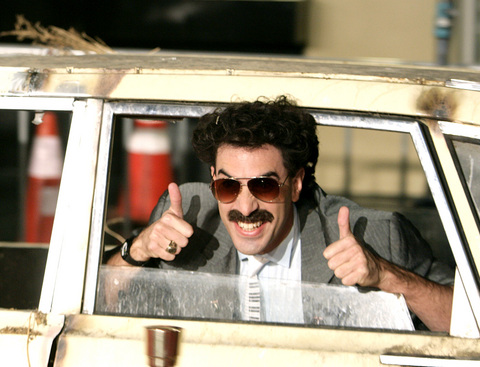
PHOTO COURTESY OF FOX
With Borat, Baron Cohen took the same basic idea that had worked with Ali G and pushed it hard, then harder. The joke begins with an apparently never-washed gray suit badly offset by brown shoes, which the performer accents with a small Afro and the kind of mustache usually now seen only in 1970s pornography, leather bars and trend articles. Think Harry Reems, circa 1972, but by way of the Urals. Married or widowed, and he appears to be both, Borat loves women, including his sister, the "Number four prostitute" in Kazakhstan, with whom he shares lusty face time in the film's opener. He's a misogynist (a woman's place is in the cage), which tends to go unnoticed because he's also casually anti-Semitic.
That Baron Cohen plays the character's anti-Semitism for laughs is his most radical gambit. The Anti-Defamation League, for one, has chided him, warning that some people may not be in on the joke. And a sampling of comments on blogs where you can watch some of the older Borat routines, including a singalong in an Arizona bar with the refrain "Throw the Jew down the well," indicates that the Anti-Defamation League is at least partly right: some people are definitely not in on the joke, though only because some people are too stupid and too racist to understand that the joke is on them. As the 19th-century German thinker August Bebel observed, anti-Semitism is the socialism of fools, a truism Baron Cohen has embraced with a vengeance.
Given this, it seems instructive to note how discussions of Borat, including the sympathetic and the suspicious, often circle over to the issue of Baron Cohen's own identity. Commentators often imply that Borat wouldn't be funny if Baron Cohen were not Jewish, which is kind of like saying that Dave Chappelle wouldn't be funny if he were not black. For these performers, the existential and material givens of growing up as a Jew in Britain and as a black man in America provide not only an apparently limitless source of fertile comic material, but they are also inseparable from their humor. But no worries: Borat makes poop jokes and carries a squawking chicken around in a suitcase.
Like General Sherman, he also lays waste to a sizable swath of the South, a line of attack that begins in New York and ends somewhere between the Hollywood Hills and Pamela Anderson's bosom. The story opens in Kazakhstan (apparently it was shot in a real Romanian village that looks remarkably like the set for a 1930s Universal horror flick), where Borat sketches out his grand if hazy plans before heading off in a horse-drawn auto. Once in New York, in between planting kisses on startled strangers and taking instruction from a humor coach, he defecates in front of a Trump tower (Donald Trump was one of Ali G's more uncooperative guests) and masturbates in front of a Victoria's Secret store. The jackass has landed.
It gets better or worse, sometimes at the same time. Whether you rush for the exits or laugh until your lungs ache will depend both on your appreciation for sight gags, eyebrow gymnastics, sustained slapstick and vulgar malapropisms, and on whether you can stomach the shock of smashed frat boys, apparently sober rodeo attendees and one exceedingly creepy gun-store clerk, all taking the toxic bait offered to them by their grinning interlocutor. There is nothing here as singularly frightening as when, during his run on HBO, Borat encountered a Texan who enthused about the Final Solution. That said, the gun clerk's suggestion of what kind of gun to use to hunt Jews will freeze your blood, especially when you realize that he hasn't misheard Borat's mangled English.
That scene may inspire accusations that Baron Cohen is simply trading on cultural and regional stereotypes, and he is, just not simply. The brilliance of Borat is that its comedy is as pitiless as its social satire, and as brainy. Baron Cohen isn't yet a total filmmaker like Jerry Lewis (the film was directed by Larry Charles, who has given it a suitably cheap video look), but the comic's energy and timing inform every scene of Borat, which he wrote with Anthony Hines, Peter Baynham and his longtime writing and production partner, Dan Mazer. These guys push political buttons, but they also clear room for two hairy men to wrestle nude in a gaspingly raw interlude of physical slapstick that nearly blasts a hole in the film.
Clenched in unspeakably crude formation, those hairy bodies inspire enormous laughs, but they also serve an elegant formal function. The sheer outrageousness of the setup temporarily pulls you out of the story, which essentially works along the lines of one of the Bob Hope-Bing Crosby road movies, though with loads of smut and acres of body hair, relieving you of the burden of having to juggle your laughter with your increasingly abused conscience. Just when you're ready to cry, you howl.
"If the comic can berate and finally blow the bully out of the water," Lewis once wrote, "he has hitched himself to an identifiable human purpose." Sacha Baron Cohen doesn't blow bullies out of the water; he obliterates them.

Just after 6am, I walked up to the ticket gate at Taipei Main Station and entered the Taiwan Railway platform without scanning any ticket; instead, I flashed the Sanrio Fun Rail pass on my phone to the gate worker and was admitted. I found my train and prepared to board. My destination? This very same station. I was embarking on a 13-hour journey on one of two round-the-island trains operated by ezTravel. They run each day, one counterclockwise around the island and one clockwise. They differ in a number of ways from an ordinary Taiwan Railway train and can make for
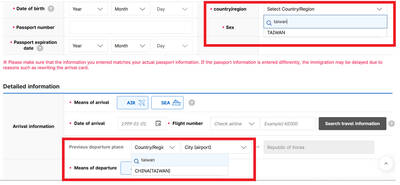
Jason Han says that the e-arrival card spat between South Korea and Taiwan shows that Seoul is signaling adherence to its “one-China” policy, while Taiwan’s response reflects a reciprocal approach. “Attempts to alter the diplomatic status quo often lead to tit-for-tat responses,” the analyst on international affairs tells the Taipei Times, adding that Taiwan may become more cautious in its dealings with South Korea going forward. Taipei has called on Seoul to correct its electronic entry system, which currently lists Taiwan as “China (Taiwan),” warning that reciprocal measures may follow if the wording is not changed before March 31. As of yesterday,

The Portuguese never established a presence on Taiwan, but they must have traded with the indigenous people because later traders reported that the locals referred to parts of deer using Portuguese words. What goods might the Portuguese have offered their indigenous trade partners? Among them must have been slaves, for the Portuguese dealt slaves across Asia. Though we often speak of “Portuguese” ships, imagining them as picturesque vessels manned by pointy-bearded Iberians, in Asia Portuguese shipping between local destinations was crewed by Asian seamen, with a handful of white or Eurasian officers. “Even the great carracks of 1,000-2,000 tons which plied

On Thursday, former Taipei mayor and founder of the Taiwan People’s Party (TPP) Ko Wen-je (柯文哲) was sentenced to 17 years in prison and had his civil rights suspended for six years over corruption, embezzlement and other charges. Seven others related to the case were also handed prison sentences, while two were found not guilty. It has been a bad week for the TPP. On Tuesday, prosecutors charged Chinese immigrant Xu Chunying (徐春鶯) with suspicion of taking part in Beijing-directed election interference. Xu has strong links to the TPP, which once offered her a party list legislator nomination. Tuesday also


 RSS
RSS