


Peter Sellers once famously declared that behind the many masks he wore, there was once a real person, but that he had had it surgically removed. The ultimate role-player, the mercurial Sellers danced on a razor's edge of a fantasy world of his own creation. Real people, who he could charm with his wit, would suddenly find themselves the subjects of the most vicious abuse.
The 2004 HBO and BBC collaboration based on the Roger Lewis book The Life and Death of Peter Sellers looks at the manic personality that lay behind the comic genius. It sports a stellar cast, and is a chance for Geoffrey Rush to put on a bravura performance, not only as Sellers, but also as Seller's mother Peg, his wife Anne, and even as Stanley Kubrick, who directed him in the classic Doctor Strangelove. This reference to Sellers' own multiple roles is one of many devices that the film successfully uses to convey the shifting sands upon which the Sellers image was built.
The Life and Death of Peter Sellers moves in and out of Sellers' fantasy world. Rush morphing into the characters around him show is a way of exploring how Sellers could manipulate the world around him to suit his fantasies. Another scene shows him voicing over documentary footage to make the past more to his liking. These devices also serve as a counterpoint to the meticulous, almost manic way in which Sellers worked himself into a role. A sequence showing Sellers exploring how he would perform Inspector Clouseau while on a commercial flight, causing utter confusion to the stewardess, is almost more hilarious that the original scene in the Pink Panther.
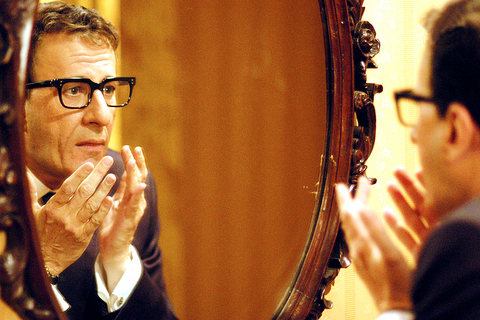
PHOTO COURTESY OF HBO
Director Stephen Hopkins pulls no punches in revealing the dark side of this comic genius, and finds most of the fault lies with Sellers' mother, brilliantly portrayed by Miriam Margolyes, at turns suffocatingly affectionate and heartlessly pushy. She gets her comeuppance, as the film tells it, when Sellers refuses to leave the film set for her deathbed, stating, in her persona, that “stars cannot afford tears.”
Rush does a splendid job in creating a sense of the intense emotional insecurity of Sellers, and his relationship with his first wife Anne (Emily Watson) and subsequently with Britt Eckland (Charlize Theron), are splendidly nuanced, always alive with the sense of fear and inadequacy that he felt about himself and his talents. The enormous price that he paid for his success, which to all intense and purposes cost him his sanity, is ever present. Despite the lavish houses, fast cars and fame of his later years, the terrible pathos of not knowing who you are never diminishes.
Redemption is found in the making of the film Being There, arguably his greatest achievement. It is seen as the great revelation for Sellers, who sees the novel as an articulation of his understanding of his personality and its deficiencies. While the making of the Pink Panther and its sequels are shown to be the result of a desire for fame and money, this was something that Sellers actively sought to make. Sellers was making his own salvation. It ties up the story nicely, giving the film, which is so full of the chaos that Sellers made of life, a clear, defined shape.
The Life and Death of Peter Sellers is interesting from a number of perspectives. It provides some lovely details of Hollywood history, is a subtle psychological study, is interesting in the methodology of its presentation, has a soundtrack wonderfully evocative of the era and has much fine acting. It won a slew of awards after it was released, including two Golden Globes for Best Motion Picture Made for Television and also Best Performance for Rush. It is only a pity that we have had to wait so long before it has been brought out in Asia.
If one asks Taiwanese why house prices are so high or why the nation is so built up or why certain policies cannot be carried out, one common answer is that “Taiwan is too small.” This is actually true, though not in the way people think. The National Property Administration (NPA), responsible for tracking and managing the government’s real estate assets, maintains statistics on how much land the government owns. As of the end of last year, land for official use constituted 293,655 hectares, for public use 1,732,513 hectares, for non-public use 216,972 hectares and for state enterprises 34 hectares, yielding

The small platform at Duoliang Train Station in Taitung County’s Taimali Township (太麻里) served villagers from 1992 to 2006, but was eventually shut down due to lack of use. Just 10 years later, the abandoned train station had become widely known as the most beautiful station in Taiwan, and visitors were so frequent that the village had to start restricting traffic. Nowadays, Duoliang Village (多良) is known as a bit of a tourist trap, with a mandatory, albeit modest, admission fee of NT$10 giving access to a crowded lane of vendors with a mediocre view of the ocean and the trains

For many people, Bilingual Nation 2030 begins and ends in the classroom. Since the policy was launched in 2018, the debate has centered on students, teachers and the pressure placed on schools. Yet the policy was never solely about English education. The government’s official plan also calls for bilingualization in Taiwan’s government services, laws and regulations, and living environment. The goal is to make Taiwan more inclusive and accessible to international enterprises and talent and better prepared for global economic and trade conditions. After eight years, that grand vision is due for a pulse check. RULES THAT CAN BE READ For Harper Chen (陳虹宇), an adviser
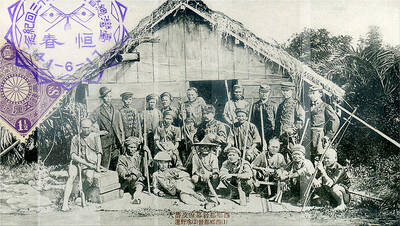
Traditionally, indigenous people in Taiwan’s mountains practice swidden cultivation, or “slash and burn” agriculture, a practice common in human history. According to a 2016 research article in the International Journal of Environmental Sustainability, among the Atayal people, this began with a search for suitable forested slopeland. The trees are burnt for fertilizer and the land cleared of stones. The stones and wood are then piled up to make fences, while both dead and standing trees are retained on the plot. The fences are used to grow climbing crops like squash and beans. The plot itself supports farming for three years.


 RSS
RSS