


Sumie at the San Want Hotel provides fashionable Japanese cuisine in a sophisticated environment. Diners pay for the setting and the pleasure of intricately constructed sashimi and deceptively simple main dishes such as grilled codfish with miso paste. It is a place for serious foodies and expense account holders.
On a recent weekday lunchtime there was a polite buzz as waiters and chefs in the open-plan kitchen catered for around 100 patrons. The restaurant can comfortably accommodate around 150 guests and has private rooms for up to 30 people.
Named after the hotel owner's sister, Sumie was established just over three years ago. The interior was conceived by Shiro Miura and as such has those typical minimalist lines favored by many Japanese designers. Clad in off-white marble, from ceiling to floor, the color scheme is set off by gray chairs, opaque green screens and a dash of red in the kitchen.
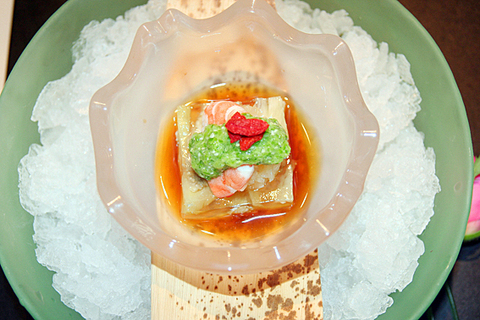
PHOTO: JULES QUARTLY, TAIPEI TIMES
For our food test, head chef Masa (吳富昌) served up an appetizer that he said was typical of the detailed work that goes into each “creation.” Marinating in a refined soy and ginger sauce and nestling on a clear jelly base was a prawn, eggplant, okra and gochi concoction. It arrived in a small, pink bowl resting on shaved ice.
“It's best eaten as a combination,” Masa instructed, as the various ingredients are intended to complement each other as a whole, rather than be appreciated individually. Despite being tiny, it packed more flavors than most main meals.
“We only use the freshest ingredients and these are changed seasonally. This way the food is better and healthier,” Masa said.
Sashimi was next and, it has to be said, this was a different species of foodstuff from the rice rolls supplied at 7-Eleven or various takeaway counters around town. Locally sourced vegetables and herbs were added to imported Japanese ingredients.
Salmon eggs on a salmon slice, with rice, shrimp, avocado and cucumber was outstanding. The eggs popped exuberantly in the mouth and even the locally sourced rice had a superior, clean taste. The sea bream miso soup blended three varieties of paste to achieve the required strength and smoothness. Fish bones were boiled up overnight to create the consomme.
The dessert was an almond-flavored tofu creation, which Masa said was “irritating” and time consuming to prepare. However, combined with honeydew melon and pineapple, the dish was a fitting finale to an impressively expensive meal.

Last week the government announced that by year’s end Taiwan will have the highest density of anti-ship missiles in the world. Its inventory could exceed 1,400, or enough for the opening two hours of an invasion from the People’s Republic of China (PRC). Snark aside, it sounds impressive. But an important piece is missing. Lost in all the “dialogues” and “debates” and “discussions” whose sole purpose is simply to dawdle and delay is what the Chinese Nationalist Party (KMT) alternative special defense budget proposal means for the defense of Taiwan. It is a betrayal of both Taiwan and the US. IT’S
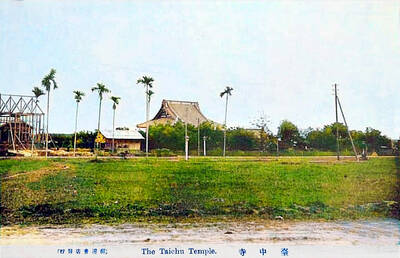
March 16 to March 22 Hidden for decades behind junk-filled metal shacks, trees and overgrowth, a small domed structure bearing a Buddhist swastika resurfaced last June in a Taichung alley. It was soon identified as a remnant of the 122-year-old Gokokuzan Taichuu-ji (Taichung Temple, 護國山台中寺), which was thought to have been demolished in the 1980s. In addition, a stone stele dedicated to monk Hoshu Ono, who served as abbot from 1914 to 1930, was discovered in the detritus. The temple was established in 1903 as the local center for the Soto school

Paul Thomas Anderson’s “One Battle After Another” was crowned best picture at the 98th Academy Awards, handing Hollywood’s top honor to a comic, multi-generational American saga of political resistance. The ceremony Sunday, which also saw Michael B. Jordan win best actor and “Sinners” cinematographer Autumn Durald Arkapaw make Oscar history as the first female director of photography to win the award, was a long-in-coming coronation for Anderson, a San Fernando Valley native who made his first short at age 18 and has been one of America’s most lionized filmmakers for decades. Before Sunday, Anderson had never won an Oscar. But “One Battle
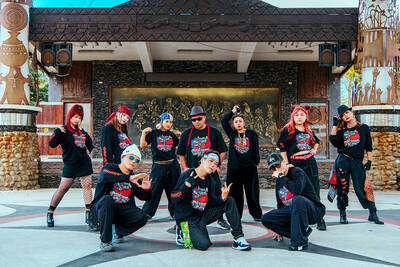
In Kaohsiung’s Indigenous People’s Park (原住民主題公園), the dance group Push Hands is training. All its members are from Taiwan’s indigenous community, but their vibe is closer to that of a modern, urban hip-hop posse. MIXING CULTURES “The name Push Hands comes from the idea of pushing away tradition to expand our culture,” says Ljakuon (洪濬嚴), the 44-year-old founder and main teacher of the dance group. This is what makes Push Hands unique: while retaining their Aboriginal roots, and even reconnecting with them, they are adamant about doing something modern. Ljakuon started the group 20 years ago, initially with the sole intention of doing hip-hop dancing.


 RSS
RSS