


Pop Stop has penis envy this week following news in most of the local media outlets that the biggest star in the Mandarin-music firmament, Jay Chou (周杰倫), has dumped his girlfriend, the former news anchor Patty Hou (侯佩岑) and picked up Hebe from the girl group S.H.E.
According to gossip rags this is the sixth hottie The Chairman (周董) has charmed in the past two years. Chou, it appears, can get a new girlfriend as easily as a mechanic changes oil.
But since Chou merely smiles and refuses to answer questions about these purported affairs, the ladies concerned are left to clarify the situation. They are in the difficult position of having to deny a tryst that never happened, or confirm the end of an affair that no one is about to admit. As a result there's a doublespeak that would be laughable if it wasn't so calculated.
Hou, who has consistently denied having a relationship with Chou — despite going on holiday to Japan with him — is currently confirming their breakup. She has achieved this convoluted feat by complaining recently that Chou “is nice to me in private but hardly acknowledges me in public.”
At a recent press junket for a well-known shampoo that clears dandruff, Hou brushed off journalists by saying she had nothing to say about Hebe and Chou, and politely asked the press pack to direct their questions to the concerned parties.
Hebe was then reported in the Taipei Times' sister paper the Liberty Times as saying, “The way I make friends is not affected by media reports.” She blamed journalists for spreading gossip about her relationship with The Chairman, though she was happy enough to sing duets with him and pre-sales of the new S.H.E. album have been boosted by all the news.
Other examples of doublespeak relating to Chou's recent “exes” and media interpretations of what their quotes actually may have meant include: Jolin Tsai (蔡依林) saying after her supposed breakup with The Chairman, “We're just classmates. It won't affect my relationship with a friend.” This was translated as, “Yes, we were lovers but not any more; the bastard dumped me.”
When Lai Wei-ru (賴薇如), MTV personality and singer with the group Seven Flowers (七朵花), said of Chou, “We're just normal friends,” the media inferred they were lovers.
After former news anchor Wang Yi-ren (王怡仁) said of Chou, “We cooperated together friend-to-friend,” journalists intuited that what she meant to say was the affair was brief but she got valuable publicity anyway.
Model Tsai Shu-zhen (蔡淑臻) met up with Chou and was quoted as saying, “We had dinner together with a director.” What reporters thought this might have meant was that it was a one-night stand.
All this is plainly ridiculous. With the absence of information, whispers are dressed up as news and the publicity machine is milked until it's dry. Now, instead of conjecturing about doublespeak, Pop Stop will fearlessly go where no other gossip column has gone before. We will take the stars' comments at face value.
In fact, The Chairman has plenty of female friends but has never had a relationship with a woman. We should ask him and see whether he responds with a smile and no comment.
In a week where gossip was sucked dry by the hot air produced by The Chairman, we learned from Yahoo Entertainment that director Ang Lee (李安) has cast singer Wang Lee-hom (王力宏) as a student in his new film, the World War II thriller Lust, Caution.
As for the dancer who flashed her boobs to thousands of hip-hop fans at Hot Dog's World Trade Center gig a few weeks ago; the price of fame has been costly for Sunny.
As well as facing questioning from the police about the incident, producers of the show intriguingly called The Moment of Success (成名一瞬間) are thinking of canceling her contract to “make an example of her.”

If one asks Taiwanese why house prices are so high or why the nation is so built up or why certain policies cannot be carried out, one common answer is that “Taiwan is too small.” This is actually true, though not in the way people think. The National Property Administration (NPA), responsible for tracking and managing the government’s real estate assets, maintains statistics on how much land the government owns. As of the end of last year, land for official use constituted 293,655 hectares, for public use 1,732,513 hectares, for non-public use 216,972 hectares and for state enterprises 34 hectares, yielding

The small platform at Duoliang Train Station in Taitung County’s Taimali Township (太麻里) served villagers from 1992 to 2006, but was eventually shut down due to lack of use. Just 10 years later, the abandoned train station had become widely known as the most beautiful station in Taiwan, and visitors were so frequent that the village had to start restricting traffic. Nowadays, Duoliang Village (多良) is known as a bit of a tourist trap, with a mandatory, albeit modest, admission fee of NT$10 giving access to a crowded lane of vendors with a mediocre view of the ocean and the trains
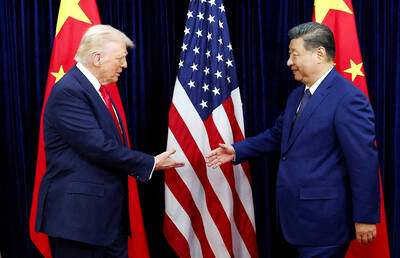
The March/April volume of Foreign Affairs, long a purveyor of pro-China pablum, offered up another irksome Beijing-speak on the issues and solutions for the problems vexing the People’s Republic of China (PRC) and the US: “America and China at the Edge of Ruin: A Last Chance to Step Back From the Brink” rang the provocative title, by David M. Lampton and Wang Jisi (王緝思). If one ever wants to describe what went wrong with US-PRC relations, the career of Wang Jisi is a good place to start. Wang has extensive experience in the US and the West. He was a visiting

One of the challenges with the sheer availability of food in today’s world is that lots of us end up spending many of our waking hours eating. Whether it’s full meals, snacks or desserts, scientists have found that it’s not uncommon for us to be mindlessly grazing at some point during all of our 16 or so waking hours. The problem? As soon as this food hits the bloodstream in the form of glucose, it initiates the release of the hormone insulin. This in turn activates a switch present in every one of our cells, which is responsible for driving cell


 RSS
RSS