


In his 1999 debut, Deuce Bigalow emerged as a shameless beach bum, driving a clunker in a land of Porsche Cayennes, cleaning the scum from the fish tanks of the rich and famous.
A housesitting gig leads Deuce, played by Rob Schneider, into the oldest profession, and he makes the most of his various dates. As a companion for hire who charges only US$10, he persuades women to reveal their hurts and faults (some are quite obvious), and they get more than they pay for: healing, and not necessarily the sexual kind. Each hokey vignette is mockery disguised as self-help.
Six blessedly Deuce-free years later, the character's creators, including Schneider's former Saturday Night Live cast mate Adam Sandler, are up to their old exploits in Deuce Bigalow: European Gigolo. They spend the film's full 77 minutes making jokes about passed gas, ethnic differences, disabilities and the shame surrounding genitalia. Setting their film in Europe gives them a wider world of cultural stereotypes to milk. In the laissez-faire haven of Amsterdam, Deuce tries to gain acceptance in a guild of gigolos by protecting his colleagues from a homicidal predator who is thinning their ranks.

The material is also wearing thin. Last time, the script chose Tourette's syndrome and limb amputation as grounds for derision, and this time it's blindness, obsessive-compulsive disorder, the removal of a larynx and even one made-up affliction that involves a woman with a penis where her nose should be.
Eddie Griffin is back as T.J., riffing on the caricature of an African-American pimp. He is the purveyor of most of the movie's insults, with his unfunny venom usually directed at Asians and gay men. (Charitably, he tries to pay one gay man a compliment by explaining that he sees him as "a normal gay, not a crazy gay -- like a musical-theater gay.") Then when photographers catch T.J. reaching inside two corpses' zippers, he explains that he doesn't mind being accused of murder so much as he fears people will think that he is gay.
Despite the story's claims that Deuce soothes the lonely ladies, there is an essential meanness to the entire project, tapping the manipulative power of taunts. Such jokes don't jibe with the times, the culture or the rebranded Adam Sandler, who has been vying for plaudits and legitimacy in Spanglish and Punch-Drunk Love. Here he helps out his old friend Schneider with a cameo appearance and takes a step backward. These two fraudulent funny men are banking on some cynical formula that mixes the happy-go-lucky and the hurtful, the curative and the destructive.
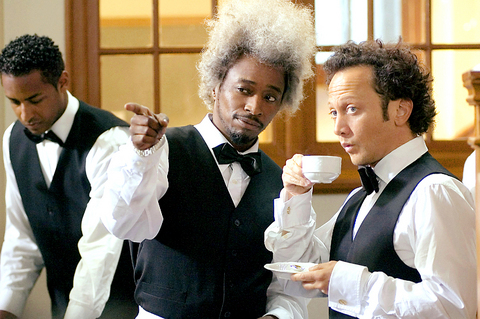
PHOTOS COURTESY OF COLOMBIA PICTURES CORPORATION

If one asks Taiwanese why house prices are so high or why the nation is so built up or why certain policies cannot be carried out, one common answer is that “Taiwan is too small.” This is actually true, though not in the way people think. The National Property Administration (NPA), responsible for tracking and managing the government’s real estate assets, maintains statistics on how much land the government owns. As of the end of last year, land for official use constituted 293,655 hectares, for public use 1,732,513 hectares, for non-public use 216,972 hectares and for state enterprises 34 hectares, yielding

The small platform at Duoliang Train Station in Taitung County’s Taimali Township (太麻里) served villagers from 1992 to 2006, but was eventually shut down due to lack of use. Just 10 years later, the abandoned train station had become widely known as the most beautiful station in Taiwan, and visitors were so frequent that the village had to start restricting traffic. Nowadays, Duoliang Village (多良) is known as a bit of a tourist trap, with a mandatory, albeit modest, admission fee of NT$10 giving access to a crowded lane of vendors with a mediocre view of the ocean and the trains

For many people, Bilingual Nation 2030 begins and ends in the classroom. Since the policy was launched in 2018, the debate has centered on students, teachers and the pressure placed on schools. Yet the policy was never solely about English education. The government’s official plan also calls for bilingualization in Taiwan’s government services, laws and regulations, and living environment. The goal is to make Taiwan more inclusive and accessible to international enterprises and talent and better prepared for global economic and trade conditions. After eight years, that grand vision is due for a pulse check. RULES THAT CAN BE READ For Harper Chen (陳虹宇), an adviser

Traditionally, indigenous people in Taiwan’s mountains practice swidden cultivation, or “slash and burn” agriculture, a practice common in human history. According to a 2016 research article in the International Journal of Environmental Sustainability, among the Atayal people, this began with a search for suitable forested slopeland. The trees are burnt for fertilizer and the land cleared of stones. The stones and wood are then piled up to make fences, while both dead and standing trees are retained on the plot. The fences are used to grow climbing crops like squash and beans. The plot itself supports farming for three years.


 RSS
RSS