


Loretta Yang Hui-shan (楊惠珊) and Chang Yi (張毅) are inseparable. They have done everything together, including giving up stardom 18 years ago to pursue a career in contemporary glass art. With two Golden Horse awards and a prize from the Asia-Pacific Film Festival for her acting, Yang shocked movie fans when she left the industry at the height of her career, taking with her the renowned and then married director, Chang Yi. Their unexpected career shift and scandalous relationship shocked the public, but as time passed they regained admiration and respect with their thriving cultural enterprise, Liuligongfang (琉璃工房).
Founded in 1987, Liuligongfang was the first glass-art workshop in all of Taiwan and China. Without any training and with no precursors to imitate, their early stages were limited to trial-and-error. The only conviction they held was, regardless of profits, this venture would highlight traditional Chinese culture. For Yang and Chang, traditional Chinese art was missing from the world of glass art and they aimed to fill the gap with pieces of liuli.
Liuli (琉璃) is the archaic Chinese word for glass artwork. The couple chose liuli in place of the more commonly used word for glass (boli, 玻璃) because, in Yang's words, "Everyone knows what glass is, and when you hear it you immediately think of a material, like bottles, glasses ?. Liuli is more refined and embodies Chinese culture and history."
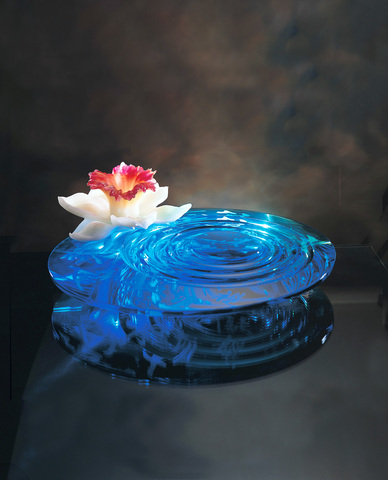
"Our goal is to develop the art of Chinese glass art so we want liuli to have aesthetic qualities but also promote feelings of respect for our history and culture," said Yang at an interview at the Liuligongfang Taipei International Gallery in Tianmu.
Since its launch, Liuligongfang has held exhibitions in Asia, Europe, South Africa, and the US, and has become part of the permanent collection of many museums at home and abroad. In terms of making a commercial success out of an art form, Yang and Chang have become to glassware what Georg Jensen is to silverware. Their enterprise has grown from two craftsmen operating a workshop in Danshui to a team of 900 employees and 56 stores worldwide.
Liuligongfang is slowing becoming a recognizable brand name. Working under the motto: "Create art, good for the human heart," Yang said whether it is a Buddha stature or a wineglass, she wants every liuli piece to convey "the richness and beauty of traditional Chinese culture." Their showrooms resemble galleries in the way each piece is displayed. Among the sparsely placed sculptures is a collection of jewelry and tableware that reflect a simple, understated refinement that has become Liuligongfang's trademark. Their time-consuming craftsmanship is reflected in the prices, which range from NT$3,000 for a necklace pendant to more than NT$500,000 for a sculpture. The recently opened TMSK restaurant in Shanghai is decorated with a liuli interior that draws from a rich cultural tradition, yet maintains contemporary style.
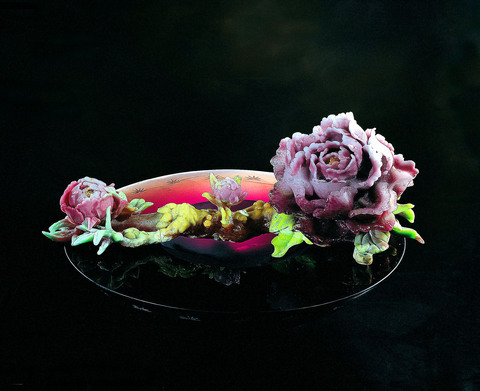
The company's popularity and pecuniary achievements have earned Yang and Chang the title of founders of contemporary Chinese glass art. "Not only did we introduce it, but we built up the market for glassware and created a demand for the products. There are now more than 100 large factories and individual workshops in China and all of those can be traced back to Liuli," Yang said.
Carving and polishing
Success, however, did not come easy -- or cheap. Chang estimated an initial investment of US$5,000 and six months would produce results, but in the end it took three years and cost them more than US$1 million, Yang said, adding that the expenses required them to mortgage everything, including her mother's home.
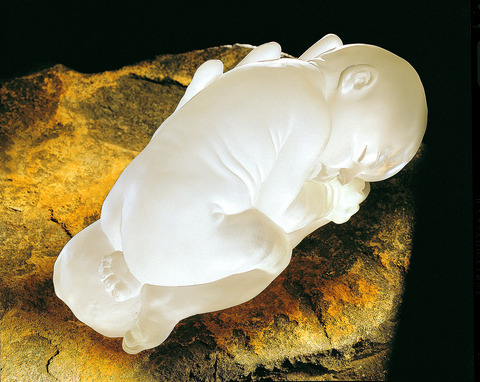
"Liuligongfang is here because of the support of our friends and family. It is like a child, that has grown up and matured into a big cultural enterprise," she said.
"Of course we became frustrated, but we started at ground zero so to give up and try something else meant we would have to start at zero again. We just considered each part a learning experience, even our failures."
In the beginning, most of their expenses were a result of the technique they use, known as pate-de-verre or lost-wax casting. It is considered the most costly and time-consuming method because it involves several molds and casting stages in addition to 12 steps for carving and polishing. Glass blowing and casting procedures were introduced to China from Europe during the Tang dynasty, but for various reasons they disappeared and were not reintroduced until the 19th century.
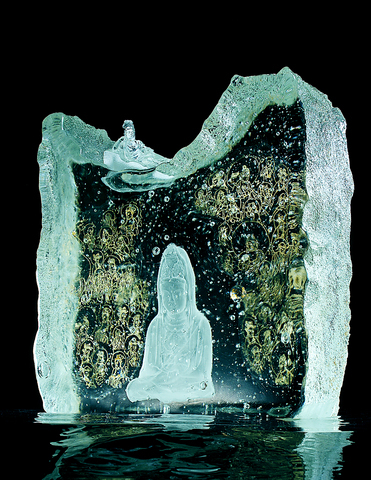
There are many simple and economical techniques used for glass craft, but each is limited in the amount of detail it can achieve. For tableware or jewelry, glass blowing is favored because one re-useable mold can be utilized. In art pieces that require a lot of detail, lost-wax is the only technique available. This is the case for Yang's Chinese designs and religious motifs.
Although Chang is also a skilled glass craftsman, he took on the administration side of the venture near the beginning and left Yang to produce the artwork. Yang considers herself shy, and during interviews where both are present, Chang will do most of the talking. In 1997, he suffered a heart attack and Yang was forced to learn more about the business responsibilities. This, she explained, was why Chang stayed outside the room until the end of our interview. "He thinks I need practice. If he was here I would just let him answer all the questions."
She has no difficultly speaking about the fame and fortune Liuligongfang has brought to her life, but insists that her real passion rests in the hands-on aspect of the job. "Without that I don't think I would still be interested in this work."
ESOTERIC ART
When Yang started sculpting, she said she had no idea what to make, and it was Chang who suggested she start with a Buddha statue. From then until now, she has continued to sculpt Buddhist figures. Initially, she had no religious ties with Buddhism, but over the years her work has brought her closer to the religion. Now, the way she speaks suggests that creating Buddhist iconography is like an esoteric form of religious practice to her.
"When I am sculpting Buddha's face I try to feel his attributes, his calmness and clear mindedness. Just like in meditation, it is a form of meditation for me. I comprehend the teachings of the Buddha now and I also realize there are some teachings that provide me with direction in life, she said, reciting scripture from a Buddhist sutra. "`When the moment comes and I attend the enlightenment my body and my soul become like crystal -- transparent, pure and flawless.' When I first read this I began to think it would be possible for me to use glass as a medium to teach the philosophy of Buddhism."
Her religious faith provided the origin for a series of Buddha and Bodhisattva statues titled Formless, But Not Without Form and another based on the Diamond Prajna Sutra, The Flowers are Beautiful and The Moon is Full. Her most prized project is an unfinished piece she began three years ago, which when completed will be a 4m high sculpture of the Chinese Bodhisattva Guan Yin.
Guan Yin of a Thousand Arms and Eye is an 18-year project that epitomizes Yang's devotion to both Buddhism and glass art. Unlike her sudden departure from the film screen several years ago, she claimed no intentions of abandoning her current profession.
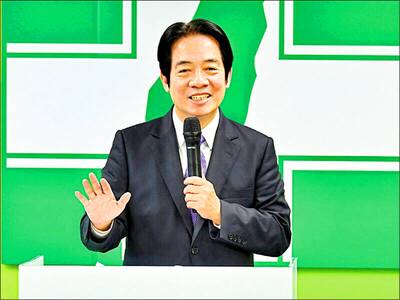
Ahead of incoming president William Lai’s (賴清德) inauguration on May 20 there appear to be signs that he is signaling to the Chinese Communist Party (CCP) and that the Chinese side is also signaling to the Taiwan side. This raises a lot of questions, including what is the CCP up to, who are they signaling to, what are they signaling, how with the various actors in Taiwan respond and where this could ultimately go. In the last column, published on May 2, we examined the curious case of Democratic Progressive Party (DPP) heavyweight Tseng Wen-tsan (鄭文燦) — currently vice premier
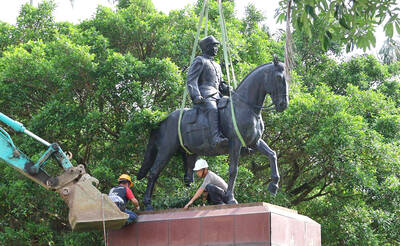
The last time Mrs Hsieh came to Cihu Park in Taoyuan was almost 50 years ago, on a school trip to the grave of Taiwan’s recently deceased dictator. Busloads of children were brought in to pay their respects to Chiang Kai-shek (蔣中正), known as Generalissimo, who had died at 87, after decades ruling Taiwan under brutal martial law. “There were a lot of buses, and there was a long queue,” Hsieh recalled. “It was a school rule. We had to bow, and then we went home.” Chiang’s body is still there, under guard in a mausoleum at the end of a path

Last week the Directorate-General of Budget, Accounting and Statistics (DGBAS) released a set of very strange numbers on Taiwan’s wealth distribution. Duly quoted in the Taipei Times, the report said that “The Gini coefficient for Taiwanese households… was 0.606 at the end of 2021, lower than Australia’s 0.611, the UK’s 0.620, Japan’s 0.678, France’s 0.676 and Germany’s 0.727, the agency said in a report.” The Gini coefficient is a measure of relative inequality, usually of wealth or income, though it can be used to evaluate other forms of inequality. However, for most nations it is a number from .25 to .50
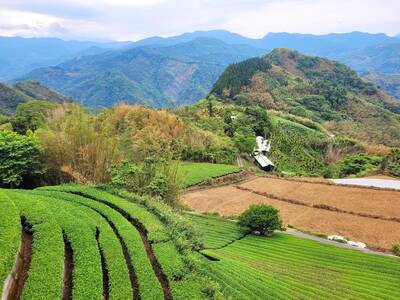
Few scenes are more representative of rural Taiwan than a mountain slope covered in row upon row of carefully manicured tea plants. Like staring at the raked sand in a Zen garden, seeing these natural features in an unnaturally perfect arrangement of parallel lines has a certain calming effect. Snapping photos of the tea plantations blanketing Taiwan’s mountain is a favorite activity among tourists but, unfortunately, the experience is often rather superficial. As these tea fields are part of working farms, it’s not usually possible to walk amongst them or sample the teas they are producing, much less understand how the


 RSS
RSS