

The aptly named exhibition The Garden of Light features the sparkling light and luminescent color that emanates from the holographic art, paintings, prints, mobiles and installations of German artist Dieter Jung.
On view at the Taipei Fine Arts Museum until May 8, with a smaller complementary display of prints at the German Cultural Center, the exhibition will then travel to the Kaohsiung Museum of Fine Arts.
In the Taipei Fine Arts Museum's lobby, the Calder-like mobile of silvery convex mirrors titled Transoptics slowly moves reflecting images of passersby upside-down. It is a good introductory piece to prepare the viewer for the show where the the work on view is about optical effects, visual perception, and how light hits on reflected surfaces.
PHOTOS COURTESY OF THE TAIPEI FINE ARTS MUSEUM
Jung's exhibition in Taiwan starts with the story of the Chinese magic mirror. Created over 2,000 years ago in China, a shiny bronze disk was made so that an image of the relief on its underside could be projected onto a screen by shining a light on it. The technology behind it predates holography as the same principle of manipulating light-waves.
The obsoleteness of the mirror serves as a lesson that advanced technology will not go beyond novelty without a good concept behind it. So, it is that combination of scientific technology and aesthetic conception that motivates the artist, who also displays his own magic mirror.
Trained in theology before becoming an artist, Jung's background in philosophical investigations of existence and belief clearly informs his art. Though the works are secular, many of the non-narrative pieces would fit into any temple or house of worship as the works have an ethereal quality.
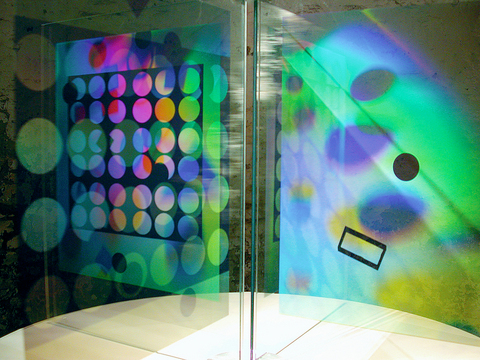
Perhaps the absence of both a narrative and a figure allows the viewer to read any kind of meaning into a simple geometric shape.
When Jung's works were shown at the Hara Museum in Tokyo, visitors sat down in front of them to meditate, as the works do have that unearthly aura about them.
So Jung was quite pleased when one of the Taipei museum guards said that in the holograms he could see eternity.
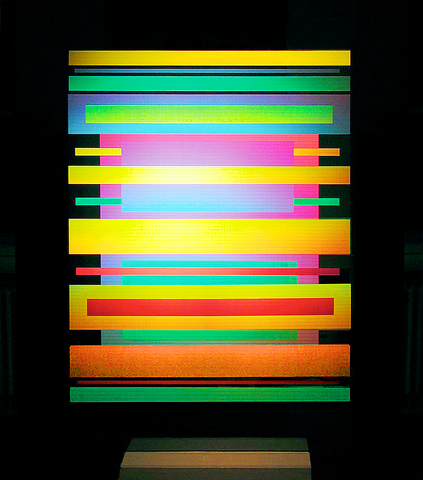
Perhaps the guard was referring to the Parochial RGB series of brightly hued geometric shapes on flat rectangular pieces of mirrored glass installed on plinths. From a distance, the holograms burst with intense, glowing color.
In holography, three-dimensional images are created on a flat surface through the diffraction of light waves with a laser. Many popular holographs contain representational images such as people, animals and buildings. In Jung's work, however, he shows that profound thoughts can be stated abstractly with only a simple line or shape.
The human figure is mainly absent from the work, with the exception of Self Portrait with Prism, where the artist is portrayed in the realm of his special technique. And a series of large white-on-white acrylic paintings bear the portraits of famous men such as Sigmund Freud and Ezra Pound. Since the contrast of the colors is slight, the images can only be seen from a distance.
It is the constant negotiating of the space around the work that the viewer must confront. So, whether the works are paintings with low-value contrast or the iridescent holographic panels, the viewer becomes a dance partner to the work, taking a step forward and back, tilting the head sideways until the right combination of distance and light are achieved to see the work in all its shimmering luminosity.
The third floor of the museum has always been a problematic space to exhibit, as the area encircles the bank of escalators and feels more like a foyer than an intimate viewing area. So a small alcove was created for the work Lines of Flight.
A large window was cut into the wall that contains a moving floor-to-ceiling holograph of vertical lines in primary colors that give the appearance of monolithic skyscrapers.
Jung exhibits a more literary and figurative type of work at the German Cultural Center in LightColourSpace.
A popular series of posters he made for a publisher of philosophy books in the 1970s includes portraits of thinkers such as Goethe, Kant, Einstein and Schiller superimposed with an intricate netting of woven lines.
And the pivotal piece on display is a small holograph of Goethe -- who developed his own color theory -- wryly perched on a stack of the famous writer's books.
This smaller exhibition about appearance and disappearance also provides a good opportunity to learn more about the center's facilities and to contemplate the juncture between art and science.
Event Information:
What: The Garden of Light
Where: The Taipei Fine Arts Museum, 181 Zhongshan N Rd, Sec 3, Taipei (
When: Until May 8, Tuesday to Sunday, 9:30am to 5:30pm
Tel: (02) 2595 7656
Information: http://www.tfam.gov.tw
What: LightColourSpace
Where: The German Cultural Center, 12F, 20 Heping W Rd, Sec 1 (
When: Until April 15, Monday to Friday, 10am to 8pm
Tel: 2365-7294
Information: http://www.dk-taipei.org.tw
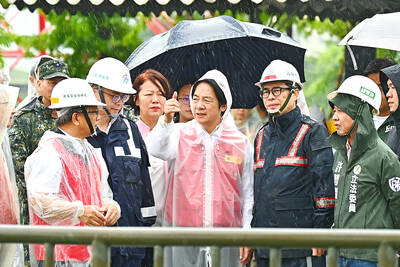
The flooding in Kaohsiung after the recent torrential rains has become an issue for mayoral candidates of both major parties. Chinese Nationalist Party (KMT) Kaohsiung mayoral candidate Ko Chih-en (柯志恩) brought in hydraulic-engineering professor Lee Hong-yuan (李鴻源), who called for comprehensive flood control measures on the Dianbao Creek (典寶溪), according to local media. Ko attacked the Democratic Progressive Party (DPP) for being behind on flood control measures, but as the city administration observed, there are many weaknesses in how the government can mitigate extreme rainfall. Nor is the river entirely under the management of the city. The low-lying Dianbao River
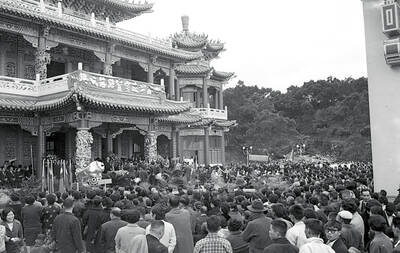
Aug. 31 to Sept. 6 More than 3 million people visited Taipei’s Zhinan Temple (指南宮) in 1973, making it Taiwan’s second-most visited scenic area that year. Built in 1891, the temple had been a tourist destination since the Japanese colonial period, when visitors had to initially take a ferry across the Jingmei River before climbing a winding trail up Houshan (猴山). Its popularity was reflected in popular media. The 1932 tune New Song of the Black Cat and Black Dog (新烏貓烏狗歌) depicted two lovers who prayed at the temple for their marriage. The man
Taiwan Power Co (Taipower, 台電) chairman Tseng Wen-sheng (曾文生) uses a sports metaphor to describe the density of electricity demand. A household is a ping-pong ball, ordinary industry a baseball and a science park a bowling ball. A data center is a shot put. Taiwan is preparing for the shot puts. Four new combined-cycle units at Hsinta (興達) and Taichung (台中), with combined capacity of about 5.2GW, are scheduled to begin supplying or testing on the grid by the end of this year. The Energy Administration’s (能源署) plan adds about 25.98GW of gas-fired capacity between this year and 2035, predominantly fueled
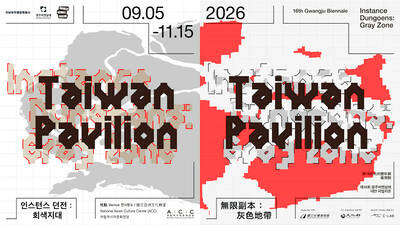
The name “Taiwan” is to appear at South Korea’s Gwangju Biennale when it opens on Saturday, after months of objections from Taiwanese artists and government agencies over an attempted name change. China Pavilion personnel halted installation and left the venue on Friday, after China’s Ambassador to South Korea Dai Bing (戴兵) objected to the restoration of the “Taiwan Pavilion” name. As of Monday, the Chinese side was reportedly preparing to withdraw, although its formal withdrawal had not been completed. The pavilion dispute began on June 10, when the ministry and participating artists said organizers had changed “Taiwan Pavilion” to “NTMoFA Pavilion,” referring


 RSS
RSS