


People are spoiled for choices of good food in the Zhongxiao-Dunhua area, which makes La Quiche easy to pass up for its understated storefront. But for a quick taste of France that doesn't bust the budget, this would be a good place to seek out amid the clutter of cheap restaurants in the network of alleys that branch off bustling Lane 216.
True to its name, this cozy, 20-person eatery specializes in baking home-style quiches and does so in style by serving up a dozen varieties baked daily on the premises. While sticking with the standard quiche Lorraine is a safe and tasty option with its plentiful onions, bacon and generous serving of Gruyere cheese, there are plenty of choices that offer a chance to expand one's horizons and discover just how versatile this all-purpose pastry can be.
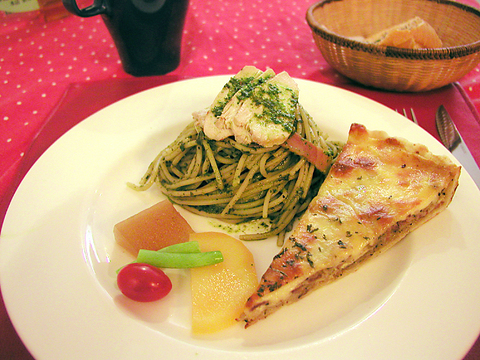
PHOTO: MAX WOODWORTH, TAIPEI TIMES.
Take the mashed potato with pineapple and chicken quiche for example. It seems an odd combination, but only to those who haven't tried it yet. Or try the tuna with sweet corn and cream sauce quiche. And in keeping with the current trend for curries, there's a chicken curry quiche on offer, as well. The quiche Provencale and the countryside mushroom with Parmesan cheese quiche, meanwhile, are exquisite.
To fill out a full meal based around a quiche, the restaurant offers side dishes, including pork chop or chicken breast on rice, or a serving of pesto spaghetti. These hardly seem like side dishes at all, but rather like an accommodation to local palettes that will usually demand either rice or noodles to round out a meal. The pesto spaghetti topped with slices of chicken breast that I ate tasted fine, but wasn't a worthy companion to my slice of quiche Lorraine. I couldn't help but feel that a simple garden salad next to a thicker wedge of quiche would have brought me closer to heaven. The set meal comes with a choice of coffee, tea or fruit juice and a clumpy, powder-based cream soup that had no business in this otherwise fine eatery.
Diners who make their way to La Quiche do so presumably to sample the quiches and might be better off just sticking with a selection of single orders, which run NT$90 per slice. Set meals average about double that price.
Due to its small size and popularity among the office-lady demographic, getting a lunch-time seat will require sharpening your elbows or, better yet, showing up a few minutes before noon. Business is fast and furious from that point and by 1pm some side dishes begin to sell out. The quiches, however, are consistently in plentiful supply. Given the low price range of the food, the restaurant is surprisingly comfortable and service is attentive and competent.

Michael slides a sequin glove over the pop star’s tarnished legacy, shrouding Michael Jackson’s complications with a conventional biopic that, if you cover your ears, sounds great. Antoine Fuqua’s movie is sanctioned by Jackson’s estate and its producers include the estate’s executors. So it is, by its nature, a narrow, authorized perspective on Jackson. The film ends before the flood of allegations of sexual abuse of children, or Jackson’s own acknowledgment of sleeping alongside kids. Jackson and his estate have long maintained his innocence. In his only criminal trial, in 2005, Jackson was acquitted. Michael doesn’t even subtly nod to these facts.
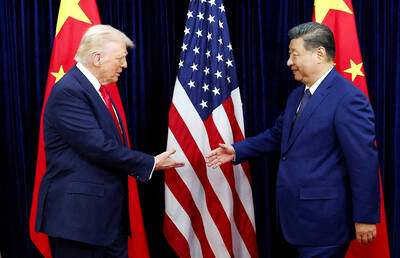
The March/April volume of Foreign Affairs, long a purveyor of pro-China pablum, offered up another irksome Beijing-speak on the issues and solutions for the problems vexing the People’s Republic of China (PRC) and the US: “America and China at the Edge of Ruin: A Last Chance to Step Back From the Brink” rang the provocative title, by David M. Lampton and Wang Jisi (王緝思). If one ever wants to describe what went wrong with US-PRC relations, the career of Wang Jisi is a good place to start. Wang has extensive experience in the US and the West. He was a visiting
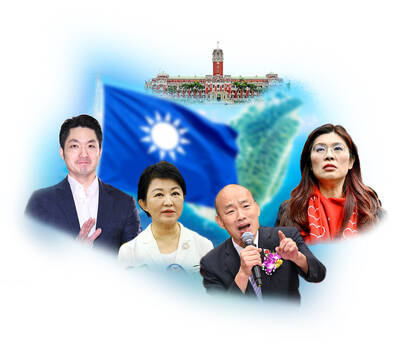
The January 2028 presidential election is already stirring to life. In seven or eight months, the primary season will kick into high gear following this November’s local elections. By this point next year, we will likely know the Democratic Progressive Party (DPP) candidate and whether the Taiwan People’s Party (TPP) will be fielding a candidate. Also around this time, the Chinese Nationalist Party (KMT) will either have already completed their primary, or it will be heading into the final stretch. By next summer, the presidential race will be in high gear. The big question is who will be the KMT’s
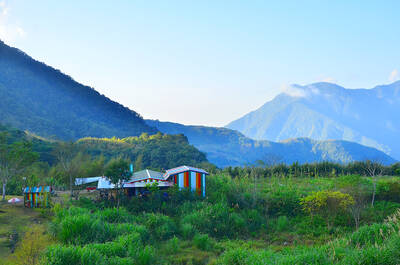
If one asks Taiwanese why house prices are so high or why the nation is so built up or why certain policies cannot be carried out, one common answer is that “Taiwan is too small.” This is actually true, though not in the way people think. The National Property Administration (NPA), responsible for tracking and managing the government’s real estate assets, maintains statistics on how much land the government owns. As of the end of last year, land for official use constituted 293,655 hectares, for public use 1,732,513 hectares, for non-public use 216,972 hectares and for state enterprises 34 hectares, yielding


 RSS
RSS