


Takeshi Kitano revives to exuberant effect the character Zatoichi, the blind master swordsman of Japanese legend, turning his tale into a gory, yet hilarious samurai genre flick. Replete with references and respectful nods to its predecessors, Zatoichi bears Kitano's imprimatur of Stooges-esque humor and wonderful moments of plain randomness that mark a welcome return to fun film-making after 2002's lugubrious Dolls.
As is the case with all martial heroes, Zatoichi, played by Kitano, is a drifter and a loner, a man with unmatched skills with the blade, who time and again finds himself reluctantly committed to delivering justice to fools. Far from being a handicap, Zatoichi's blindness is actually an advantage. His other senses have reached near-spiritual acuteness, canceling the need for eyesight, while lesser fighters tend to assume an easy match-up. This makes most of the fight scenes go like this: there's a zing, a flash and then usually a fountain of blood as Zatoichi's opponent goes down in a split second with an awful gagging sound.
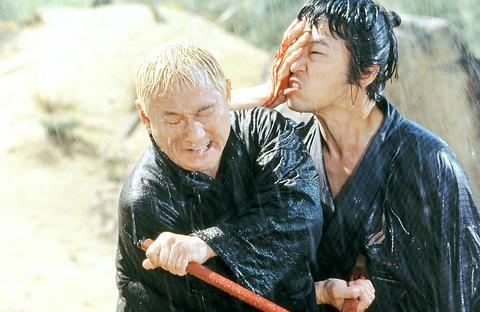
PHOTO COURTESY OF BIG FILM
In Kitano's version of the Zatoichi story, the hero wanders into a small town beset by the Ginzo gang, which has hired master bodyguard Hittori to eliminate rival gangs and help run protection rackets that are making life miserable for the townsfolk. As a hired henchman, Hittori struggles with the morality of his line of work, which he has undertaken to help pay for his ailing wife's treatment. But there is also a flashback to Hittori's early training, when he was maliciously beaten by his master, suggesting that his choice to become a paid killer has also to do with a sinister desire for revenge. Either way, his path was destined to cross with the righteous Zatoichi, who tries to scrape a living as a humble blind masseur, despite his highly
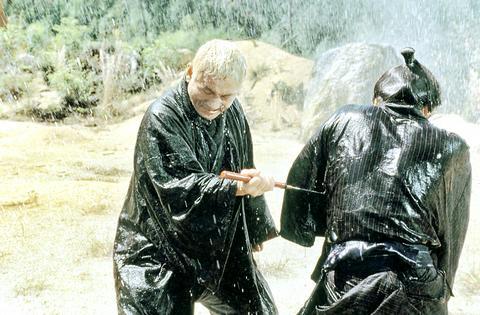
PHOTO COURTESY OF BIG FILM
marketable sword skills.
At first Zatoichi settles quietly in the home of Aunt Oume, helping out on the farm, administering massages and in the evenings indulging his one weakness for gambling with Oume's jester nephew Shinkichi. Their good luck at the gambling table -- it's not actually luck, Zatoichi can hear how the dice fall -- leads the two into an encounter with a pair of prostitutes, who Zatoichi quickly unmasks as killers out to avenge the deaths of their parents 10 years before at the hands of the Ginzo gang. Moved by the prostitutes' story, the gears are set in motion for justice to arrive swiftly at the doorstep of the Ginzo crew and for a seaside match-up between Zatoichi and Hittori reminiscent of the 1956 classic Samurai III: Duel at Ganryu Island.
In Zatoichi, Kitano masters the careful balance of preserving the mystery of the lead character, without leaving him flat. Zatoichi speaks little, but his humor and affable manner make him the most human among the many stock evil and good characters. Meanwhile, the secondary characters of Hittori and the prostitutes are dwelt upon at some length to help explain Zatoichi's motivation for getting involved in the town's feuds. Some surprising twists at the end introduce some welcome complexity through a batch of overlooked characters, as well.
Zatoichi's release falls coincidentally between the Taiwan releases of Kill Bill: Vol. I and Kill Bill: Vol. II, begging a comparison between Quentin Tarantino's and Kitano's liberal use of B-movie cheese and over-the-top gore. While Tarantino is quite consciously preoccupied with creating a chic and encyclopedic peon to martial arts movies, Kitano's result is less self-consciously referential and ultimately more humorous and fun. And Zatoichi is nothing if not fun to watch from its ominous beginning to its end featuring an extended tap-dance scene that, frankly, only Kitano could get away with and that must be seen to be believed.

Behind a car repair business on a nondescript Thai street are the cherished pets of a rising TikTok animal influencer: two lions and a 200-kilogram lion-tiger hybrid called “Big George.” Lion ownership is legal in Thailand, and Tharnuwarht Plengkemratch is an enthusiastic advocate, posting updates on his feline companions to nearly three million followers. “They’re playful and affectionate, just like dogs or cats,” he said from inside their cage complex at his home in the northern city of Chiang Mai. Thailand’s captive lion population has exploded in recent years, with nearly 500 registered in zoos, breeding farms, petting cafes and homes. Experts warn the

The unexpected collapse of the recall campaigns is being viewed through many lenses, most of them skewed and self-absorbed. The international media unsurprisingly focuses on what they perceive as the message that Taiwanese voters were sending in the failure of the mass recall, especially to China, the US and to friendly Western nations. This made some sense prior to early last month. One of the main arguments used by recall campaigners for recalling Chinese Nationalist Party (KMT) lawmakers was that they were too pro-China, and by extension not to be trusted with defending the nation. Also by extension, that argument could be
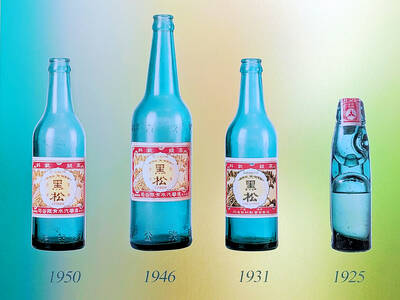
Aug. 4 to Aug. 10 When Coca-Cola finally pushed its way into Taiwan’s market in 1968, it allegedly vowed to wipe out its major domestic rival Hey Song within five years. But Hey Song, which began as a manual operation in a family cow shed in 1925, had proven its resilience, surviving numerous setbacks — including the loss of autonomy and nearly all its assets due to the Japanese colonial government’s wartime economic policy. By the 1960s, Hey Song had risen to the top of Taiwan’s beverage industry. This success was driven not only by president Chang Wen-chi’s

Last week, on the heels of the recall election that turned out so badly for Taiwan, came the news that US President Donald Trump had blocked the transit of President William Lai (賴清德) through the US on his way to Latin America. A few days later the international media reported that in June a scheduled visit by Minister of National Defense Wellington Koo (顧立雄) for high level meetings was canceled by the US after China’s President Xi Jinping (習近平) asked Trump to curb US engagement with Taiwan during a June phone call. The cancellation of Lai’s transit was a gaudy


 RSS
RSS