


"From the red lights and alcohol-fueled Linshen North Road in the small hours, to the morning joggers in the Da'an Park, we saw with our camera the many different faces of Taipei in 24 hours," said Lee Cheng-chang (
For the 24 photos they took in 24 hours on Nov. 8, they took home Sony's latest digital camera and vouchers worth NT$20,000. Their works are current on show with those of five other winning teams at the main FNAC in Taipei.
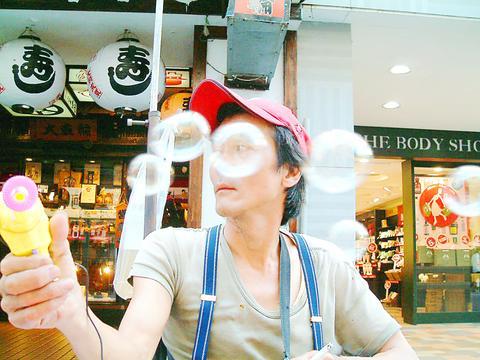
PHOTO COURTESY OF FNAC
One of the most popular amateur photography events in Taipei, the competition, organized by FNAC and Shin Kong Mitsukoshi Cultural Foundation, was held on a larger scale in its second year, and the winners show remarkable improvement.

PHOTO COURTESY OF FNAC
Last year's competition was so popular that the organizers admitted 91 teams in Taipei and more in Taichung and Tainan. To adjust to the increasing number of digital camera-users, the organizers have also shifted the format from traditional prints to digital photos.
At Taipei Artist Village, participants, mostly young students, took photos on the theme "Turn Left, Turn Right." At the Red Playhouse in Ximenting, they tried to capture the "old dreams" of the historical building. At the 228 Memorial Hall, they explored the meanings of "encounters in the dark."
The resulting works amazed Chuan Huei-hua (
Lee and Chou, who admitted that they had perused the themes thoroughly well before the day of competition, present the most lingering images with thought-provoking subtlety.
For "Turn Left, Turn Right," the theme with the greatest risk of either stating the obvious or totally missing the point, they shot a young woman and a little girl arranging their respective piles of papers on facing cabinets while many participants shot pedestrians literally walking in different directions on the street, probably influenced by the bestselling book and movie of the same title.
Their four images on "The Old Dreams of the Red Playhouse" are beautiful studies of light and shade. A close-up of a disused old-style film projector with a flyer of the trendy Room 18 club stuck on it is nostalgic and humorous, capturing in a glance the many contradictions and transformations that make this city an interesting place.
The latest trends in amateur photography and teenage culture are evident in the works of other winners in all three cities.
Lin Pei-rou (
A stuffed monkey doll travels from a market to a river bank in the works of Lo Chian-su (
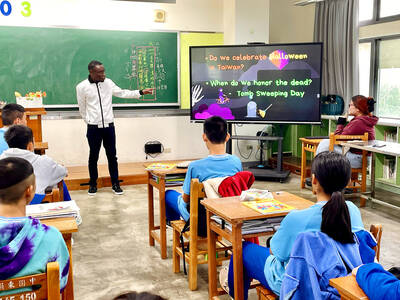
For many people, Bilingual Nation 2030 begins and ends in the classroom. Since the policy was launched in 2018, the debate has centered on students, teachers and the pressure placed on schools. Yet the policy was never solely about English education. The government’s official plan also calls for bilingualization in Taiwan’s government services, laws and regulations, and living environment. The goal is to make Taiwan more inclusive and accessible to international enterprises and talent and better prepared for global economic and trade conditions. After eight years, that grand vision is due for a pulse check. RULES THAT CAN BE READ For Harper Chen (陳虹宇), an adviser
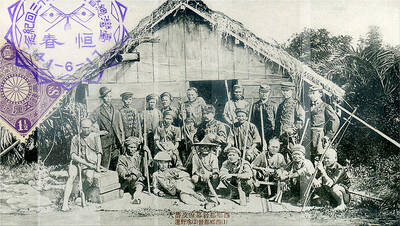
Traditionally, indigenous people in Taiwan’s mountains practice swidden cultivation, or “slash and burn” agriculture, a practice common in human history. According to a 2016 research article in the International Journal of Environmental Sustainability, among the Atayal people, this began with a search for suitable forested slopeland. The trees are burnt for fertilizer and the land cleared of stones. The stones and wood are then piled up to make fences, while both dead and standing trees are retained on the plot. The fences are used to grow climbing crops like squash and beans. The plot itself supports farming for three years.
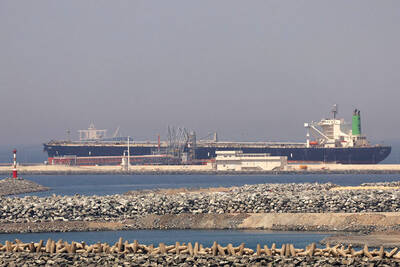
The breakwater stretches out to sea from the sprawling Kaohsiung port in southern Taiwan. Normally, it’s crowded with massive tankers ferrying liquefied natural gas from Qatar to be stored in the bulbous white tanks that dot the shoreline. These are not normal times, though, and not a single shipment from Qatar has docked at the Yongan terminal since early March after the Strait of Hormuz was shuttered. The suspension has provided a realistic preview of a potential Chinese blockade, a move that would throttle an economy anchored by the world’s most advanced and power-hungry semiconductor industry. It is a stark reminder of

May 4 to May 10 It was once said that if you hadn’t performed at the Sapphire Grand Cabaret (藍寶石大歌廳), you couldn’t truly be considered a star. Taking the stage at the legendary Kaohsiung club was more than just a concert. Performers were expected to entertain in every sense, wearing outlandish or revealing costumes and staying quick on their feet as sharp-tongued, over-the-top hosts asked questions and delivered jokes that would be seen as vulgar, even offensive, by today’s standards. Opening in May 1967 during a period of strict political and social control, Sapphire offered a rare outlet for audiences in


 RSS
RSS