


Good art exhibitions are not lacking in Taiwan, but how often does one come across an art show with an all-star line-up that took six years to put together? The Special Show of Fine Arts Festival: The Winners of National Literature and Art Achievement Award (美術節特展 -- 國家文藝獎得主作品展), which will open tomorrow at Taipei's Howard Salon (福華沙龍), is exactly such a dream exhibition.
The six artists are the winners of the six annual National Literature and Art Achievement Award given by the National Culture and Arts Foundation of the ROC. Artists have to go through a strict selection process to qualify in the five categories -- fine arts, literature, music, dance and theater. Winning the award is viewed as an artist's highest achievement in this country.
Lin Huai-min (林懷民), director of the Cloud Gate Dance Theater (雲門舞集), Taiwan's most famous dance group, and Ju Tzung-ching (朱宗慶), head of Ju Percussion Group (朱宗慶打擊樂團), one of the country's most active and popular music groups, both major figures in Taiwan's arts establishment, are both former winners of the award.
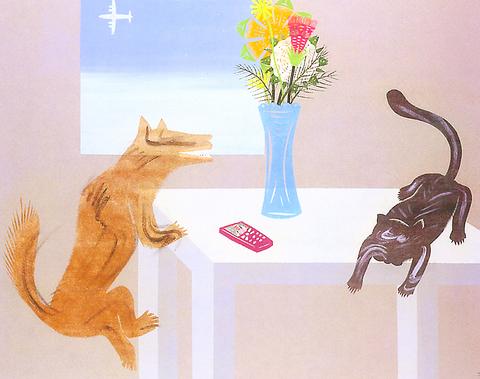
PHOTO COURTESY OF HOWARD SALON
To celebrate the coming Fine Arts Day, which falls on March 25, Howard Salon has gathered 22 works from artists Cheng Shan-hsi (鄭善禧), Liao Shiou-ping (廖修平), Chang Chau-tang (張照堂), Hsia Yan (夏陽), Wang Pan-yuan (王攀元) and Hsiao Chin (蕭勤). Each presented three to four works which they consider most representative of their career.
Liao, a pioneer printmaker in Taiwan, will present his latest oil works, which have a strong traditional Taiwanese flavor. Chang, the youngest of the six, will show his surrealistic photographs dealing with social issues. Wang, who won the award at the age of 90, will exhibit poetic depictions of a serene and contented life in his oil paintings. Hsia, who set up the avant-garde Oriental Painting Society in 1956 with Hsiao and six others, will present acute social commentary through his mixed media works. Cheng will delight viewers with his idyllic Chinese ink paintings.
For those interested in Hsiao's abstract acrylic paintings, a touring exhibition celebrating his winning of the award last September is currently on show at the gallery of the National Chiao Tung University, 1001 Dahsueh Rd., Hsinchu City (新竹市大學路1001號).
The Special Show of Fine Arts Festival: The Winners of National Literature and Art Achievement Award will run until April 7. Howard Salon is on the 2nd floor of Howard Plaza Hotel, 160 Renai Rd., Sec. 3, Taipei (台北市仁愛路三段160號). The gallery opens from 11:00am to 9:30pm.
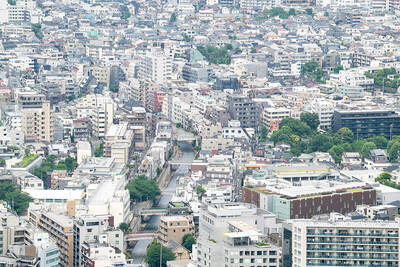
The canonical shot of an East Asian city is a night skyline studded with towering apartment and office buildings, bright with neon and plastic signage, a landscape of energy and modernity. Another classic image is the same city seen from above, in which identical apartment towers march across the city, spilling out over nearby geography, like stylized soldiers colonizing new territory in a board game. Densely populated dynamic conurbations of money, technological innovation and convenience, it is hard to see the cities of East Asia as what they truly are: necropolises. Why is this? The East Asian development model, with
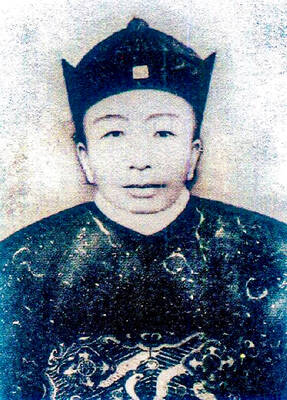
June 16 to June 22 The following flyer appeared on the streets of Hsinchu on June 12, 1895: “Taipei has already fallen to the Japanese barbarians, who have brought great misery to our land and people. We heard that the Japanese occupiers will tax our gardens, our houses, our bodies, and even our chickens, dogs, cows and pigs. They wear their hair wild, carve their teeth, tattoo their foreheads, wear strange clothes and speak a strange language. How can we be ruled by such people?” Posted by civilian militia leader Wu Tang-hsing (吳湯興), it was a call to arms to retake
This is a deeply unsettling period in Taiwan. Uncertainties are everywhere while everyone waits for a small army of other shoes to drop on nearly every front. During challenging times, interesting political changes can happen, yet all three major political parties are beset with scandals, strife and self-inflicted wounds. As the ruling party, the Democratic Progressive Party (DPP) is held accountable for not only the challenges to the party, but also the nation. Taiwan is geopolitically and economically under threat. Domestically, the administration is under siege by the opposition-controlled legislature and growing discontent with what opponents characterize as arrogant, autocratic
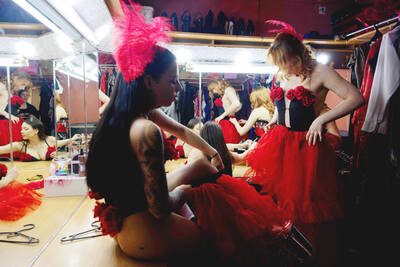
When Lisa, 20, laces into her ultra-high heels for her shift at a strip club in Ukraine’s Kharkiv, she knows that aside from dancing, she will have to comfort traumatized soldiers. Since Russia’s 2022 invasion, exhausted troops are the main clientele of the Flash Dancers club in the center of the northeastern city, just 20 kilometers from Russian forces. For some customers, it provides an “escape” from the war, said Valerya Zavatska — a 25-year-old law graduate who runs the club with her mother, an ex-dancer. But many are not there just for the show. They “want to talk about what hurts,” she


 RSS
RSS