

The Thucydides Trap has become a popular lens for understanding US-China relations. Its logic is simple: When a rising power challenges an established one, fear and mistrust grow, making conflict increasingly difficult to avoid. Over the past decade, Chinese President Xi Jinping (習近平) has repeatedly invoked this distinctly American concept to frame his country’s rivalry with the US.
It is unusual for a Chinese Communist Party (CCP) leader to use a US-made framework to lecture a US leader, yet that is precisely what happened during the Beijing summit between Xi and US President Donald Trump in May. The Thucydides Trap is particularly useful for Xi because it casts China as the natural “rising power,” the US as the anxious incumbent, and US policymakers’ unwillingness to accommodate China’s rise as the central source of tension.
This framing also serves a deeper purpose. It shifts attention away from the nature of China’s political system, encouraging the world to see US-China relations primarily as a great-power rivalry rather than a contest between vastly different political systems. However, the most important question is not simply whether China is rising; it is what kind of system is rising.
Illustration: Mountain People
Contemporary China is best understood as a communist totalitarian system with Chinese characteristics. Recognizing the nature of that system is essential to making sense of China’s past and anticipating its future.
“Totalitarian,” it is important to note, is not a pejorative label. It describes a distinct institutional structure. If China is seen merely as a rising power, the challenge appears to be one of great-power competition, inviting accommodation and compromise. If it is viewed as a strictly authoritarian regime, the problem is one of political repression, with gradual reform offering a possible remedy. However, if China is a communist totalitarian system, then its domestic institutional structure necessarily shapes its external behavior, with profound implications for its role within the international order.
The distinction between totalitarianism and authoritarianism is not just semantic. A totalitarian party is not a political party in the conventional sense. It is an organization designed to penetrate and control the state, the bureaucracy, the economy, the media, (coercive) institutions, personnel, ideology, social organizations and even private life.
By contrast, authoritarian regimes try to monopolize political power, suppress opposition and restrict civil liberties, but might leave significant parts of society relatively autonomous. This limited pluralism can foster economic growth and an expanding middle class, which can in turn lead to liberalization and, eventually, democracy. South Korea and Taiwan are prime examples.
For decades, the US, Europe and other Western democracies have treated China as an authoritarian regime, hoping that economic development would lead to greater social pluralism and turn it into the next Taiwan.
China’s reform era initially appeared to validate these optimistic predictions. Private enterprise flourished, local governments competed for growth, media controls loosened somewhat, and elements of civil society began to emerge. To many observers, China seemed to be moving away from totalitarianism and settling into a more conventional form of authoritarianism. Continued economic development, they believed, would eventually push the country toward constitutional rule.
However, China’s totalitarian institutions proved more resilient than expected, because the CPP never relinquished its monopoly over political power and the levers that sustained it: the bureaucracy, the security apparatus, the financial system, the flow of information and strategic industries. The liberalization of the reform era took place within the boundaries of a system designed to preserve one-party rule. Therefore, its subsequent reversal cannot be explained simply by the choices of one leader. Instead, it reflects deeper institutional forces that never disappeared.
What accounts for the remarkable persistence of Chinese totalitarianism? The answer lies in “institutional genes”: recurring institutional elements that enable a political system to reproduce itself over time. The most important of these elements concern the distribution of power and property rights, and the prevailing social consensus that legitimizes this distribution. Because these elements sustain the larger structure of power, those who benefit from it have strong incentives to preserve and reproduce them.
That said, the term is a social-science concept, not a biological theory. Institutional genes can evolve, although they generally change slowly, and their effects are not deterministic. The concept does not imply that China’s development is culturally predetermined or that the country is destined to repeat the same historical patterns. Rather, institutional genes help explain why political systems can retain fundamental features even through periods of profound change.
To qualify as an institutional gene, an element must meet three conditions: It must persist over time, give powerful actors an incentive to keep it in place and play a foundational role in shaping the broader institutional architecture. Longevity alone is not enough. A religion, custom, administrative title or cultural tradition can endure for centuries without shaping the foundations of political power. For example, Buddhism played an important role in Chinese history, but it did not become integral to the structure of the state in the way the imperial bureaucracy, land rights and the civil-service examination system did.
Institutional change is often path-dependent. As the late Nobel laureate economist Douglass North showed, institutions shape incentives, and institutional change often follows inherited paths. Institutional genes are the recurring elements that carry those paths forward, making some arrangements easier to reproduce and alternatives harder to establish.
Consider imperial China, where political power was centralized through a vertical bureaucracy answerable to the emperor. The state exercised ultimate authority over land and economic privileges, while the examination system determined who could enter government service, and official Confucianism served as the ideological foundation. Together, these elements formed a trinity that sustained imperial rule for centuries.
While contemporary China has a different trinity, the structural similarities are striking: a party-state bureaucracy; party-state control over land, finance and key parts of the economy; and centralized oversight of staffing and ideological conformity. The CCP retains final authority over every major political and economic institution, and local party-state organs enjoy substantial administrative and economic autonomy even as they remain subordinate to centralized political and personnel control. I call this system regionally administered totalitarianism (RADT).
Institutional genes should not be confused with historical determinism. Although they shape the paths political systems are likely to follow, they do not dictate every outcome. What persists is the underlying structure, not the individuals who occupy positions within it. In imperial China, the identities of emperors and county magistrates mattered less than the system in which they operated: a centralized hierarchy that delegated administrative power locally, but retained political control from above.
The same principle applies to property rights. The critical question is not who owns a particular asset, but who ultimately controls land, capital, labor and information. Such arrangements are reproduced through incentives, coercion, ideology and organizational power. While they can and do change, new policies or reformist declarations alone are rarely enough to dislodge them.
Taiwan offers the clearest example. It is an ethnically Chinese society with deep historical and cultural ties to mainland China, yet it became a constitutional democracy. Its institutional genes evolved under Japanese rule and were carried forward under the Republic of China. It found expression in concrete institutions, including local elections, private property rights and elements of constitutional government. Its continued development contributed to the emergence of civil society and growing demands for political reform.
This placed Taiwan on a different institutional path from that of China. Although the Chinese Nationalist Party (KMT) authoritarian rule sharply constrained these institutions, it did not eradicate either their underlying institutional genes or those genes’ concrete manifestations. Over time, these institutional legacies provided an important foundation for Taiwan’s democratic transition.
If culture predetermined political outcomes, Taiwan’s trajectory would be difficult to explain. However, viewed through an institutional lens, the divergence between Taiwan and China becomes much easier to understand.
Institutions cannot endure through structure alone. This is where incentive compatibility comes in: Given the constraints they face, enough people must find it in their interest to follow the rules.
When applied to autocracy, self-interest does not mean free choice. It includes decisions made under coercion. If resistance can result in imprisonment, torture, loss of livelihood or death, obedience might be the rational choice even for someone who despises the regime.
This mechanism, which I call “tyrannical incentive compatibility,” helps explain how a dictatorship can remain stable without genuine popular support. Such stability does not require devotion; it can rest on fear, dependence, fragmented opposition or simply the absence of viable alternatives.
A totalitarian party can go further by mobilizing people against one another. It can induce individuals to pressure, denounce, coerce or attack others through organized campaigns that eventually harm nearly everyone. It can also pursue a long-term objective fundamentally at odds with ordinary citizens’ interests by breaking it into a series of short-term stages. At each stage, participation might appear rewarding, safe or unavoidable, drawing people toward an outcome they would never have chosen had they known where it would lead.
Communist totalitarianism thus does more than rely on top-down repression; it rules through organized participation in repression. The CCP’s land reform and collectivization, the Great Leap Forward and the Cultural Revolution all reflected this logic.
Communist totalitarianism, of course, did not originate in China. Its ideological roots lay in Europe, its first institutionalized form took shape in Russia, and it reached China through the Communist International. That raises a fundamental question: If communist totalitarianism was imported, why did it take root so deeply in China?
To answer this question, look to Western Europe, where radical egalitarian religious movements, Jean-Jacques Rousseau, the French Revolution, Francois-Noel Babeuf, Karl Marx and later Vladimir Lenin contributed to the intellectual genealogy of totalitarian ideology. Yet the first durable communist regime appeared not in Western Europe but in Russia, where autocratic rule, revolutionary traditions and a political-religious inheritance that fused church and state created the institutional conditions for Bolshevism to take hold.
The Bolsheviks, in turn, built a disciplined, conspiratorial and intensely ideological party. Through the Comintern, they sought to reproduce that model abroad. Those efforts failed in most countries. In China, they succeeded. The reason was neither that China was somehow destined for communism nor that Marxism grew naturally out of Chinese tradition. Rather, imported Bolshevik institutions proved compatible with certain features of China’s existing order: a long legacy of centralized bureaucratic rule, weak constraints on sovereign power, traditions of clandestine political organization and the absence of deeply rooted constitutional limits on political authority.
That interaction between the imported Bolshevik model and China’s existing institutions was crucial. Without the Comintern, communist totalitarianism would not have arrived in China in the form it did, and without domestic compatibility, it would not have taken root. This is a causal argument about institutional transmission and local adaptation.
The post-Mao Zedong (毛澤東) reform era is often seen as China’s break with totalitarianism. I see it differently. Former Chinese leader Deng Xiaoping (鄧小平) launched his reforms to save the regime from the disasters of Maoism, not to end CCP rule.
During this period, China shifted away from some features of the RADT model toward regionally decentralized authoritarianism. Local governments were strongly incentivized to promote growth, private enterprise expanded and limited pluralism emerged in economic and social life. These changes were real and consequential.
However, reform stopped well short of abolishing the CCP’s monopoly on political power. The party retained control over the military and security apparatus, senior personnel appointments, ideology, finance, land, state-owned enterprises and the legal system. It tolerated private enterprise so long as it helped preserve the regime by contributing to economic growth, but never accepted autonomous institutions capable of constraining its power.
Over time, private enterprise, civil society, legal consciousness and constitutional ideas began to generate alternative institutional genes. These elements increasingly came into conflict with the totalitarian institutions that had survived the reform era. The tightening of CCP control under Xi reflects that tension. Xi’s desire for greater power is only part of the story. The shift also represents an institutional response by a ruling party that regards autonomous sources of economic, social and political power as potential threats to its survival.
In this sense, China’s trajectory is not simply a return to Maoism. History does not repeat so neatly. However, the underlying features of that earlier system — including party supremacy, ideological control, coercive capacity, and the subordination of property and social organization to the state — have reasserted themselves.
Some might ask why it matters whether China is called authoritarian or totalitarian. The answer is simple: The wrong category produces the wrong expectations. If China is seen as a conventional authoritarian state, economic growth, social modernization and global integration would be expected to have a moderating effect on the regime. If China is a conventional rising power, it might be amenable to accommodation and negotiation, and the Thucydides Trap would reduce its rivalry with the US to a conventional great-power transition.
However, if China is a communist totalitarian system with Chinese characteristics, the problem runs deeper than authoritarianism or great-power competition. The CCP’s objective is not merely national strength, but the preservation and expansion of a system in which the party controls power, property, organization, ideology and coercion. Its conduct abroad cannot be separated from the way the CCP exercises power at home.
This is also why analytical clarity cannot be divorced from moral clarity. Totalitarian systems are defined in part by their systematic violations of human rights. Treating these as peripheral abuses obscures the nature of totalitarian rule.
After World War II, the Austrian economist Ludwig von Mises observed that repeated efforts to halt the rise of totalitarianism in many countries had failed. His observation proved prescient: Democracies have often been slow to recognize totalitarian systems as such, treating them instead as difficult partners, developmental states, nationalist powers or ordinary autocracies. There is nothing ordinary about a system that extends party authority to every aspect of political and social life, subordinates individual rights to party rule and turns citizens into instruments of domination.
That brings us back to Xi’s fondness for the Thucydides Trap. By framing China as a normal rising power and the US as a nervous incumbent, he seeks to focus global attention on preventing a great-power conflict, rather than on harder questions about the nature of China’s totalitarian system and what its ascendancy would mean for the world.
How democracies understand China determines how they deal with it. Misreading the nature of the regime can lead them to treat China as an ordinary great power, mistake tactical accommodation for genuine liberalization and confuse economic integration with political moderation. The stakes extend beyond US-China relations and the rights and freedoms of Chinese citizens to the future of the international order.
China’s experience shows why the origins and resilience of political systems matter — and why even far-reaching reforms might fail to transform them. However, history is not destiny. Institutions change when the forces that reinforce them change. Although China is not condemned by its past, its future depends on whether the institutions that have defined its political order for generations finally give way to something new. The first step is to recognize its totalitarian regime for what it is.
Chenggang Xu, a senior research fellow at the Stanford Center on China’s Economy and Institutions at Stanford University, is the author of Institutional Genes: Origins of China’s Institutions and Totalitarianism.
Copyright: Project Syndicate
For the last 15 years, China has relied on gray zone operations to advance its territorial ambitions across Asia. And for 15 years, the US has struggled to respond. But the open door on which China has been pushing may finally be closing. Gray zone operations involve the assertive use of a variety of tools in ways that create conditions that can be described as neither peace nor war. Military forces might act provocatively — even dangerously — while carefully avoiding violence, whereas law enforcement employs nonlethal violence as a first resort. Such an approach creates difficult calculations for its targets.
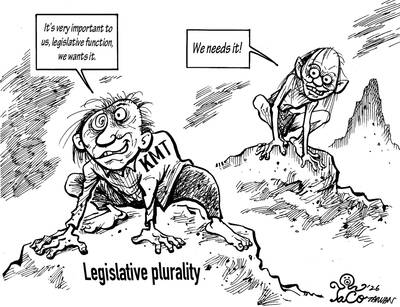
EDITORIAL CARTOON
China’s new exit and entry regulations might signal an increase in the risk that Taiwanese travelers will face, an analyst said on Tuesday last week. The new rules, which take effect on Sept. 15, expand the power of authorities to restrict travel on national, industrial and technological security grounds, question travelers about their reasons for leaving and inspect electronic data. Taiwanese who do not support the ruling party should not dismiss the warnings as fearmongering or propaganda. Beijing applies its “anti-secession” laws indiscriminately, an official said recently while presenting a report on proposed amendments to combat China’s efforts at transnational repression. Chinese
President William Lai (賴清德) late last month received a delegation of Polish members of the European Parliament at the Presidential Office — the first single-party, single-nation delegation from the EU legislature to visit Taipei in nearly two terms. The group, led by former Polish prime minister Beata Szydlo, also met Legislative Yuan Speaker Han Kuo-yu (韓國瑜), a gesture spanning Taiwan’s political divide. For most Taiwanese observers, this was a pleasant, if minor, diplomatic event. It was much more than that — and the timing matters. Within the same fortnight, Hudson Institute senior fellow Ken Moriyasu said in the Washington Examiner


 RSS