

Japan’s defense posture has long relied on doublethink. How else can you explain the nation’s ability to simultaneously be devoutly opposed to atomic weapons, while sitting safely underneath the US nuclear umbrella?
Japanese Minister of Defense Shinjiro Koizumi faced those contradictions head-on recently when he referred to shifting attitudes toward such arms by countries such as France and Finland. He told an interviewer that Tokyo must also “discuss all policies, without any taboos.”
From the reaction, you might have thought he called on the country to spin up a Manhattan Project of its own, instead of merely advocating for an open discussion. China, Russia and North Korea — all in possession of nuclear arsenals — blasted the remarks. Coming ahead of the 81st anniversary of the bombing of Hiroshima and Nagasaki, the comments were quickly condemned. Nihon Hidankyo, the Nobel Peace Prize-winning atomic bomb survivors’ organization, dubbed his suggestion “out of the question.” Hiroshima Governor Mika Yokota has declared that the world was in “a crisis where the nuclear taboo might be broken.”
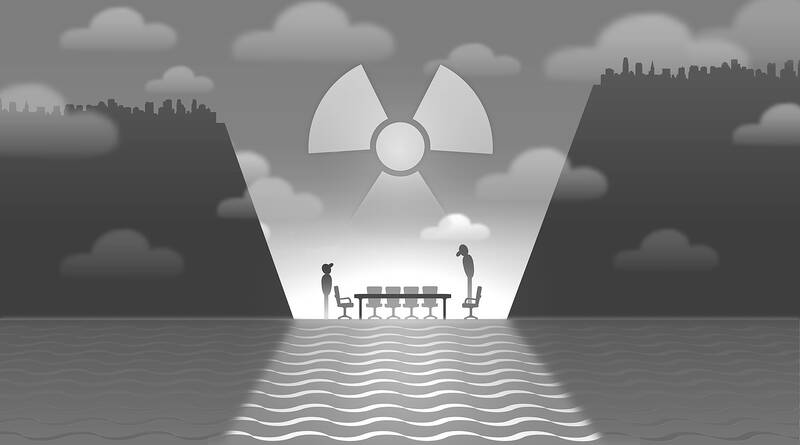
Illustration: Yusha
Opposing the use of the bomb is a norm that should, of course, remain intact. However, Japan must dispense with the idea that merely discussing the possibility of having a debate is controversial.
That conversation does not mean adoption. While some advocate for Tokyo acquiring its own nuclear weapons, in the short term there is near-zero possibility; it is just too politically sensitive in the only country to have ever suffered nuclear attack.
Japan’s three non-nuclear principles, adopted by then-Japanese prime minister Eisaku Sato in 1967, are non-binding guidelines that say the nation would not possess, produce or permit the introduction of nuclear weapons into its territory. With his frequent references to Finland, which recently lifted its own ban on allowing such arms on its land, what Koizumi is seeking to do is move the Overton window on the third of those.
The principles are worthy goals, as is Japan’s commitment to eliminating nuclear arms. They are also hypocritical: The reality is that Japan is not a country that rejects the nuclear deterrent, but is instead one protected by it, even as it maintains political rituals that keep it at arm’s length.
Tokyo is deeply dependent on the US’ nuclear umbrella. Its own defense strategy says that “in dealing with the threat of nuclear weapons, US extended deterrence, with nuclear deterrence at its core, is essential.”
In talks this June, Washington explicitly reaffirmed its commitment to defending its ally with the full range of capabilities, including nuclear.
It is getting harder to explain why those weapons are indispensable to protecting Japan while simultaneously arguing that they are morally and politically unacceptable to have in the country itself. In today’s security environment, it is harder still to rationalize why just talking about them should be beyond the pale.
The time for these post-World War II shibboleths has passed. One reason to accelerate such discussions is US plans to deploy nuclear-armed sea-launched cruise missiles on Virginia-class attack submarines in the next decade, as Shizuka Kuramitsu, a nuclear weapons research analyst at the Carnegie Endowment for International Peace, said recently. Such vessels frequently call at Japanese ports. Tokyo and Washington want Japan to increase its contribution to regional security, and the flakiness US President Donald Trump’s administration is one reason why Japan must, in the near term, bind the US closer, and boost both sides’ dependence on the other.
Japan has made much progress in modernizing its defense posture, as Koizumi said. It has abandoned a spending cap of 1 percent of GDP, and dismantled self-imposed export controls that have stunted the defense industry. However, as he also remarked, the world is moving faster still. China, Russia and North Korea want to see Tokyo continue to limit its own power. Domestic taboos only aid their goals, while doing nothing to rein in those countries’ own growing nuclear arsenals.
At anniversary events for Hiroshima and Nagasaki, Japanese Prime Minister Sanae Takaichi said that her administration maintains the three principles, but sidestepped questions about how far that would extend into the future. Before becoming prime minister, she called for a debate over allowing nuclear sharing, that is, placing US weapons in Japan.
Expect more blowback and complaints about “neo-militarism” if, as expected, she includes the possibility of debating the third principle in an earlier-than-scheduled update of the country’s three defense documents later this year. However, keep in mind that former Japanese prime minister Shigeru Ishiba, arguably the most left-leaning Liberal Democratic Party prime minister of recent times and one welcomed by Beijing, also called for nuclear sharing in Asia shortly before becoming leader.
The outcome of the debate should not be a fait accompli. There are lots of arguments against possessing nuclear weapons or allowing US arms on Japanese soil, but if so, the argument should be won through discussion, rather than being declared off-limits before both sides have been considered.
Lost in the fuss over Koizumi’s remarks was his most important point: That Japan cannot let fear of how others might react determine what it is allowed to talk about. The country’s nuclear deterrence is already outsourced; the boundaries of its debate should not be.
Gearoid Reidy is a Bloomberg Opinion columnist covering Japan and the Koreas. He previously led the breaking news team in North Asia and was the Tokyo deputy bureau chief. This column reflects the personal views of the author and does not necessarily reflect the opinion of the editorial board or Bloomberg LP and its owners.

For the last 15 years, China has relied on gray zone operations to advance its territorial ambitions across Asia. And for 15 years, the US has struggled to respond. But the open door on which China has been pushing may finally be closing. Gray zone operations involve the assertive use of a variety of tools in ways that create conditions that can be described as neither peace nor war. Military forces might act provocatively — even dangerously — while carefully avoiding violence, whereas law enforcement employs nonlethal violence as a first resort. Such an approach creates difficult calculations for its targets.
China’s new exit and entry regulations might signal an increase in the risk that Taiwanese travelers will face, an analyst said on Tuesday last week. The new rules, which take effect on Sept. 15, expand the power of authorities to restrict travel on national, industrial and technological security grounds, question travelers about their reasons for leaving and inspect electronic data. Taiwanese who do not support the ruling party should not dismiss the warnings as fearmongering or propaganda. Beijing applies its “anti-secession” laws indiscriminately, an official said recently while presenting a report on proposed amendments to combat China’s efforts at transnational repression. Chinese
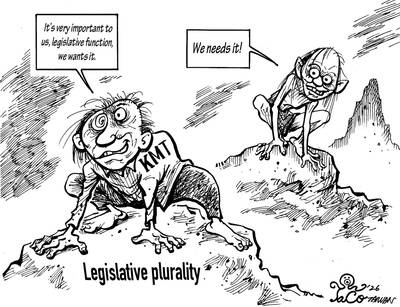
EDITORIAL CARTOON
President William Lai (賴清德) late last month received a delegation of Polish members of the European Parliament at the Presidential Office — the first single-party, single-nation delegation from the EU legislature to visit Taipei in nearly two terms. The group, led by former Polish prime minister Beata Szydlo, also met Legislative Yuan Speaker Han Kuo-yu (韓國瑜), a gesture spanning Taiwan’s political divide. For most Taiwanese observers, this was a pleasant, if minor, diplomatic event. It was much more than that — and the timing matters. Within the same fortnight, Hudson Institute senior fellow Ken Moriyasu said in the Washington Examiner


 RSS
RSS