


For the last 15 years, China has relied on gray zone operations to advance its territorial ambitions across Asia. And for 15 years, the US has struggled to respond. But the open door on which China has been pushing may finally be closing. Gray zone operations involve the assertive use of a variety of tools in ways that create conditions that can be described as neither peace nor war. Military forces might act provocatively — even dangerously — while carefully avoiding violence, whereas law enforcement employs nonlethal violence as a first resort. Such an approach creates difficult calculations for its targets.
China’s new exit and entry regulations might signal an increase in the risk that Taiwanese travelers will face, an analyst said on Tuesday last week. The new rules, which take effect on Sept. 15, expand the power of authorities to restrict travel on national, industrial and technological security grounds, question travelers about their reasons for leaving and inspect electronic data. Taiwanese who do not support the ruling party should not dismiss the warnings as fearmongering or propaganda. Beijing applies its “anti-secession” laws indiscriminately, an official said recently while presenting a report on proposed amendments to combat China’s efforts at transnational repression. Chinese
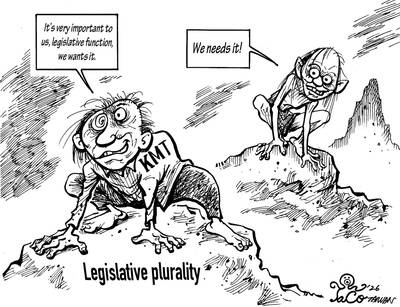
EDITORIAL CARTOON
President William Lai (賴清德) late last month received a delegation of Polish members of the European Parliament at the Presidential Office — the first single-party, single-nation delegation from the EU legislature to visit Taipei in nearly two terms. The group, led by former Polish prime minister Beata Szydlo, also met Legislative Yuan Speaker Han Kuo-yu (韓國瑜), a gesture spanning Taiwan’s political divide. For most Taiwanese observers, this was a pleasant, if minor, diplomatic event. It was much more than that — and the timing matters. Within the same fortnight, Hudson Institute senior fellow Ken Moriyasu said in the Washington Examiner



 RSS
RSS