


Gamers who long ago coveted Nvidia Corp’s graphics cards because they rendered computer games so beautifully could soon be eyeing new Windows computers that plug that technology right into a laptop’s brain. Nvidia’s latest effort to diversify itself from the monumentally successful business of selling chips for artificial intelligence (AI) servers is to offer consumers and businesses an alternative to notebooks with “Intel inside.” It is a smart hedge for Nvidia. Whether the computers would be a smart buy for you is far less certain.
Nvidia plans to offer machines built by the likes of Lenovo Group Ltd, Hewlett Packard Enterprise Co and Dell Technologies Inc that are better adapted to running AI-powered software and agents. Nvidia calls its new RTX Spark a “superchip” because it fuses two things into one package: A CPU, the brain that runs a personal computer, and a GPU, the graphics engine Nvidia originally built for video games that turned out to be so good at AI that it now powers data centers.
Shares of Intel Corp declined by as much as 7.3 percent in early Monday trading after the announcement by Nvidia chief executive officer Jensen Huang (黃仁勳) at the Computex technology show in Taiwan.
On the face of it, Huang is not only expanding his sphere of influence in the global chip market, but also hedging his bets on where AI demand could go. Nvidia’s US$5 trillion market valuation has long had the whiff of a gamble because so much revenue is dependent on just a handful of large customers. For this fiscal year, for instance, one customer accounted for 22 percent of Nvidia’s total sales and another for 14 percent, meaning two buyers brought in more than one-third of turnover. Nvidia does not name the customers in its filings, but they are likely companies such as Hon Hai Precision Industry Co, which assemble systems for hyperscalers like Microsoft Corp and Amazon.com Inc.
Now it can also capture business at the so-called edge of the AI business by pitching its technology to end users. Lenovo, HP and Dell, three of the manufacturers Nvidia would sell to, account for about two-thirds of worldwide PC shipments.
If the new venture does not work, Nvidia still has the 4 percent stake in Intel that it bought. That particular hedge was worthwhile because while Nvidia has years of experience building for consumer machines from its days making graphics cards for gamers, it does not have a strong track record building the brains of personal computers.
Most laptops today run on chips made by Intel or Advanced Micro Devices Inc, which are relatively thirsty for power. Chips based on Arm Holdings PLC’s technology, the kind found in smartphones and Apple Inc’s Macs, are famed instead for sipping less energy and being gentler on battery life.
However, the GPUs that Nvidia makes for data centers are notoriously energy intensive. That, and their price tag have made building AI extremely costly for labs like OpenAI and Anthropic, and hyperscalers such as Microsoft.
It is hard to see how successful a laptop can be if it is running AI agents or whizzy AI features in Adobe Inc’s Photoshop, but dies within a few hours. However, Nvidia’s RTX Spark is built on Arm’s energy-efficient blueprints, suggesting it might power laptops in an energy saving way too. At least, that is the idea.
Nvidia is touting “the most efficient PC chip ever built,” and promises “all-day” battery life, but it has not shared figures for energy-intensive tasks like gaming or running AI agents. The company only says that it would release more performance metrics closer to when its chip goes to market this autumn, and that they are “roughly equivalent” to its RTX 5070 graphics chip for laptops.
Is the RTX 5070 graphics chip efficient? Not especially. If pushed hard with a game, it has been known to drain a laptop’s battery life. And Nvidia would not give further details on how the new RTX Spark superchip compares to those from the competition. That leaves an open question that could come back to bite later this year if independent testing shows laptops with an Nvidia brain are a power suck.
This would not be Nvidia’s first run at the PC market. More than a decade ago, Nvidia’s Tegra chips powered Microsoft’s first Windows-on-Arm device, a tablet with a detachable keyboard called the Surface RT. However, the device could not run a range of third-party apps such as Google Chrome, Photoshop and many PC games because most of those programs were designed to run on Intel-style chips, and not Arm.
These days, chips based on Arm’s designs have a built-in translator that can run many more programs, which is a promising step forward even if software compatibility for the RTX Spark is still unclear. The bigger question is whether Nvidia can deliver all that power without battery life paying the price
Parmy Olson is a Bloomberg Opinion columnist covering technology. A former reporter for the Wall Street Journal and Forbes, she is author of Supremacy: AI, ChatGPT and the Race That Will Change the World. This column reflects the personal views of the author and does not necessarily reflect the opinion of the editorial board or Bloomberg LP and its owners.
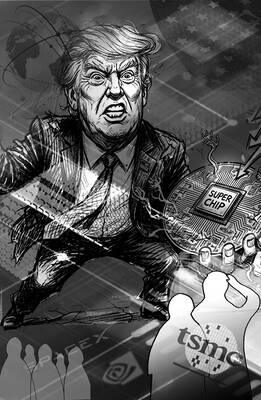
The White House’s decision to take a 9.9 percent stake in Intel Corp is looking like very shrewd business indeed. Since the government bought in at US$20.47 a share last August, the US chipmaker’s surging stock price has delivered the US a US$43 billion return. One of the reasons the investment has so far proved so sound is that the White House has made sure of it. According to The Wall Street Journal, Howard personally pushed deals on Intel’s behalf with some of the most lucrative clients imaginable. They include Nvidia Corp, the company at the heart of the AI
A single photograph can cut through a lot of noise, but it can also be used to misrepresent the truth. At the very least, it can concentrate the mind on something that requires further investigation. On Monday last week, Ma Ying-jeou Foundation CEO Tai Hsia-ling (戴遐齡) and former National Security Council secretary-general King Pu-tsung (金溥聰) held a news conference in which they showed a photograph of former foundation CEO Hsiao Hsu-tsen (蕭旭岑), now Chinese Nationalist Party (KMT) deputy chairman. In the image Hsiao is seated next to Xiamen Taiwan Businessmen Association chairman Han Ying-huan (韓螢煥). The two men were holding
I first met Professor Ray Jiing (井迎瑞) as a film and documentary student at Shih Hsin University’s (SHU) Department of Radio Television and Film in 1988. The following year, he went on to become the director of the Chinese Taipei Film Archive — forerunner of the Taiwan Film and Audiovisual Institute (TFAI). Over his eight-year tenure, Jiing rescued and restored over 200 classic Taiwanese films. In 1997, he established the Graduate Institute of Studies in Documentary and Film Archiving at Tainan National University of the Arts (TNNUA), and I joined the program in his third cohort of students. Beyond a

President William Lai Ching-te’s (賴清德) May 20 second-anniversary address was not just a routine policy review; it was damage control. US President Donald Trump’s remarks — that he did not want to see anyone move toward independence and that the delivery of a major Taiwan arms package could depend on the progress of US-China relations — unsettled Taiwan’s public and created an opening for opposition parties to question whether Taiwan was being treated as a bargaining chip in Washington’s dealings with Beijing. Lai’s speech was designed to close that opening. The address covered the expected ground: sovereignty, cross-strait relations, defense spending,


 RSS
RSS