


June marks the 37th anniversary of the 1989 Tiananmen Square protests. Since Chinese President Xi Jinping’s (習近平) rise to power, China has extended a model of governance that prioritizes national security over pluralism to Hong Kong through far-reaching legal restructuring.
While citizens in China have long been deprived of meaningful civil and political rights, Hong Kong — under the framework of the 1984 Sino-British Joint Declaration and Hong Kong’s Basic Law — was promised a higher degree of autonomy and rights protection after the 1997 political handover. Yet this promise has been steadily undermined.
Since the imposition of the National Security Law in 2020, Hong Kongers have lost the ability to freely criticize the authorities without facing serious legal consequences. What once distinguished the territory’s civic space has been dismantled. The new security order has not merely curtailed dissent; it has transformed the territory’s legal institutions into instruments of enforcement.
However, enforcing compliance is not the same as earning trust. A system that governs through fear ultimately reveals its own insecurity.
A striking example of this shift is the prosecution of Chow Hang-tung (鄒幸彤) and Lee Cheuk-yan (李卓人), former leaders of the Hong Kong Alliance in Support of Patriotic Democratic Movements of China (also known as the Alliance) and longtime organizers of the annual candlelight vigils in Victoria Park. Their trial marks a turning point in the redefinition of lawful political expression as criminal conduct.
From the outset, the proceedings were deeply politicized, with the verdicts widely perceived as predetermined. The Alliance’s call to end one-party rule — once part of Hong Kong’s accepted political discourse — was recast as incitement to subversion. In doing so, the prosecution collapsed the distinction between dissent and threat, treating advocacy for democratic reform as evidence of criminal intent and subordinating universal values such as human rights and the rule of law to political imperatives.
In contrast, Chow’s defense drew on legal reasoning, moral conviction and political conscience, exposing the ideological rigidity underpinning the charges against her. The issue was not simply the fate of individual defendants, but the role of the courts. No longer operating as impartial arbiters, they have been tasked with disciplining dissent.
Once the courts established that even memorialization could be construed as subversion, public commemoration of Tiananmen in Hong Kong became untenable.
The banning of the June 4 vigil since 2020, followed by the dissolution of the Alliance, signaled the closure of a civic space that had endured for decades. Yet the story does not end in silence. Instead, memory has moved.
Overseas Hong Kongers have taken up the task of commemoration in cities such as Taipei, London, Manchester, Vancouver and Toronto. The migration of these vigils is more than an act of defiance; it is evidence of the forced relocation of public memory.
What once took place openly in Victoria Park now unfolds within migrant communities sustained by shared remembrance and civic commitment.
In this emerging diaspora space, advocates have adapted to new conditions. Cross-border networks and digital platforms facilitate coordination and solidarity beyond the reach of any single jurisdiction. Technology, once used primarily for surveillance, has also become a tool for connection and resistance. The result is a reconstitution of Hong Kong’s civic life beyond its territorial limits.
Meanwhile, within Hong Kong, the expanding security order has made political neutrality difficult. Legal and civic institutions continue to be reshaped even as official narratives present the territory as a stable global financial hub. In practice, everyday life is marked by caution. Self-censorship reflects an internalized sense of surveillance, as people regulate what they say and even what they allow themselves to think.
This climate is reinforced by an extensive ecosystem of propaganda and disinformation that promotes narratives of national rejuvenation and political conformity. Dissent, when it appears, is recoded in irony or indirect reference. Under such conditions, the public sphere narrows even as it persists in altered form.
Internationally, advocacy for Hong Kong has grown more difficult. In a global environment shaped by geopolitical competition and compromise, external support for the territory’s democratic movement has weakened, with political prisoners at risk of being sidelined in diplomatic bargaining.
Authoritarian regimes routinely delegitimize dissent by casting activists as foreign agents. Such narratives justify repression while reinforcing claims to legitimacy. Yet the persistence of Hong Kong’s civic consciousness, at home and abroad, suggests that these efforts are only partially successful.
Ultimately, the trial of Chow and Lee indicates that Hong Kong’s legal system has been repurposed as a mechanism of ideological discipline. At the same time, the global diffusion of Tiananmen commemorations reveals a parallel development: the rise of a new political landscape in which Hong Kong’s civic life survives across borders.
Around the world, Hong Kongers are following the Alliance’s legacy to remember June 4 and situate their struggles within a wider contest over freedom and historical memory. If Victoria Park no longer serves as a site of mourning and peaceful protest, its legacy flourishes in migrant communities that refuse to let remembrance be extinguished.
Joseph Tse-Hei Lee is a professor of history at Pace University in New York.
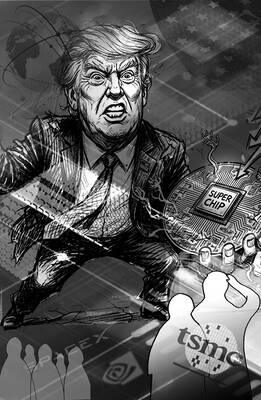
The White House’s decision to take a 9.9 percent stake in Intel Corp is looking like very shrewd business indeed. Since the government bought in at US$20.47 a share last August, the US chipmaker’s surging stock price has delivered the US a US$43 billion return. One of the reasons the investment has so far proved so sound is that the White House has made sure of it. According to The Wall Street Journal, Howard personally pushed deals on Intel’s behalf with some of the most lucrative clients imaginable. They include Nvidia Corp, the company at the heart of the AI
A single photograph can cut through a lot of noise, but it can also be used to misrepresent the truth. At the very least, it can concentrate the mind on something that requires further investigation. On Monday last week, Ma Ying-jeou Foundation CEO Tai Hsia-ling (戴遐齡) and former National Security Council secretary-general King Pu-tsung (金溥聰) held a news conference in which they showed a photograph of former foundation CEO Hsiao Hsu-tsen (蕭旭岑), now Chinese Nationalist Party (KMT) deputy chairman. In the image Hsiao is seated next to Xiamen Taiwan Businessmen Association chairman Han Ying-huan (韓螢煥). The two men were holding
I first met Professor Ray Jiing (井迎瑞) as a film and documentary student at Shih Hsin University’s (SHU) Department of Radio Television and Film in 1988. The following year, he went on to become the director of the Chinese Taipei Film Archive — forerunner of the Taiwan Film and Audiovisual Institute (TFAI). Over his eight-year tenure, Jiing rescued and restored over 200 classic Taiwanese films. In 1997, he established the Graduate Institute of Studies in Documentary and Film Archiving at Tainan National University of the Arts (TNNUA), and I joined the program in his third cohort of students. Beyond a
President William Lai Ching-te’s (賴清德) May 20 second-anniversary address was not just a routine policy review; it was damage control. US President Donald Trump’s remarks — that he did not want to see anyone move toward independence and that the delivery of a major Taiwan arms package could depend on the progress of US-China relations — unsettled Taiwan’s public and created an opening for opposition parties to question whether Taiwan was being treated as a bargaining chip in Washington’s dealings with Beijing. Lai’s speech was designed to close that opening. The address covered the expected ground: sovereignty, cross-strait relations, defense spending,


 RSS
RSS