


Extreme rainfall has become the new normal for countries across East Asia, which is why South Korea has, in the past few years, been rolling out “digital twin” technology to assist with its adaptation efforts.
The idea is to build a virtual model that can simulate flood paths and predict inundation areas in 3D space, allowing decisionmakers to see how flooding might unfold before it happens.
It represents a fundamental shift in disaster management thinking, from post-disaster response to pre-disaster forecasting, and from experience-based judgement to data-driven decisionmaking. As a nation prone to climate vulnerabilities, Taiwan has much to learn from this transition.
The core concept of the digital twin is to build a virtual replica of the environment and continuously update it with real-time sensor data to reflect dynamic real-world changes. In flood prevention, this means integrating large-scale spatial data such as river terrain, drainage systems, underground infrastructure, building distribution and soil permeability into a 3D model. Combined with radar rainfall data, water level sensors and weather forecasts, the system can simulate potential flood pathways and inundation depths hours before heavy rain arrives.
Taiwan is not without a foundation to build on. The National Science and Technology Center for Disaster Reduction has accumulated rich flood-risk map resources, while local governments have built water-level monitoring stations and early warning systems, with some working with research institutions to develop flood forecasting models.
However, those efforts continue to run up against the same bottlenecks: Data are scattered across agencies with inconsistent standards; simulation results are difficult to visualize in real time as decisionmaking tools; local disaster management staff lack sufficient training in digital tools; and cross-agency data integration has not been institutionalized.
The cost of this is clear. Whenever a typhoon passes, the most difficult decisions for local governments are rarely whether to evacuate, but when to evacuate, which areas to evacuate and how to allocate resources.
Under the current system, such judgements rely heavily on the experience and intuition of local leaders and disaster personnel, but lack systematic simulation support. The value of digital twin technology lies in transforming these judgements from matters of individual intuition into systematic processes that are repeatable, verifiable and can be rehearsed in advance.
Policy implementation requires several key prerequisites to be in place simultaneously.
First, a nationally unified spatial data governance framework for disaster prevention must be established. At present, geographic data maintained by the Ministry of the Interior, the Water Resources Agency, the Central Weather Administration and local governments vary in standards, update frequency and accessibility.
Without solving data interoperability, even the most advanced simulation platform would produce inaccurate results due to poor data quality. The government should designate a single authority to coordinate data standards and cross-agency integration.
Second, digital twin flood prevention technologies should be incorporated into statutory spatial planning tools. Their greatest value lies in simulating the consequences of potential development projects for flood risks. If environmental impact assessments for land development projects are required to include flood risk analysis based on digital twin simulations, it would pose a fundamental challenge to Taiwan’s tendency of reclaiming and developing low-lying areas. This would allow data — not development pressure — to guide decisionmaking.
Third, local government capacity in digital disaster prevention must be strengthened. In South Korea, investment in local disaster personnel training was carried out alongside platform development, which helped ensure that central tools could actually be used at the local level. In Taiwan, where local government personnel resources and budgets can differ greatly between regions, central technological investments might not actually translate into real disaster prevention capabilities without systemic capacity-building programs
South Korea has accelerated technological investment as a result of the disasters it has experienced. Taiwan’s geographic and climatic conditions are even more challenging, with typhoons, earthquakes, torrential rain and landslides often occurring in combination and requiring higher levels of system resilience.
The simulation capability of digital twins represents only one side of the coin; what makes it useful as a technology is the broader institutional architecture of data governance, regulatory frameworks and talent development. Before the next flood, Taiwan needs an integrated platform where all data can be integrated across the same virtual space.
Roger Chen is a legal specialist for a technology corporation.
Translated by Gilda Knox Streader
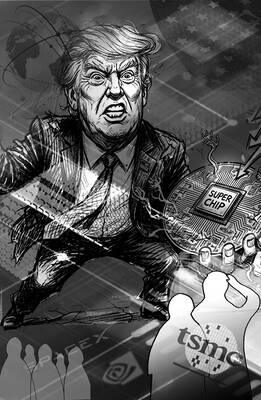
The White House’s decision to take a 9.9 percent stake in Intel Corp is looking like very shrewd business indeed. Since the government bought in at US$20.47 a share last August, the US chipmaker’s surging stock price has delivered the US a US$43 billion return. One of the reasons the investment has so far proved so sound is that the White House has made sure of it. According to The Wall Street Journal, Howard personally pushed deals on Intel’s behalf with some of the most lucrative clients imaginable. They include Nvidia Corp, the company at the heart of the AI
A single photograph can cut through a lot of noise, but it can also be used to misrepresent the truth. At the very least, it can concentrate the mind on something that requires further investigation. On Monday last week, Ma Ying-jeou Foundation CEO Tai Hsia-ling (戴遐齡) and former National Security Council secretary-general King Pu-tsung (金溥聰) held a news conference in which they showed a photograph of former foundation CEO Hsiao Hsu-tsen (蕭旭岑), now Chinese Nationalist Party (KMT) deputy chairman. In the image Hsiao is seated next to Xiamen Taiwan Businessmen Association chairman Han Ying-huan (韓螢煥). The two men were holding
I first met Professor Ray Jiing (井迎瑞) as a film and documentary student at Shih Hsin University’s (SHU) Department of Radio Television and Film in 1988. The following year, he went on to become the director of the Chinese Taipei Film Archive — forerunner of the Taiwan Film and Audiovisual Institute (TFAI). Over his eight-year tenure, Jiing rescued and restored over 200 classic Taiwanese films. In 1997, he established the Graduate Institute of Studies in Documentary and Film Archiving at Tainan National University of the Arts (TNNUA), and I joined the program in his third cohort of students. Beyond a
President William Lai Ching-te’s (賴清德) May 20 second-anniversary address was not just a routine policy review; it was damage control. US President Donald Trump’s remarks — that he did not want to see anyone move toward independence and that the delivery of a major Taiwan arms package could depend on the progress of US-China relations — unsettled Taiwan’s public and created an opening for opposition parties to question whether Taiwan was being treated as a bargaining chip in Washington’s dealings with Beijing. Lai’s speech was designed to close that opening. The address covered the expected ground: sovereignty, cross-strait relations, defense spending,


 RSS
RSS