


Speaking at the Shangri-La Dialogue security forum in Singapore on Saturday last week, a senior Royal Marines officer defended the UK’s transits through the Taiwan Strait.
The UK upholds the UN Convention on the Law of the Sea (UNCLOS) and believes there should be no “no-go” areas for navigation, including in strategic waterways such as the Taiwan Strait and the English Channel, said General Rob Magowan, commander of the UK’s Cyber and Specialist Operations Command.
“UNCLOS enables that free flow of trade and people to enable [the] global economy. There should be no no-go areas. The United Kingdom is not proposing that the North Sea or the English Channel or the Irish Sea are no-go areas. These are free and open seas for the global commons,” he said.
UNCLOS stipulates that a nation’s territorial waters extend 12 nautical miles (about 22km) from its shores. At just 33km wide at its narrowest point, the English Channel is not wholly international waters and includes overlapping British and French claims. However, the UK and France permit the passage of foreign vessels for international shipping.
Against that backdrop, Magowan said that transit through international straits such as the Taiwan Strait should not be obstructed by any state. Foreign naval vessels, while not representing trade themselves, make such transits as gestures of preserving freedom of navigation.
This position contrasts sharply with that of Chinese Communist Party (CCP) officials, who regularly object to foreign naval transits through the Taiwan Strait. CCP representatives, including former Chinese ambassador to the US Cui Tiankai (崔天凱), who also spoke at the forum, assert that the Taiwan Strait falls under Chinese jurisdiction.
Under UNCLOS — to which China is a signatory — that position is not consistent with international maritime law. Even if Beijing were assumed to have sovereignty over Taiwan and the Penghu archipelago, international waters would still exist across the Strait. At its narrowest point, there is about 140km between Penghu and mainland China; even accounting for territorial waters extending from both sides, a broad corridor of international waters remains.
In practice, Taiwan is not under Chinese sovereignty, making Beijing’s objections even less relevant, as many foreign transits are conducted in support of Taiwan’s de facto status and are unopposed by Taipei.
China’s rejection of key UNCLOS interpretations is reflected in its response to the July 12, 2016, ruling by an arbitral tribunal in The Hague, which rejected much of Beijing’s South China Sea claims. Within hours of the ruling, China declared it “null and void” and said it neither accepted nor recognized the decision in the case brought by the Philippines.
China continues to make expansive maritime sovereignty claims that critics say are inconsistent with UNCLOS, particularly in the South China Sea. Although former Chinese Ministry of Foreign Affairs spokesman Wang Wenbin (汪文斌) has said Beijing never claimed the entire South China Sea, China Coast Guard operations in the region suggest a broader assertion of control.
China has repeatedly harassed other claimants, including the Philippines, Vietnam, Malaysia and Indonesia, and has shadowed or challenged naval vessels from Australia, the US, Canada, the UK, Germany and other European countries transiting the area. Beijing has described such passages as provocations, underscoring its rejection of the principles underpinning UNCLOS, critics said.
This is why many countries — not just the UK — have become more vocal in asserting that most of the South China Sea and the Taiwan Strait are international waters, and that freedom of navigation through them must be maintained.
UN member states such as China and Russia remain signatories to international conventions while selectively interpreting or disregarding them. Meanwhile, Taiwan adheres to UNCLOS principles despite not being a UN member — a situation that undermines the consistency of the international order.
At its core, the dispute centers on China’s objections to foreign naval activity in waters it considers sensitive, even as it is accused of conducting its own incursions into neighboring states’ territory. These include the disputed Himalayan border with India, waters around the Diaoyutai Islands (釣魚台), Taiwan’s surrounding waters and airspace, and contested areas of the South China Sea.
China should be held to international norms, including UNCLOS obligations, regardless of its territorial claims over Taiwan or disputed maritime features. Recent disruptions to global shipping in the Strait of Hormuz highlight the risks posed by any obstruction of key maritime routes, underscoring the importance of maintaining open passage in the Taiwan Strait and South China Sea.
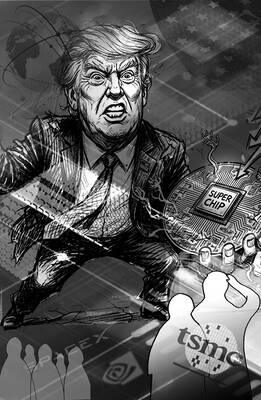
The White House’s decision to take a 9.9 percent stake in Intel Corp is looking like very shrewd business indeed. Since the government bought in at US$20.47 a share last August, the US chipmaker’s surging stock price has delivered the US a US$43 billion return. One of the reasons the investment has so far proved so sound is that the White House has made sure of it. According to The Wall Street Journal, Howard personally pushed deals on Intel’s behalf with some of the most lucrative clients imaginable. They include Nvidia Corp, the company at the heart of the AI
A single photograph can cut through a lot of noise, but it can also be used to misrepresent the truth. At the very least, it can concentrate the mind on something that requires further investigation. On Monday last week, Ma Ying-jeou Foundation CEO Tai Hsia-ling (戴遐齡) and former National Security Council secretary-general King Pu-tsung (金溥聰) held a news conference in which they showed a photograph of former foundation CEO Hsiao Hsu-tsen (蕭旭岑), now Chinese Nationalist Party (KMT) deputy chairman. In the image Hsiao is seated next to Xiamen Taiwan Businessmen Association chairman Han Ying-huan (韓螢煥). The two men were holding
I first met Professor Ray Jiing (井迎瑞) as a film and documentary student at Shih Hsin University’s (SHU) Department of Radio Television and Film in 1988. The following year, he went on to become the director of the Chinese Taipei Film Archive — forerunner of the Taiwan Film and Audiovisual Institute (TFAI). Over his eight-year tenure, Jiing rescued and restored over 200 classic Taiwanese films. In 1997, he established the Graduate Institute of Studies in Documentary and Film Archiving at Tainan National University of the Arts (TNNUA), and I joined the program in his third cohort of students. Beyond a
President William Lai Ching-te’s (賴清德) May 20 second-anniversary address was not just a routine policy review; it was damage control. US President Donald Trump’s remarks — that he did not want to see anyone move toward independence and that the delivery of a major Taiwan arms package could depend on the progress of US-China relations — unsettled Taiwan’s public and created an opening for opposition parties to question whether Taiwan was being treated as a bargaining chip in Washington’s dealings with Beijing. Lai’s speech was designed to close that opening. The address covered the expected ground: sovereignty, cross-strait relations, defense spending,


 RSS
RSS