


When the UK’s most charismatic postwar leader protests that British Prime Minister Keir Starmer’s failures are not due to “personality” or “a failure to communicate,” we should only half-believe him.
Former British prime minister Tony Blair insists that changing the ruling party’s leader is “irrelevant if it does not start a policy debate.” In a self-fulfilling prophecy, it already has — although the main effect has been to make rivals for the Labour crown, including Starmer, vie to define themselves against Blair. Manchester Mayor Andy Burnham suggested that the architect of three election victories is merely a titan whose time has gone.
Knowing that his near 6,000-word essay last week on the government’s predicament would spark a reaction, Blair insists that his analysis is all about the need to reframe “policies” and a “vision,” rather than a critique of Starmer as an ineffectual leader.
Much of Blair’s thinking is sound. He is more alert to the limits of the state than his party is today and more attuned to sweeping technological changes, saying in a subsequent newspaper column that artificial-intelligence developments “blow his mind.”
However, on the idea that you can change politics, divorced from personality, he is mistaken. You do not have to subscribe in full to the Victorian idea that history is driven by the impact of great men and women on events (rather than the other way round), but Blair underplays how important strong will and persuasive powers are to a successful prime minister. One like him, in fact.
Starmer failed to have “a worked-out, coherent plan for the country,” Blair said, and that much is true — the prime minister arrived in No. 10 without a substantial agenda. However, character traits determine whether leaders take chances to forge a path, not lack of commitment to the right think-tank solutions.
Two years of international crisis since Starmer took office have provided opportunities his government did not take or even seem to consider to be worth acting on. It is unfair to complain that he is not Blair at the height of his powers. Starmer never claimed to be visionary. What worries colleagues and reasonable critics alike is his marked inability to seize the moment.
In short order, Germany’s unwieldy coalition government has set up a 500 billion euro (US$582.3 billion) fund for military spending and security infrastructure. Berlin has seen the scale of the Russian threat, and the US’ wavering commitment to countering that, and done something decisive about it.
Compare that with a prime minister who parades his credentials as a supporter of Ukraine, but has failed to rally voters and his lawmakers for a period of intensifying hybrid war. It has already taken a year to bang together the heads of his chancellor of the exchequer and defense secretary just to put another £18 billion behind the UK’s armed forces and publish an overdue defense investment plan. Starmer has spoken of the US’ war of choice in the Persian Gulf, too, as a “line in the sand” and is calling for greater national self-reliance, but what he actually wants to do about this is magisterially unclear.
I believe Blair, who told voters that “I feel the hand of my history on my shoulders” when helping bring peace to Northern Ireland, would not have stood for such nonsense on the greatest matters. By the time the Good Friday Agreement was in play, Blair had mastered every detail, wooing every player at home and abroad to secure a deal. Later, he applied a similar degree of commitment to the second Iraq war. On that, his judgement was flawed, overcome by a desire to saddle up alongside the US.
However, these two examples — one success, one failure — remind us that a leader’s sheer force of personality and eloquence can move mountains. Blair won his British House of Commons vote on Iraq in 2003 with a hefty majority. A diffident Starmer, by contrast, failed to win over his lawmakers for key welfare reform last year — measures most outside the party’s hard left know are essential — because he could not craft a narrative to explain why they should follow him.
Like it or not, a leader’s personality and determination make a difference. Former British prime minister Margaret Thatcher had a similar ability to drive her party where she wanted, and yes, it does often end in securing the wrong goal and a rueful departure from office. However, at least she and Blair had a decade of boom before the bust.
Starmer too often wills the ends, but not the means, mistaking activity for achievement. In the Gulf crisis, this has been the British government’s default setting. It leaves gaps where plans are needed.
In illuminating commentary on the fallout from the closure of the Strait of Hormuz oil and gas route, Nick Butler, a former BP Plc executive close to Labour governments, said that the crisis would be devastating for economies such as the UK even if a truce between US President Donald Trump and Iran holds. Consumers are set to suffer from an inflationary spiral and rising food prices. The long tail of damage to the UK would be drastic. The British government has responded with gimmicks, offering free bus travel for children in August. Is that really their best shot?
British MP Wes Streeting, aiming for the pragmatists’ vote in the Labour leadership race, seems to have got the point. In a weekend interview, he said that by failing to reopen oil and gas fields in the North Sea, Starmer’s government is sacrificing tax receipts at a time of stressed public finances during an energy crisis.
“There’s sometimes a danger of Britain wanting to lead the world. We cut off our own nose to spite our face without contributing to the greater whole,” he said.
Given Britain’s fiscal straits, the rest of this year would be a stern test for any prime minister, but the short takeaway from a loquacious former Labour leader’s essay on his party’s inadequacies is that it is folly to waste a serious crisis. Instead of providing the “coherent plan” Blair demands, the contenders for No. 10 are refighting ancient party battles about “neoliberalism.” However, the lesson of what might be the short Starmer era is that it is not only the plan that needs to stick: It is the sheer bloody-minded force of will needed to drive it through — or to pivot when facts change dramatically.
It is fashionable to complain that Britain today is ungovernable. Blair, warts and all, reminds us of the flaw in that analysis. To govern effectively needs leadership. When that is missing, things fall apart. First, you need the person; the politics follows.
Martin Ivens is the editor of the Times Literary Supplement. Previously, he was editor and chief political commentator of the Sunday Times. This column reflects the personal views of the author and does not necessarily reflect the opinion of the editorial board or Bloomberg LP and its owners.
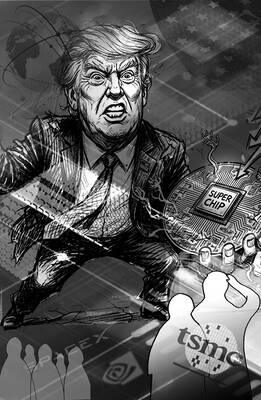
The White House’s decision to take a 9.9 percent stake in Intel Corp is looking like very shrewd business indeed. Since the government bought in at US$20.47 a share last August, the US chipmaker’s surging stock price has delivered the US a US$43 billion return. One of the reasons the investment has so far proved so sound is that the White House has made sure of it. According to The Wall Street Journal, Howard personally pushed deals on Intel’s behalf with some of the most lucrative clients imaginable. They include Nvidia Corp, the company at the heart of the AI
The Ministry of the Interior, working with the navy and coast guard, is organizing Taiwan’s first joint exercise simulating escort tankers carrying liquefied natural gas (LNG) and oil through a Chinese blockade. The drills simulate fuel transport along three maritime corridors leading toward Japan, the Philippines and the US. Deputy Minister of the Interior Sawyer Mars (馬士元) said that a blockade of the Taiwan Strait would amount to “almost a 100 percent blockade of the regional energy supply.” Minister of National Defense Wellington Koo said planning to counter a blockade is standard practice in Taipei. While the exercise is limited in
A single photograph can cut through a lot of noise, but it can also be used to misrepresent the truth. At the very least, it can concentrate the mind on something that requires further investigation. On Monday last week, Ma Ying-jeou Foundation CEO Tai Hsia-ling (戴遐齡) and former National Security Council secretary-general King Pu-tsung (金溥聰) held a news conference in which they showed a photograph of former foundation CEO Hsiao Hsu-tsen (蕭旭岑), now Chinese Nationalist Party (KMT) deputy chairman. In the image Hsiao is seated next to Xiamen Taiwan Businessmen Association chairman Han Ying-huan (韓螢煥). The two men were holding
I first met Professor Ray Jiing (井迎瑞) as a film and documentary student at Shih Hsin University’s (SHU) Department of Radio Television and Film in 1988. The following year, he went on to become the director of the Chinese Taipei Film Archive — forerunner of the Taiwan Film and Audiovisual Institute (TFAI). Over his eight-year tenure, Jiing rescued and restored over 200 classic Taiwanese films. In 1997, he established the Graduate Institute of Studies in Documentary and Film Archiving at Tainan National University of the Arts (TNNUA), and I joined the program in his third cohort of students. Beyond a


 RSS
RSS