


The frequency of crashes caused by people driving under the influence of drugs has not only seriously threatened the lives and safety of the drivers themselves, but exposed other road users to danger.
Taiwan often faced evidentiary challenges in cases of drug-impaired driving, allowing many offenders to escape severe punishment. To implement a “zero tolerance” policy for drug-impaired driving, amendments to Article 185-3 of the Criminal Code took effect on March 13. However, they seem to have failed to curb drug driving.
The Criminal Code classifies drug-impaired driving as an abstract endangerment offense, or an offense based on the presumption of danger. Under Article 185-3, Paragraph 1, Subparagraph 3, a driver poses an abstract danger if “drugs, narcotics or other similar substances, or their metabolites [are] present in [the driver’s] urine or blood specified by the Executive Yuan at concentrations equal to or exceeding the limits,” constituting unsafe driving.
The approach is similar to the blood alcohol concentration threshold. Once a driver exceeds the threshold — namely, the testing standards for commonly abused drugs and their metabolites announced by the Executive Yuan — their behavior constitutes an abstract danger, leading to criminal prosecution.
Article 185-3, Paragraph 1, Subparagraph 4 of the Criminal Code stipulates that “there are circumstances other than those stipulated in the preceding subparagraph which might prove that the person has consumed drugs, narcotics or other similar substances which prevent the person from driving safely.”
That provision is the basis for the determination of a concrete endangerment offense. The phrase “prevent the person from driving safely” refers to a situation in which a danger to traffic safety has already emerged.
As for determining whether there are other circumstances proving the person has consumed an illegal substance, courts and law enforcement authorities might rely on evidence that demonstrates a danger to safe driving, such as abnormal driving behavior, failure of field sobriety or coordination tests, or other signs and symptoms observed at the scene.
If the detected drug concentration does not meet the statutory threshold and police bodycam footage shows that the driver responded appropriately, walked steadily and exhibited no signs of incapacity or the inability to drive safely, the courts are likely to acquit the defendant of the drug-impaired driving charge, given the absence of evidence of any concrete danger.
However, even if a court finds the defendant not guilty of drug-impaired driving, the defendant’s use of illegal substances, regardless of the level of concentration, still constitutes a breach of the Narcotics Hazard Prevention Act (毒品危害防制條例), and they would remain subject to observation, rehabilitation or other penalties under that statute.
Drug driving and drunk driving are legally regarded as posing a high risk to public safety, and a zero tolerance policy should be adopted. The penalties for both offenses are completely aligned under the Criminal Code. A key issue is that, where an offense under any subparagraph of Article 185-3 results in death, the penalty is only imprisonment of “not less than three years but less than 10 years,” with repeat offenders subject to a maximum of life in prison. Where it results in serious injury, the penalty is only imprisonment for “not less than one year, but less than seven years,” with repeat offenders subject to imprisonment for three to 10 years. Those penalties seem too lenient.
The law should be amended to increase the severity of the punishments to deter offenses.
Chuang Yu-Sen is legal counsel for the Taiwan Energy Service Association.
Translated by Kyra Gustavsen
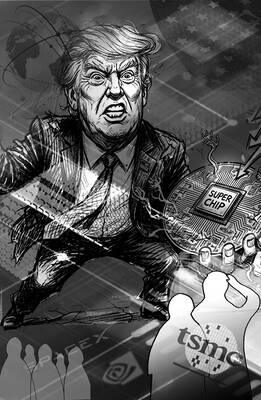
The White House’s decision to take a 9.9 percent stake in Intel Corp is looking like very shrewd business indeed. Since the government bought in at US$20.47 a share last August, the US chipmaker’s surging stock price has delivered the US a US$43 billion return. One of the reasons the investment has so far proved so sound is that the White House has made sure of it. According to The Wall Street Journal, Howard personally pushed deals on Intel’s behalf with some of the most lucrative clients imaginable. They include Nvidia Corp, the company at the heart of the AI
The Ministry of the Interior, working with the navy and coast guard, is organizing Taiwan’s first joint exercise simulating escort tankers carrying liquefied natural gas (LNG) and oil through a Chinese blockade. The drills simulate fuel transport along three maritime corridors leading toward Japan, the Philippines and the US. Deputy Minister of the Interior Sawyer Mars (馬士元) said that a blockade of the Taiwan Strait would amount to “almost a 100 percent blockade of the regional energy supply.” Minister of National Defense Wellington Koo said planning to counter a blockade is standard practice in Taipei. While the exercise is limited in
A single photograph can cut through a lot of noise, but it can also be used to misrepresent the truth. At the very least, it can concentrate the mind on something that requires further investigation. On Monday last week, Ma Ying-jeou Foundation CEO Tai Hsia-ling (戴遐齡) and former National Security Council secretary-general King Pu-tsung (金溥聰) held a news conference in which they showed a photograph of former foundation CEO Hsiao Hsu-tsen (蕭旭岑), now Chinese Nationalist Party (KMT) deputy chairman. In the image Hsiao is seated next to Xiamen Taiwan Businessmen Association chairman Han Ying-huan (韓螢煥). The two men were holding
I first met Professor Ray Jiing (井迎瑞) as a film and documentary student at Shih Hsin University’s (SHU) Department of Radio Television and Film in 1988. The following year, he went on to become the director of the Chinese Taipei Film Archive — forerunner of the Taiwan Film and Audiovisual Institute (TFAI). Over his eight-year tenure, Jiing rescued and restored over 200 classic Taiwanese films. In 1997, he established the Graduate Institute of Studies in Documentary and Film Archiving at Tainan National University of the Arts (TNNUA), and I joined the program in his third cohort of students. Beyond a


 RSS
RSS