


Taiwan’s high-tech industry is undergoing a major shift. Local companies are becoming deeply integrated with global artificial intelligence (AI) supply chains through engagement with customers and operational restructuring, while technology shifts to agentic AI from generative models.
That increases Taiwan’s role in the AI evolution and has a spillover effect across the entire electronics supply chain.
The close and strategic partnerships involving Taiwanese suppliers was made clear in remarks by Nvidia Corp chief executive officer Jensen Huang (黃仁勳).
“Taiwan is much more than a semiconductor hub — it is the epicenter of a highly complex [AI] supply chain that ultimately builds the world’s technology,” Huang told reporters on Thursday while dining in Taipei with more than 30 CEOs of local suppliers. “It starts with wafers, of course, which are used to build chips; then packaging, which connects the systems; interconnects; copper; silicon photonics; and the entire supply chain required for power delivery, cooling systems and power generation.”
That is why Nvidia is substantially increasing its spending in Taiwan to US$100 billion or US$150 billion a year, from US$10 billion or US$15 billion the company spent five years ago, he said on Tuesday last week.
Nvidia’s local ecosystem has expanded to about 150 companies this year since the company spoke about moving toward agentic AI at Computex Taipei last year, when 122 local companies were part of Nvidia’s supply chain.
Taiwan Semiconductor Manufacturing Co (TSMC), the world’s biggest supplier of AI accelerators, as well as key component suppliers to Nvidia — from chip designer MediaTek Inc, power unit supplier Delta Electronics Inc, Unimicron Technology Corp, a supplier of printed circuit boards and IC substrates, and heat dissipation specialist Asia Vital Components Co — are being affected by the AI capital expenditure cycle, research firm Semivision said.
MediaTek is a good example. Taiwan Stock Exchange data showed that the company’s shares have surged to NT$4,410 as of Friday last week from NT$1,470 at the beginning of the year amid a bright outlook for its new customized chip business. MediaTek is collaborating with Nvidia to produce Microsoft Windows-based notebook computers that are aimed at meeting agentic AI demand among average consumers using edge devices.
Santa Clara, California-based Advanced Micro Devices Inc (AMD) also aims to build its own AI chip packaging ecosystem to ensure stable capacity supply. AMD on May 22 said it would invest US$10 billion in the Taiwanese microchip ecosystem over the next three years to enhance packaging capacity availability after rapidly growing AI infrastructure demand led to supply constraints of TSMC’s chip-on-wafer-on-substrate (CoWoS) packaging technology.
AMD’s advanced packaging ecosystem partners include ASE Technology Holding Co and its subsidiary Siliconware Precision Industries Co, as well as Powertech Technology Inc.
The revaluation of stock prices of firms in the AI supply chain indicates that Taiwanese electronics companies are moving toward a better profit model and breaking away from the traditional business of providing contract manufacturing services with slim margins. The electronics industry’s transformation is fueling Taiwan’s GDP growth to the highest it has been in 16 years, according to a forecast released on Thursday last week by the Directorate-General of Budget, Accounting and Statistics. Taiwan’s economy is expected to expand 9.64 percent this year, the government agency said.
However, Wistron Corp chairman Simon Lin (林憲銘) said that it is a “painful” transformation, given the increase in complexity of making a server compared with making a standard PC. Servers are more likely to be semi-customized products, while technology migration has accelerated, Lin said.
The development of AI technology accelerates technology cadence, meaning that each year there is a new generation of server models and chips, he said, from the three-year generation cycle that had been the standard. Companies have to be prepared for a complete transformation of operating models, or they will not catch the opportunities in AI, he said.
TSMC cochief operating officer Y.J. Mii (米玉傑) said the company began investing in CoWoS technology 15 to 17 years ago, before the packaging technology gained the massive traction it has recently, to the point of being a pillar of the AI industry. Mii attributed the success to the chipmaker’s longstanding and close partnerships with customers, allowing TSMC to deploy new technologies earlier than others.
After more than three decades of being primarily hardware assemblers, Taiwan’s electronics companies have become the backbone of global technology development, as no other country has such a comprehensive AI supply chain.
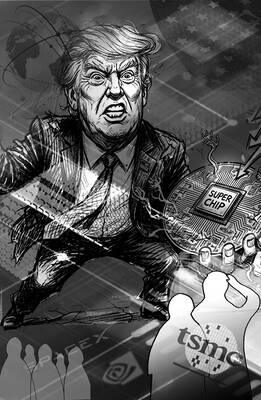
The White House’s decision to take a 9.9 percent stake in Intel Corp is looking like very shrewd business indeed. Since the government bought in at US$20.47 a share last August, the US chipmaker’s surging stock price has delivered the US a US$43 billion return. One of the reasons the investment has so far proved so sound is that the White House has made sure of it. According to The Wall Street Journal, Howard personally pushed deals on Intel’s behalf with some of the most lucrative clients imaginable. They include Nvidia Corp, the company at the heart of the AI
The Ministry of the Interior, working with the navy and coast guard, is organizing Taiwan’s first joint exercise simulating escort tankers carrying liquefied natural gas (LNG) and oil through a Chinese blockade. The drills simulate fuel transport along three maritime corridors leading toward Japan, the Philippines and the US. Deputy Minister of the Interior Sawyer Mars (馬士元) said that a blockade of the Taiwan Strait would amount to “almost a 100 percent blockade of the regional energy supply.” Minister of National Defense Wellington Koo said planning to counter a blockade is standard practice in Taipei. While the exercise is limited in
A single photograph can cut through a lot of noise, but it can also be used to misrepresent the truth. At the very least, it can concentrate the mind on something that requires further investigation. On Monday last week, Ma Ying-jeou Foundation CEO Tai Hsia-ling (戴遐齡) and former National Security Council secretary-general King Pu-tsung (金溥聰) held a news conference in which they showed a photograph of former foundation CEO Hsiao Hsu-tsen (蕭旭岑), now Chinese Nationalist Party (KMT) deputy chairman. In the image Hsiao is seated next to Xiamen Taiwan Businessmen Association chairman Han Ying-huan (韓螢煥). The two men were holding
I first met Professor Ray Jiing (井迎瑞) as a film and documentary student at Shih Hsin University’s (SHU) Department of Radio Television and Film in 1988. The following year, he went on to become the director of the Chinese Taipei Film Archive — forerunner of the Taiwan Film and Audiovisual Institute (TFAI). Over his eight-year tenure, Jiing rescued and restored over 200 classic Taiwanese films. In 1997, he established the Graduate Institute of Studies in Documentary and Film Archiving at Tainan National University of the Arts (TNNUA), and I joined the program in his third cohort of students. Beyond a


 RSS
RSS