


The escalating controversy surrounding the Ma Ying-jeou Foundation is all too easily viewed through the lens of a family drama, with former aides and political associates pointing the finger at one another.
The issues, tied up with family matters, an aging former president and long-held grievances, are attention-grabbing, but they cannot overshadow the central question: Did the cash allegedly donated by Xiamen Taiwan Businessmen Association chairman Han Ying-huan (韓螢煥) enter the foundation’s accounts, and if not, why not?
On Monday last week, Ma Ying-jeou Foundation CEO Tai Hsia-ling (戴遐齡) and former National Security Council secretary-general King Pu-tsung (金溥聰) held a news conference in which they showed a photograph of Han and former foundation CEO Hsiao Hsu-tsen (蕭旭岑) exchanging what appeared to be a large wad of cash. They questioned why the alleged donation of NT$1 million (US$31,868) never appeared in the foundation’s records.
Hsiao, who has been Chinese Nationalist Party (KMT) deputy chairman since November last year, said that the money was a personal donation from Han, which he received on Ma’s behalf.
The New Taipei City Department of Cultural Affairs said that it was investigating the matter and requested that the foundation clarify the nature of the donation. The department seeks to understand the flow of funds, their purpose and whether they were formally registered in accounts.
As a nonprofit established for the public benefit, the foundation’s donations and activities require more than verbal explanations.
The foundation has long organized cross-strait exchange activities, and issues concerning donors, payment methods, the donations’ intended use and accounting practices have raised broader questions about how foundations established or led by political figures are managing cross-strait financial transactions.
The authorities should not simply wait for the foundation’s own explanation; they should require its board of directors to provide documentation concerning the accounting records, use of funds and board resolutions.
Likewise, the foundation’s board should not treat the investigation as an internal matter, but should show the public how each sum of money was handled.
If the money was truly a personal gift, the foundation should explain how it was separated from the nonprofit’s affairs. If they were used for foundation-related expenditures, then the matter should be subject to the accounting requirements set out in the Foundations Act (財團法人法).
Reducing the controversy to a family drama or simple political infighting overshadows the financial records at the center of the matter. What the Ma Ying-jeou Foundation must answer is why an alleged cash donation arising under the banner of public service cannot be found in its accounting records.
Calls for an audit are simply demands that the foundation be subject to the oversight procedures expected of any nonprofit. If the sum can be explained, then let the books speak for themselves. If it cannot, then it must be made clear that no narrative of family drama narrative can excuse a foundation from its legal and ethical obligations of transparent accounting.
Steve Ho is a retired engineer.
Translated by Gilda Knox Streader
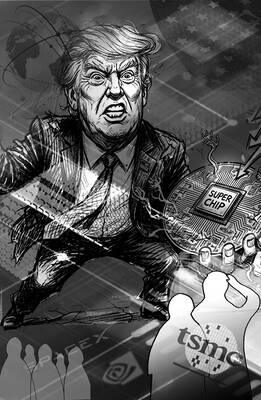
The White House’s decision to take a 9.9 percent stake in Intel Corp is looking like very shrewd business indeed. Since the government bought in at US$20.47 a share last August, the US chipmaker’s surging stock price has delivered the US a US$43 billion return. One of the reasons the investment has so far proved so sound is that the White House has made sure of it. According to The Wall Street Journal, Howard personally pushed deals on Intel’s behalf with some of the most lucrative clients imaginable. They include Nvidia Corp, the company at the heart of the AI
In a Taiwanese university classroom, a lecturer asks in English: “Can anyone give me an example from Taiwan?” Students look down. No one answers. After class, one student writes on the course platform in Mandarin: “I understood the concept, but I didn’t know how to answer in English.” That moment highlights a key issue in Taiwan’s English-medium instruction (EMI) reform: It is not just about more English-taught courses, but whether students can learn, participate and belong. EMI expansion is part of the Bilingual 2030 policy and the Ministry of Education’s BEST Program, aiming to improve English ability, support EMI teaching
A single photograph can cut through a lot of noise, but it can also be used to misrepresent the truth. At the very least, it can concentrate the mind on something that requires further investigation. On Monday last week, Ma Ying-jeou Foundation CEO Tai Hsia-ling (戴遐齡) and former National Security Council secretary-general King Pu-tsung (金溥聰) held a news conference in which they showed a photograph of former foundation CEO Hsiao Hsu-tsen (蕭旭岑), now Chinese Nationalist Party (KMT) deputy chairman. In the image Hsiao is seated next to Xiamen Taiwan Businessmen Association chairman Han Ying-huan (韓螢煥). The two men were holding
The Ministry of the Interior, working with the navy and coast guard, is organizing Taiwan’s first joint exercise simulating escort tankers carrying liquefied natural gas (LNG) and oil through a Chinese blockade. The drills simulate fuel transport along three maritime corridors leading toward Japan, the Philippines and the US. Deputy Minister of the Interior Sawyer Mars (馬士元) said that a blockade of the Taiwan Strait would amount to “almost a 100 percent blockade of the regional energy supply.” Minister of National Defense Wellington Koo said planning to counter a blockade is standard practice in Taipei. While the exercise is limited in


 RSS
RSS